
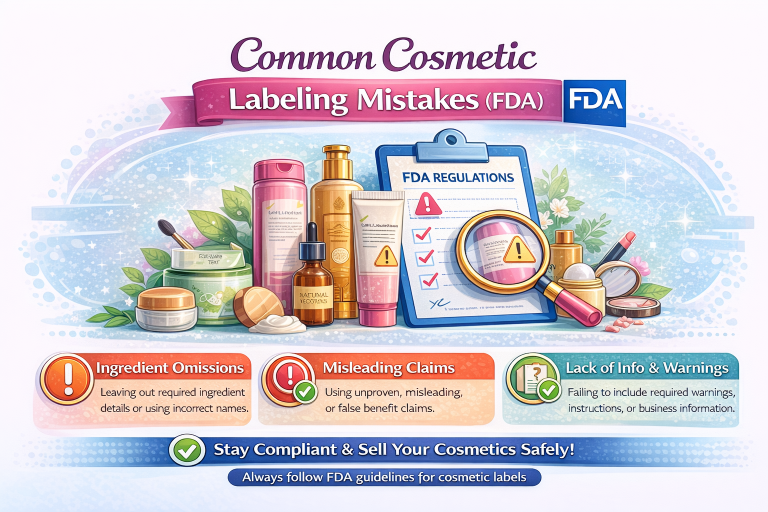
Common Cosmetic Labeling Mistakes (FDA Guide)
The two required label panels, the INCI ingredient rules, the claim traps, and the mistakes that get cosmetics detained — with how to fix each.
Key Takeaways
- Two required areas — the PDP (identity + net quantity) and the information panel.
- INCI, in order — ingredients by INCI name, descending by weight to 1%.
- Drug claims reclassify — "treats/cures/repairs" makes a cosmetic a drug.
- "FDA Approved" is prohibited — FDA doesn't approve cosmetics.
- MoCRA adds a contact — a domestic contact for adverse-event reports.
- Non-compliant = misbranded — detention, warning letters, refusal.
Cosmetic Label Anatomy — Two Panels
| Panel | Must carry |
|---|---|
| Principal Display Panel (PDP) the part shown at retail — usually the front (21 CFR 701.10) | Statement of identity (what the product is, e.g., "moisturizing lotion") · Net quantity of contents — bottom 30% of the panel, in both U.S. customary and metric units, type sized to the panel |
| Information Panel usually to the right of, or behind, the PDP | Ingredient declaration (INCI names, descending order) · Name & place of business of the manufacturer/packer/distributor · Required warnings (21 CFR 740) · MoCRA: responsible person & adverse-event contact |
The Ingredient Declaration (INCI)
- Use INCI names — the standardized International Nomenclature of Cosmetic Ingredients names (21 CFR 701.3); a non-INCI or wrong name is misbranding
- Descending order by weight — down to 1% — ingredients above 1% listed most-to-least
- Below 1% & color additives — may be listed in any order after the above-1% group
- Fragrance/flavor — may be listed with the umbrella terms "fragrance" or "flavor" (a fragrance-allergen disclosure rule is coming but isn't final)
- Match the listing — the on-pack INCI list must align with your product listing
Common Mistakes & How to Fix Them
| Mistake | Why it's a problem | Fix |
|---|---|---|
| Wrong / incomplete INCI list | Misbranding; #1 failure | Correct INCI names, descending order; match the listing |
| Net quantity errors | Missing units/placement/type size | Both U.S. & metric, bottom 30% of PDP, sized to panel |
| No responsible-party name/address | Misbranding; common for imports | Add manufacturer/packer/distributor + "Distributed by …" |
| Drug claims | Reclassifies as a drug | Keep to appearance/cleansing; remove treat/cure/repair |
| "FDA Approved" statement | Prohibited — false/misleading | Remove it; FDA doesn't approve cosmetics |
| Missing MoCRA adverse-event contact | Non-compliant under MoCRA | Add a domestic address/phone/electronic contact |
| Missing required warning | Misbranding (e.g., aerosols) | Add the applicable 21 CFR 740 warning |
| Illegible / non-conspicuous text | Fails prominence rules | Correct type size and placement |
Drug Claims & "FDA Approved"
Drug claims. Words like treat, cure, prevent, heal, or claims that affect the body's structure or function, turn a cosmetic into a drug. "Moisturizes" is cosmetic; "treats eczema," "clears acne," or "stimulates collagen" is a drug claim — and FDA reads the whole presentation (label, website, ads), so a drug claim anywhere can create the problem. See cosmetic vs OTC drug.
Required Warnings & the MoCRA Contact
- Aerosol / self-pressurized products — flammability and use warnings (21 CFR 740)
- Bubble bath products — a specific caution
- Feminine deodorant sprays — a specific warning
- Tanning products without sunscreen — a required warning
- MoCRA adverse-event contact — a domestic address, phone, or electronic contact for the responsible person to receive adverse-event reports
Get Your Cosmetic Label Reviewed
FDA Registration Assistance reviews your label against 21 CFR Parts 701 and 740 and MoCRA: the PDP (statement of identity, net quantity, units, placement, type size), the information panel (INCI declaration and order, name/place of business, required warnings, adverse-event contact), and the claims across the package and online for drug-classification and "FDA approved" problems — and we confirm the label matches your product listing.
Contact us at info@fdaregistrationassistance.com or call +1 (928) 275-8333 for a quote. An independent compliance firm serving 1,000+ companies across 135+ countries, with 15+ years of experience.
Frequently Asked Questions — Cosmetic Labeling
1. What are the required parts of a cosmetic label?
Two areas. The Principal Display Panel (PDP) — the part shown at retail, usually the front — must carry the statement of identity (what the product is) and the net quantity of contents. The information panel (usually to the right or the back) must carry the ingredient declaration in INCI names, the name and place of business of the manufacturer/packer/distributor, any required warnings, and — under MoCRA — the responsible person and a contact for adverse-event reports. The governing rules are 21 CFR Parts 701 and 740, plus the FD&C and Fair Packaging & Labeling Acts.
2. What is the most common cosmetic labeling mistake?
An incorrect or incomplete ingredient declaration. Ingredients must be listed by their INCI names in descending order of predominance by weight (down to 1%), and using the wrong names, wrong order, or omitting ingredients is the single most frequent failure. It's closely followed by drug claims that turn a cosmetic into a drug, and by net-quantity and responsible-party errors. Most are caught by a pre-print label review.
3. How must ingredients be listed?
By INCI (International Nomenclature of Cosmetic Ingredients) names, in descending order of predominance by weight down to 1%. Ingredients present at 1% or less, and color additives, may be listed in any order after the above-1% group. Fragrance and flavor may be listed with the umbrella terms "fragrance" or "flavor" (though a fragrance-allergen disclosure rule is coming). Using a non-INCI or incorrect name can make the product misbranded.
4. Where does the net quantity go, and in what units?
The net quantity of contents goes on the PDP, in the bottom 30% of the panel, in a line generally parallel to the base of the container. It must be in both U.S. customary and metric units — weight for solids/semisolids (avoirdupois pound and ounce), fluid measure for liquids — and the type size scales with the size of the PDP. Missing units, wrong placement, or too-small type are common, avoidable errors.
5. Can I label my cosmetic "FDA Approved"?
No. FDA does not approve cosmetics, and it's prohibited to label or advertise a cosmetic with any statement suggesting FDA approval — it's treated as false or misleading. This includes "FDA Approved," and "FDA Registered" framed to imply approval. Even after MoCRA registration and listing, the accurate statement is that your facility is registered and products are listed, not that the product is FDA-approved.
6. Which claims turn my cosmetic into a drug?
Claims to treat, cure, prevent, or heal, or to affect the body's structure or function. "Moisturizes" is cosmetic; "treats eczema," "clears acne," "stimulates collagen," or "repairs the skin barrier" are drug claims that reclassify the product as a drug, subject to a completely different (and heavier) set of FDA requirements. Because FDA reads the whole presentation — label, website, ads — a drug claim anywhere can create the problem, even if the panel is otherwise perfect.
7. What does MoCRA add to cosmetic labeling?
MoCRA didn't rewrite the Part 701 ingredient-declaration rules, but it added two things to the label picture: the responsible person must be identified, and the label must include a domestic contact (address, phone, or electronic) through which the responsible person can receive adverse-event reports. A fragrance-allergen disclosure requirement is also coming through FDA rulemaking, though it isn't final yet. Your on-pack label also has to stay consistent with your product listing and safety records.
8. Do I have to include a business name and address?
Yes. The label must state the name and place of business of the manufacturer, packer, or distributor. If the firm named isn't the manufacturer, the name must be qualified — for example, "Manufactured for …" or "Distributed by …". Omitting this, or a missing/invalid U.S. address where required, is a common misbranding trigger, especially for imported products.
9. What warning statements do cosmetics need?
It depends on the product. Under 21 CFR Part 740, certain cosmetics require specific cautions — for example, aerosol/self-pressurized products need flammability and use warnings, bubble bath products carry a caution, and there are warnings for feminine deodorant sprays and for products whose safety hasn't been substantiated. Tanning products without sunscreen require a specific warning. Missing a required warning makes the product misbranded.
10. Does the label have to be in English?
Yes — required label information must be in English (products distributed solely in Puerto Rico or a territory where a different language predominates are an exception, and if the label has any foreign-language representations, all required statements must appear in that language too). Foreign labels that aren't adapted to U.S. English requirements are a frequent import problem.
11. Do my online listings need to match my label?
Yes. Website and marketplace copy, images, and ads are part of how FDA views the product, so a claim online that isn't on the label can still create a compliance problem — and inconsistent claims between the label, the listing, and the marketing draw scrutiny. Review the physical label and the online presentation together, and keep the label consistent with your product listing and safety documentation.
12. What happens if my cosmetic label is non-compliant?
The product is misbranded, which can lead to import detention or refusal, marketplace/retailer removal, warning letters, recalls, and reputational damage. Labeling is one of the most common reasons cosmetic shipments are held at U.S. ports. Because the fix after production means reprints or relabeling (or re-export), catching label issues before printing is far cheaper.
13. Does FDA approve or check my label before I sell?
No. FDA does not pre-approve cosmetic labels or formulations. The company is responsible for ensuring the label complies before marketing — and FDA can review it later at import, on complaint, or during enforcement. "FDA doesn't check it first" is not "it's fine"; a non-compliant label is misbranded whether or not FDA has looked at it.
14. Can I fix a labeling mistake after import?
Sometimes — relabeling under certain conditions is possible — but it's slow and costly, and a detained shipment or a warning letter is a far worse outcome than a pre-print correction. Pre-printed label inventory using an outdated ingredient list or claim also becomes non-compliant when a formula or rule changes, so labels need to be managed as formulas and regulations move.
15. What are the biggest labeling mistakes to check first?
In order: drug claims that reclassify the product; incorrect/incomplete INCI ingredient declaration; net-quantity errors (missing metric or U.S. units, wrong placement, small type); missing responsible-party name/address; missing MoCRA adverse-event contact; "FDA approved" statements; missing required warnings; and illegible or non-conspicuous required text. A structured label review works through all of these before the label is printed.
16. How does FDA Registration Assistance review cosmetic labels?
We review the label against 21 CFR Parts 701 and 740 and MoCRA: the PDP (statement of identity, net quantity, units, placement, type size), the information panel (INCI ingredient declaration and order, name/place of business, required warnings, and the adverse-event contact), and the claims across the package and online for drug-classification and "FDA approved" problems — and we confirm the label matches your product listing. We flag issues before you print or import. We're an independent compliance firm serving 1,000+ companies across 135+ countries with 15+ years of experience. Contact info@fdaregistrationassistance.com or +1 (928) 275-8333.
