OTC Drug Label Review Before You Sell in the U.S.
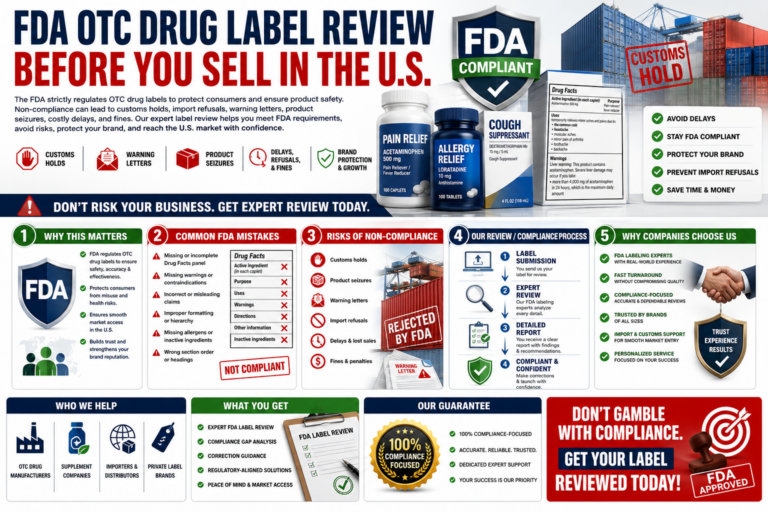
The Drug Facts panel anatomy, the format rules, the active-specific warnings, and when to review — so the label is right before it's expensive to change.
Key Takeaways
- Drug Facts is a fixed format — 21 CFR 201.66, required sections in a set order.
- Warnings are active-specific — you can't copy them from another product.
- The label must match your SPL listing — mismatches cause rejections.
- Claims count too — package + website + Amazon are one compliance picture.
- Foreign labels rarely comply — plan on a U.S. redesign, not a translation.
- Review before you print — the cheapest point to fix everything.
Drug Facts Panel Anatomy — In Order
Under 21 CFR 201.66, these sections must appear in this sequence, each separated by a barline. Rearranging or omitting them makes the label non-compliant:
- "Drug Facts" — the title ("Drug Facts (continued)" on any subsequent panel)
- Active ingredient(s) — "(in each [dosage unit])," the established name, and the quantity per unit (topicals state the proportion)
- Purpose(s) — the pharmacological category or principal intended action
- Use(s) — the indication(s) for the product
- Warnings — with standardized subheadings (see below)
- Directions — dosing; a table when there are three or more age groups
- Other information — e.g., storage conditions
- Inactive ingredients — listed alphabetically
- Questions or comments? — optional, with a phone number
- "For external use only" (or the applicable route statement)
- "Do not use"
- "Ask a doctor before use if" / "Ask a doctor or pharmacist before use if"
- "When using this product"
- "Stop use and ask a doctor if"
- "If pregnant or breast-feeding"
- "Keep out of reach of children"
It's Not Just What — It's How
- Boxed enclosure — the panel is set off in a box or similar enclosure
- Barlines & hairlines — distinctive horizontal barlines separate each section; hairlines separate the warnings subheadings
- Standardized headings — exact heading wording, with a larger, bold "Drug Facts" title
- Type size & contrast — minimum type sizes and high contrast (black on white or one contrasting color)
- Standard vs modified format — a modified format applies if the Drug Facts would need more than 60% of the available labeling surface
Warnings Are Active-Specific
The required warnings change with the active ingredient — copying another product's warnings is a frequent, serious error. Examples:
| Active | Required warning (example) |
|---|---|
| Acetaminophen | Liver warning |
| NSAIDs (aspirin, ibuprofen, naproxen) | Stomach-bleeding warning (aspirin also: Reye's syndrome) |
| Benzoyl peroxide | Skin irritation, sun sensitivity, may bleach hair/fabric |
| Sunscreen | Skin Cancer/Skin Aging alert (when applicable) |
Compliant vs Risky Labeling
| Area | Compliant | Risky |
|---|---|---|
| Drug Facts panel | Required structure, headings, order, content | Supplement-style box, missing headings, bad format |
| Claims | Within the applicable OTC category | Disease/treatment claims beyond what's permitted |
| Active ingredients | Correctly named, quantified, tied to purpose | Missing, inconsistent, or contradicted by marketing |
| Warnings | Match the active, route, and users | Copied from another product, incomplete, too small |
| Online listings | Package + website + Amazon reviewed together | Only the package checked; online claims add risk |
Review Before It Gets Expensive
- Before packaging is printed — the cheapest point to fix format, warnings, and claims
- Before you import — so registration, listing, and labeling issues surface before shipment
- Before an Amazon/retail listing goes live — online claims create risk even with a good package
- Before distribution — retailers and fulfillment partners often request compliance documentation
Get Your OTC Label Reviewed
FDA Registration Assistance reviews your Drug Facts panel against 21 CFR 201.66 (format, section order, headings, barlines, type), confirms the active-specific warnings and directions for the applicable monograph, checks claims across the package and online listings, and verifies the label matches your SPL listing — flagging issues before you print, import, or list. We also handle the related registration and listing work.
Contact us at info@fdaregistrationassistance.com or call +1 (928) 275-8333 for a quote. An independent compliance firm serving 1,000+ companies across 135+ countries, with 15+ years of experience.
Frequently Asked Questions — OTC Drug Label Review
1. What is the Drug Facts panel?
The Drug Facts panel is the standardized information box required on OTC drug labels under 21 CFR 201.66. It presents required information in a fixed order — active ingredient(s) and purpose, uses, warnings, directions, other information, inactive ingredients, and (optionally) a questions/contact line — using standardized headings, a boxed enclosure, and horizontal barlines between sections. The format is meant to make OTC drug information easy for consumers to read and compare, so it isn't optional or freely designed.
2. What are the required Drug Facts sections, in order?
In order: (1) the title "Drug Facts"; (2) Active ingredient(s), with the established name and quantity per dosage unit; (3) Purpose(s); (4) Use(s) — the indications; (5) Warnings, with standardized subheadings; (6) Directions; (7) Other information (e.g., storage); (8) Inactive ingredients; and (9) Questions or comments (optional, with a phone number). They must appear in this sequence, each separated by a barline. Rearranging or omitting sections makes the label non-compliant.
3. What warnings subheadings does the panel use?
The Warnings section uses standardized subheadings in a set order, as applicable to the product: a route statement like "For external use only"; "Do not use"; "Ask a doctor before use if"; "Ask a doctor or pharmacist before use if"; "When using this product"; "Stop use and ask a doctor if"; "If pregnant or breast-feeding"; and "Keep out of reach of children." Which subheadings apply, and their exact wording, depend on the active ingredient and the applicable monograph.
4. Are the required warnings different for each ingredient?
Yes — and this is where many labels fail. Warnings are active-specific: acetaminophen requires a liver warning; NSAIDs (aspirin, ibuprofen, naproxen) require a stomach-bleeding warning; aspirin requires a Reye's syndrome warning for children/teens; benzoyl peroxide requires skin-irritation and bleaching cautions; sunscreens require a Skin Cancer/Skin Aging alert when applicable. Copying another product's warnings is a common and serious mistake, because the required set changes with the active.
5. What are the Drug Facts format rules?
The panel must be set off in a box or enclosure, with a larger, bold "Drug Facts" title, standardized headings, distinctive horizontal barlines separating each section, and hairlines separating the warnings subheadings. There are minimum type sizes and high-contrast requirements (typically black on white or a single contrasting color). If the Drug Facts would need more than 60% of the available labeling surface, a "modified" format is used. Directions appear in a table when there are three or more age groups.
6. Does FDA pre-approve OTC drug labels?
Generally no — FDA does not pre-approve each OTC label before sale. But the company is fully responsible for compliance with the Drug Facts rules, the applicable monograph, and drug listing requirements, and FDA can review the label during import, inspection, marketplace complaints, or enforcement. "FDA doesn't pre-approve it" is not the same as "it's fine" — a non-compliant label is misbranded whether or not FDA has looked at it yet.
7. Why does the label have to match my SPL listing?
Your drug listing (SPL) includes the labeling content, so the physical label and the SPL must be consistent — same active ingredient and strength, same claims, same warnings. A mismatch between the label and the listing is a common cause of listing rejections and import questions. Reviewing the label and the listing together, against the monograph, keeps them aligned.
8. Do claims and marketing affect label compliance?
Yes. Claims help establish intended use, so FDA can consider the whole commercial presentation — package, website, Amazon listing, images, inserts, and ads — not just the physical label. A claim that goes beyond the applicable monograph (or implies FDA approval) can make the product misbranded or an unapproved new drug, even if the Drug Facts panel itself is formatted correctly. Claims and the panel have to be reviewed together.
9. Why do foreign labels usually fail?
Because U.S. Drug Facts requirements are specific and unlike most other countries' labeling. Foreign labels commonly fail on the Drug Facts format, the required warnings, English-language requirements, and U.S.-specific claim rules. Home-country compliance doesn't transfer. Imported OTC drugs almost always need a U.S. label review and, usually, a re-designed label rather than a translation.
10. When should I review my OTC label?
Before packaging artwork is finalized and printed, before inventory is imported, and before an Amazon or retail listing goes live. Correcting a label after production — reprints, relabeling, re-export — is expensive and slow, especially when goods are already in transit or in a warehouse. A pre-print review is the cheapest point to catch Drug Facts, warnings, claims, and ingredient issues.
11. What happens if my label is missing a required warning?
The product is misbranded. Missing, incomplete, or insufficiently prominent warnings create both a compliance violation and a consumer-safety concern, and they can lead to import detention, marketplace removal, retailer rejection, or a warning letter. Because warnings are active-specific and non-negotiable, they're one of the first things a proper label review checks.
12. Can a compliant-looking label still be wrong?
Yes. A label can look professional and still be non-compliant — a supplement-style "facts" box instead of a true Drug Facts panel, warnings copied from a different active, a claim outside the monograph, an active ingredient that doesn't match the listing, or type that's too small. Appearance isn't compliance; the panel has to meet the actual 201.66 format and the monograph.
13. Does drug registration replace label compliance?
No — they're separate. Drug establishment registration and NDC listing identify the facility and product; label compliance is about the Drug Facts panel, warnings, and claims. A product can be registered and listed but still have a non-compliant label, and vice versa. You need both the registration/listing work and a compliant label — one doesn't substitute for the other, and neither is FDA "approval."
14. Do Amazon and e-commerce listings need review too?
Yes. Marketplace titles, descriptions, image text, A+/enhanced content, and ads can create intended-use and compliance problems even when the physical label is fine, because online claims count toward how FDA views the product. Amazon can also request compliance documentation or remove listings. Reviewing the physical label and the online presentation as one picture avoids creating new risk after launch.
15. What do you need to review my OTC label?
Typically the full label artwork (and outer carton), product images, the active and inactive ingredient details, the intended use, directions, and warnings, plus website and marketplace listing copy and information about the manufacturer, labeler, and importer. The more complete the materials, the more accurate the review — especially for imported and private-label products where responsibilities can be split.
16. How does FDA Registration Assistance review OTC labels?
We review the Drug Facts panel against 21 CFR 201.66 (format, section order, headings, barlines, type), confirm the active-specific warnings and directions for the applicable monograph, check claims across the package and online listings for intended-use problems, and verify the label matches your SPL listing — flagging issues before you print, import, or list. We also handle the related registration, listing, and U.S. Agent work. We're an independent compliance firm serving 1,000+ companies across 135+ countries with 15+ years of experience. Contact info@fdaregistrationassistance.com or +1 (928) 275-8333.