
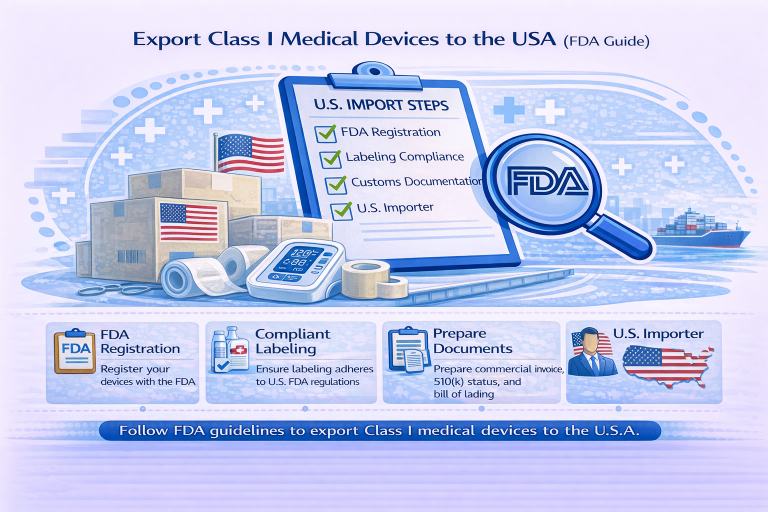
Exporting Class I Medical Devices to the USA
A foreign manufacturer's pathway for Class I devices — why it's the fastest device route, and the steps that still apply.
Key Takeaways
- Class I is the fastest device path — most are 510(k)-exempt (no premarket submission).
- But confirm it's really Class I — "reserved" Class I devices still need a 510(k).
- Still register & list — 21 CFR Part 807, annual, with the MDUFA establishment fee.
- U.S. Agent + initial importer — both required for a foreign device.
- General controls apply — labeling, UDI, MDR, quality (records/complaints; sterile = full system).
- Exempt/cleared ≠ FDA "approved."
The Class I Advantage: 510(k)-Exemption
The reason Class I is the lowest-barrier device class to bring to the U.S. is simple: FDA has exempted most Class I devices from the 510(k), so for most Class I products there's no premarket notification to prepare, file, or wait on. That removes the biggest cost and delay a Class II device faces.
How to Bring a Class I Device to the U.S.
- Confirm classification. Your device is Class I with a specific product code, and isn't "reserved." See device classification.
- Confirm 510(k)-exemption. Most Class I are exempt (no submission); prepare a 510(k) only if reserved / new use / different technology.
- Register & list. FDA establishment registration and device listing (21 CFR Part 807) — annual, with the MDUFA establishment fee. See the registration checklist.
- Designate a U.S. Agent. Required for the foreign establishment (807.40). See the Class I U.S. Agent.
- Set up the U.S. initial importer. The first U.S. receiver registers and lists.
- Meet general controls. Labeling (801), UDI (830), MDR (803), and the quality system (records/complaints; full system if sterile).
- File the import entry. Clear customs/FDA at entry — see importer support.
What "Exempt" Still Requires
- Establishment registration & device listing — 21 CFR Part 807, annual, with the MDUFA establishment fee ($11,423 FY2026, a government fee)
- U.S. Agent for the foreign establishment, and a U.S. initial importer
- Labeling & UDI — 21 CFR Part 801 and Part 830
- Medical Device Reporting — 21 CFR Part 803
- Records & complaint files — 820.180 & 820.198 apply even under the GMP exemption
- Full quality system if sterile — the reduced GMP exemption doesn't apply to sterile devices (QMSR compliance date Feb 2, 2026)
Import Realities & Common Mistakes
- Two registered parties — the foreign manufacturer (with U.S. Agent) and the U.S. initial importer
- Assuming exempt = no obligations — register, list, general controls, records/complaints still apply
- Missing that it's "reserved" or has a new use/technology — it actually needed a 510(k)
- A sterile device without the full quality system
- Non-compliant labeling or missing UDI; a missing/outdated U.S. Agent
- Calling it "FDA approved" — inaccurate and a compliance risk
Export Your Class I Device to the U.S.
FDA Registration Assistance runs the full pathway for foreign Class I device manufacturers: confirming classification and 510(k)-exemption, completing registration and listing, serving as your U.S. Agent, coordinating the U.S. initial importer, and reviewing labeling/UDI and the quality-system requirements (including the sterile case). We keep the government (MDUFA) fee distinct from our service fee and never imply your device is "FDA approved."
Contact us at info@fdaregistrationassistance.com or call +1 (928) 275-8333 for a quote. An independent compliance firm serving 1,000+ companies across 135+ countries, with 15+ years of experience.
Frequently Asked Questions — Exporting Class I Devices to the USA
1. How hard is it to export a Class I medical device to the USA?
Class I is the most straightforward device class to bring into the U.S., because most Class I devices are 510(k)-exempt - meaning there's usually no premarket submission to file or wait for. But "easiest" is not "no requirements." As a foreign manufacturer you still must confirm the device is genuinely Class I, complete FDA establishment registration and device listing, designate a U.S. Agent, have a U.S. initial importer, meet general controls (labeling, UDI, MDR, quality system), and clear the import entry. So the path is real but manageable - not a free pass.
2. Are all Class I devices 510(k)-exempt?
Most are, but not all. FDA has exempted the large majority of Class I devices from 510(k), so for most Class I products you don't file a premarket notification. But certain "reserved" Class I devices still require a 510(k), and the exemption is lost if your device has a new intended use or uses a different fundamental technology than the classified generic type. So step one is confirming your specific product code is Class I and actually exempt - don't assume.
3. What's the pathway to bring a Class I device to the U.S.?
In order: (1) confirm classification - your device is Class I with a specific product code, and isn't "reserved"; (2) confirm 510(k)-exemption (or prepare a 510(k) if it's reserved/new-use/different-technology); (3) complete FDA establishment registration and device listing (21 CFR Part 807); (4) designate a U.S. Agent (required for foreign establishments); (5) have a U.S. initial importer register and list; (6) meet general controls - labeling, UDI, MDR, and the quality system; (7) file the import entry. Each step has its own detail, but that's the sequence.
4. Does an exempt Class I device still need FDA registration?
Yes. 510(k)-exempt only removes the premarket notification - it does not remove establishment registration and device listing (21 CFR Part 807), which are required and renew annually (with the MDUFA establishment fee, a government fee). It also doesn't remove general controls: labeling, UDI, Medical Device Reporting, and the records/complaint-file requirements that apply even under the reduced GMP exemption. So an exempt Class I device is registered and listed, just without a 510(k).
5. Do I need a U.S. Agent to export a Class I device to the U.S.?
Yes. Any foreign establishment that registers with FDA must designate a U.S. Agent (21 CFR 807.40) - a U.S.-based contact for FDA - and the registration generally can't be completed without one. The device U.S. Agent has a defined, limited role (facilitating FDA communication, helping schedule inspections, receiving documents) and a consent step. It's a required piece of the market-entry package for any foreign Class I device manufacturer.
6. What is the initial importer, and do I need one?
For devices, the "initial importer" is the first U.S. party that receives the imported device, and it must register and list with FDA (21 CFR Part 807). So a foreign Class I device typically has two registered parties: the foreign manufacturer (with a U.S. Agent) and the U.S. initial importer. The initial importer handles device obligations on the U.S. side; a separate customs Importer of Record handles the customs entry/duties (they may or may not be the same entity).
7. Is there a fee to register a Class I device establishment?
Yes - unlike food, device establishment registration carries an annual MDUFA establishment fee (a government fee - $11,423 for FY2026), paid to FDA regardless of whether the device is 510(k)-exempt. It's separate from any consulting fee, and the amount changes each fiscal year. The 510(k) exemption saves you the 510(k) submission and its fee, but not the annual device establishment registration fee.
8. What labeling and quality requirements apply?
General controls apply even to exempt Class I devices: compliant labeling (21 CFR Part 801), Unique Device Identification (UDI, 21 CFR Part 830) where applicable, Medical Device Reporting (21 CFR Part 803), and the quality system (the QMSR, harmonized with ISO 13485, with a compliance date of February 2, 2026). Most Class I devices are exempt from most of the quality system except the records (820.180) and complaint-file (820.198) requirements - but a device labeled sterile must meet the full quality system.
9. Does a sterile Class I device have extra requirements?
Yes. The reduced GMP exemption for Class I devices does not apply to devices labeled or represented as sterile. So a sterile Class I device must comply with the full quality system, including sterilization validation - even though it may still be 510(k)-exempt. Many everyday Class I devices are sterile (certain dressings, some single-use items), so if yours is, plan for the complete quality system, not the reduced exempt version.
10. Is my Class I device "FDA approved" once I've registered?
No. An exempt Class I device is registered and listed - it receives no FDA premarket review, so it's neither "cleared" (a 510(k) term) nor "approved" (a PMA term). Marketing it as "FDA approved" or "FDA cleared" is inaccurate, and using registration to imply approval is specifically prohibited (21 CFR 807.39). Describe it accurately: your establishment is registered and the device is listed. This matters for your U.S. marketing and marketplace listings.
11. How long does it take to bring a Class I device to market?
Because most Class I devices are exempt, there's no 510(k) review to wait on, so the timeline is driven by the administrative steps: confirming classification, obtaining a DUNS, registering and listing, designating a U.S. Agent, setting up the initial importer, and getting labeling/UDI/quality in order. That's much faster than a Class II device needing a 510(k) - but it still takes real time to do correctly, and rushing the classification or labeling causes problems at import. We don't promise a fixed turnaround, since it depends on your documentation.
12. What can stop my Class I device at the border?
Common causes: the foreign establishment isn't registered (or the U.S. Agent is missing/outdated); no initial importer is registered; the device is actually "reserved" or has a new use and needed a 510(k); non-compliant labeling or missing UDI; a sterile device without the full quality system; or the product is misbranded/adulterated. Any of these can lead to detention or refusal, and repeated problems can trigger an import alert (DWPE). Getting the pathway right up front prevents most border issues.
13. How is Class I different from Class II for market entry?
The big difference is the 510(k). Most Class I devices are exempt - no premarket submission - so entry is mainly registration, listing, U.S. Agent, initial importer, and general controls. Most Class II devices require a 510(k) clearance before marketing, which adds a substantial submission, review, and cost. So Class I is the fastest, lowest-barrier device class to bring to the U.S. - which is exactly why confirming your device really is Class I (and not Class II) is the pivotal first step.
14. How do I confirm my device is Class I?
Identify the intended use and technological characteristics, then find the matching product code and classification regulation in FDA's Product Classification Database (Class I devices sit across 21 CFR Parts 862-892). Confirm the product code is Class I, check the 510(k)-exempt and GMP-exempt indicators, and verify it isn't "reserved." If your device has a novel use or technology, it may fall outside the exempt generic type. Getting this right determines your entire pathway - it's worth confirming carefully.
15. What if my device turns out to be Class II or III?
Then the pathway changes: a Class II device typically needs a 510(k) clearance, and a Class III device needs premarket approval (PMA) - both substantial submissions on top of registration, listing, U.S. Agent, and general controls. That's why classification comes first. If you assumed Class I but your device is actually Class II/III, marketing it as exempt would leave it non-compliant. We confirm the class before mapping the market-entry plan.
16. How does FDA Registration Assistance help export Class I devices to the U.S.?
We run the full pathway for foreign Class I device manufacturers: confirming classification and 510(k)-exemption, completing FDA establishment registration and device listing, serving as your U.S. Agent, coordinating the U.S. initial importer, reviewing labeling/UDI and the quality-system requirements (including the sterile case), and helping ensure entries clear. We keep the government (MDUFA) fee distinct from our service fee and don't imply your device is "FDA approved." We're an independent compliance firm serving 1,000+ companies across 135+ countries with 15+ years of experience. Contact info@fdaregistrationassistance.com or +1 (928) 275-8333.
