
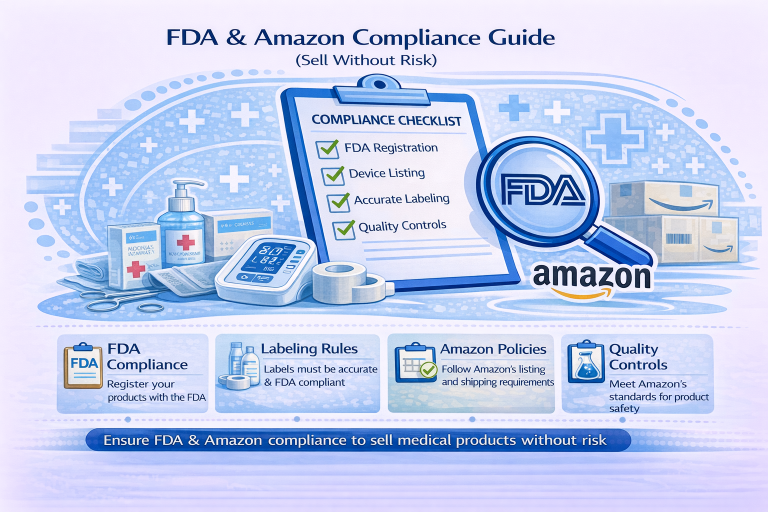
FDA Compliance for Selling on Amazon
What FDA compliance Amazon expects — by category — and why claims and documentation, not slogans, keep your listings up.
Key Takeaways
- You need both — FDA compliance and Amazon's category policies.
- Amazon ≠ FDA — but it enforces FDA law and removes non-compliant listings.
- Supplements (2026) — third-party cGMP verification (Amazon-approved TIC) + ISO 17025 COA.
- Claims are the #1 removal trigger — disease claims make a product an unapproved drug.
- Consequences escalate — listing suppression → ASIN removal → account suspension.
- Compliance reduces risk, doesn't eliminate it — and isn't the same as FDA registration.
Amazon Enforces FDA Rules as Marketplace Policy
Amazon isn't a regulator, but for FDA-regulated categories it requires products to comply with FDA law and its own policies before (and after) they're listed. So you're meeting two overlapping sets of requirements:
- The FDA rules for your product — registration where required, compliant labeling, lawful claims, and any premarket authorization
- Amazon's category policies — documentation, testing/verification (supplements), and gating that the platform requires to list
What Amazon Expects, by Product Type
| Category | What Amazon expects (FDA-based) |
|---|---|
| Dietary supplements | cGMP verification via an Amazon-approved TIC + finished-product ISO 17025 COA; compliant Supplement Facts, DSHEA disclaimer, no disease claims |
| OTC drugs | Drug Facts panel, NDC, monograph-compliant actives/claims, drug establishment registration/listing |
| Cosmetics | MoCRA-compliant labeling (INCI, warnings, adverse-event contact); cosmetic claims only (no drug claims/SPF) |
| Medical devices | FDA registration/listing, required 510(k)/PMA, compliant labeling/UDI, truthful claims |
| Food | FDA facility registration, Nutrition Facts/allergens/net quantity, truthful claims |
Dietary Supplements: the 2026 Requirements
Amazon's 2026 policy raised the bar for all supplements (not just high-risk ones):
- Third-party cGMP verification — proof the product is made under 21 CFR 111 GMP, verified by an Amazon-approved TIC (Testing, Inspection & Certification) organization
- ISO/IEC 17025 COA — a finished-product Certificate of Analysis from an accredited lab, submitted via Seller Central's compliance dashboard
- The COA must match the label — quantitative results supporting the active-ingredient levels on the Supplement Facts, with matching names/units and stated methods (a raw-material supplier COA doesn't count)
- Typical panels — identity, potency, heavy metals, microbials, and adulterant/undeclared-API screening
- FDA-compliant label — Supplement Facts, the DSHEA disclaimer, "not intended to diagnose, treat, cure, or prevent any disease," no FDA logo
- Usually annual — testing/verification is refreshed to maintain compliance
Claims Get More Listings Pulled Than Anything Else
Across supplements, cosmetics, and food, the single biggest removal trigger is an illegal claim — especially a disease claim ("treats," "cures," "prevents," or names a condition). A disease claim turns the product into an unapproved drug in FDA's eyes, and Amazon removes it accordingly.
Compliance Reduces Risk — It Doesn't Eliminate It
No one can promise you'll "sell without risk" or never be removed. Amazon's policies change, enforcement is at Amazon's discretion, and FDA rules apply independently. What proper compliance does is materially reduce your risk by removing the most common reasons listings get pulled:
- Correct registration where required, and a U.S. Agent if you're a foreign seller
- Compliant labeling for your category
- Defensible claims — no disease claims; required disclaimers present
- The required documentation/testing — for supplements, the cGMP/TIC verification and ISO 17025 COA
Sell FDA-Regulated Products on Amazon, Compliantly
FDA Registration Assistance handles the FDA foundation that keeps Amazon listings durable: registration where required, label review against FDA rules, claims review to keep you out of drug-claim territory, classification (cosmetic vs OTC drug, device class), and coordination of the documentation Amazon asks for. We can't guarantee Amazon outcomes — but we reduce the compliance reasons listings get pulled.
Contact us at info@fdaregistrationassistance.com or call +1 (928) 275-8333 for a quote. An independent compliance firm serving 1,000+ companies across 135+ countries, with 15+ years of experience.
Frequently Asked Questions — FDA Compliance on Amazon
1. Do I need FDA compliance to sell on Amazon?
If you sell FDA-regulated products (dietary supplements, OTC drugs, cosmetics, medical devices, or food), yes - and you also need to meet Amazon's own category policies. Amazon isn't the FDA, but it enforces FDA law as marketplace policy and removes listings that aren't compliant. So you're meeting two overlapping sets of requirements: the FDA rules for your product, and Amazon's category-specific documentation/policy requirements. Getting the FDA side right is the foundation for staying on the platform.
2. Is Amazon compliance the same as FDA registration?
No - they're related but distinct. FDA registration (where required) puts your establishment in FDA's system; Amazon's requirements are the platform's own policies for listing a product, which often require FDA-compliant labeling, claims, and documentation (and, for supplements, third-party testing/verification). You can be FDA-registered and still have an Amazon listing removed for a claim or a missing document - and Amazon's checks don't replace your actual FDA obligations. You generally need both.
3. What does Amazon require for dietary supplements?
As of Amazon's 2026 policy, dietary supplements must demonstrate cGMP compliance (21 CFR 111) verified by an Amazon-approved third-party Testing, Inspection, and Certification (TIC) organization, and provide a Certificate of Analysis (COA) from an ISO/IEC 17025-accredited laboratory - submitted through Seller Central's compliance dashboard. The COA must be for the finished product and quantitatively support the active-ingredient levels claimed on the Supplement Facts panel. The label must follow FDA rules (Supplement Facts, the DSHEA disclaimer, no disease claims, no FDA logo). Testing is typically required annually.
4. What is the ISO 17025 COA requirement?
Amazon requires supplement Certificates of Analysis to come from an ISO/IEC 17025-accredited laboratory (verified by an Amazon-approved TIC). The COA should identify the accredited lab (name, address, accreditation number, authorized signature), report results supporting the ingredient concentrations claimed on the Supplement Facts, state the methods used, and match the label's ingredient names and units. A raw-material supplier's COA doesn't satisfy this - it must be finished-product testing. Typical panels include identity, potency, heavy metals, microbials, and adulterant screening.
5. What triggers an Amazon listing removal for FDA products?
The single biggest trigger is illegal claims - especially disease claims (e.g., "treats," "cures," or "prevents" a condition) on a supplement, cosmetic, or food, which make the product an unapproved drug. Other triggers: missing or non-compliant documentation (for supplements, the cGMP/TIC verification and ISO 17025 COA); non-compliant labeling; selling a product that needs FDA authorization it doesn't have; and inconsistencies between the label, the COA, and the listing. Any of these can cause listing suppression, ASIN removal, or account issues.
6. What does Amazon require for OTC drugs?
OTC drug products (topicals with a Drug Facts panel, sunscreens, acne products, etc.) must be legitimate OTC drugs: a compliant Drug Facts label, an NDC, monograph-compliant actives/claims (or an approved application), and the underlying FDA drug establishment registration and listing. Amazon may gate the category and request documentation, and it removes products making claims beyond what's allowed. "FDA approved" claims for a monograph OTC drug are inaccurate and a red flag.
7. What does Amazon require for cosmetics?
Cosmetics must have FDA-compliant labeling (identity, net quantity, INCI ingredient list, warnings, responsible-party info, and the MoCRA adverse-event contact) and must stay within cosmetic claims. The moment a cosmetic makes a drug claim (treats a condition, affects the body's structure/function) or adds SPF, it's a drug - and Amazon will treat it accordingly or remove it. Under MoCRA, facility registration and product listing also apply. Claims are the usual failure point.
8. What does Amazon require for medical devices?
Medical devices sold on Amazon must comply with FDA: establishment registration and device listing, the required premarket authorization (a 510(k) for most Class II devices, PMA for Class III), compliant labeling and UDI, and truthful claims. Amazon may gate device categories and request documentation, and it removes devices that lack required clearance/approval or make unsupported claims. As on the FDA side, calling a 510(k) device "approved" (vs cleared) is a common error.
9. What does Amazon require for food?
Food products need FDA facility registration (for the manufacturer) and FDA-compliant labeling - a Nutrition Facts panel, ingredient list, allergen declarations, net quantity, and responsible-party info - plus truthful claims. Amazon has its own food listing policies and can remove non-compliant food listings. Health/disease claims on food are a common removal trigger, and imported food carries added scrutiny. See our food label review for Amazon sellers and how to avoid a food listing removal.
10. Can you guarantee I won't get removed or suspended?
No - and be skeptical of anyone who promises "sell without risk" or guarantees you'll never be removed. Amazon's policies change, enforcement is at Amazon's discretion, and FDA rules apply independently. What proper compliance does is materially reduce your risk: correct registration, compliant labeling, defensible claims, and (for supplements) the required testing/verification remove the most common reasons listings get pulled. It's risk reduction and durability, not a guarantee.
11. What are the consequences of non-compliance on Amazon?
They escalate: a listing can be suppressed (hidden from search), an ASIN can be removed, and repeated or serious issues can lead to account deactivation - on top of any FDA enforcement (warning letters, import refusal) that applies independently. Because Amazon ties compliance to account health, one non-compliant product can affect your whole account. That's why it's worth getting the FDA compliance right before listing, not after a takedown.
12. Do foreign sellers have extra Amazon/FDA requirements?
Yes. A foreign company selling FDA-regulated products still needs the FDA basics (registration where required, a U.S. Agent for foreign establishments, compliant labeling) plus Amazon's category requirements. Imported products face added FDA scrutiny at the border (and can be subject to import alerts), and Amazon still expects the same documentation. So a foreign Amazon seller is layering FDA registration + U.S. Agent + import compliance under Amazon's policies.
13. Does "FDA registered" help my Amazon listing?
Being registered where required is necessary, but "FDA registered" is not a marketing badge and is not the same as "FDA approved." Overstating it (e.g., implying FDA endorsement) can itself be a compliance problem. What actually protects your listing is the substance: compliant labeling, defensible claims, and the required documentation/testing. Use accurate language - registered and listed, or cleared/approved only where truly applicable.
14. How far ahead should I prepare before listing?
Prepare before you list, not after a takedown. For supplements especially, arranging cGMP verification through an Amazon-approved TIC and obtaining a finished-product ISO 17025 COA takes lead time, and label/claims fixes are cheaper before printing and listing. Building the registration, labeling, claims, and documentation up front avoids the far more expensive path of a suppressed listing, lost sales, and rushed remediation. Timing varies, so start the testing/verification early.
15. What are the most common Amazon FDA-compliance mistakes?
Disease/illegal claims (the top one); missing the supplement cGMP/TIC verification and ISO 17025 COA; using a raw-material COA instead of finished-product; label/COA/listing inconsistencies; treating an OTC drug or device like a general product (missing Drug Facts/NDC or required clearance); assuming "natural" or "FDA registered" exempts you; and thinking Amazon compliance replaces FDA compliance. Most are avoidable with correct labeling, claims, and documentation up front.
16. How does FDA Registration Assistance help Amazon sellers?
We handle the FDA foundation that keeps Amazon listings durable: FDA registration where required, label review against FDA rules, claims review to keep you out of drug-claim territory, classification (cosmetic vs OTC drug, device class), and coordination of the documentation Amazon asks for - including guidance on the supplement cGMP/ISO 17025 testing route. We can't guarantee Amazon outcomes, but we reduce the compliance reasons listings get pulled. We're an independent compliance firm serving 1,000+ companies across 135+ countries with 15+ years of experience. Contact info@fdaregistrationassistance.com or +1 (928) 275-8333.
