
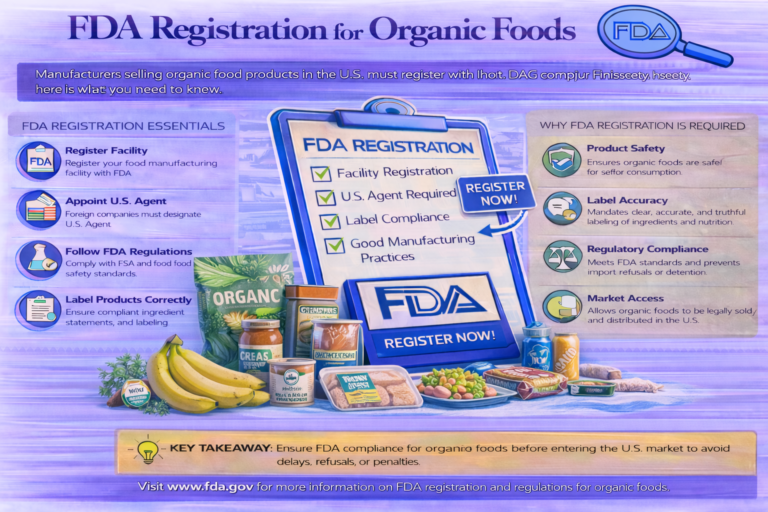
FDA Registration for Organic Food Products
Why organic is USDA-regulated (not FDA), the two separate systems, the labeling tiers, and the USDA Organic seal.
Key Takeaways
- "Organic" is USDA-regulated, not FDA — a certified, legally protected term (7 CFR 205).
- Two separate systems — FDA food safety + USDA organic certification; you need both.
- Four labeling tiers — 100% organic, organic (≥95%), made with organic (≥70%), below 70%.
- USDA seal only on the top two — 100% organic and organic.
- Certified by a USDA-accredited agent — with an organic system plan and annual inspection.
- Organic ≠ safer or healthier — it's about production methods; FDA rules still apply.
Regulated — but by USDA
Most diet and marketing terms — "keto," "vegan," "natural" — aren't FDA-defined, so they're governed only by the truthful-and-not-misleading standard. Gluten-free is the exception FDA does define. Organic is the exception a different agency owns. It's a federally regulated, legally protected, certified term under USDA's National Organic Program (7 CFR Part 205), in effect since 2002.
What You Can Call It — and the Seal
| Label claim | Organic content (excl. water & salt) | USDA Organic seal? |
|---|---|---|
| "100% organic" | 100% — every ingredient certified organic | Yes |
| "Organic" | ≥ 95% (up to 5% non-organic from the National List) | Yes |
| "Made with organic [ingredients]" | ≥ 70% (up to 30% non-organic) | No |
| Below 70% | Identify organic ingredients in the ingredient list only | No |
Certification & What Organic Prohibits
- USDA-accredited certifying agent — you develop an organic system plan, are inspected annually, and comply with USDA standards and the National List
- No synthetic pesticides or fertilizers — except substances specifically allowed on the National List
- No GMOs, no irradiation, no sewage sludge — and, for livestock, no synthetic growth hormones or antibiotics
- $5,000 exemption — operations with ≤$5,000/year in organic sales are exempt from certification but must still meet the standards and cannot use the USDA seal or claim "certified organic"
Importing Organic Food
- Meet the USDA standard — imported organic must be certified to USDA NOP or covered by a USDA organic equivalency/trade arrangement with the exporting country
- NOP import certificate + Organic Integrity Database — documentation to support the organic claim
- Plus the FDA track — foreign facility registers, keeps a U.S. Agent, and the importer runs FSVP with prior notice
- A foreign organic logo isn't enough — on its own it doesn't authorize a U.S. "organic" claim or the USDA seal
Get Your Organic Foods Compliant
FDA Registration Assistance handles the FDA side in full — facility registration, U.S. Agent, label review (Nutrition Facts, allergens, and organic-claim placement), and FSVP for imports — and coordinates with your USDA organic certification so the two systems line up. We don't issue organic certification (that's your USDA-accredited certifier); we make sure the FDA compliance and the organic labeling are both correct.
Contact us at info@fdaregistrationassistance.com or call +1 (928) 275-8333. Food Facility Registration is available starting at $858. Trusted by companies across 135+ countries, with 15+ years of experience.
Frequently Asked Questions
1. Do organic foods require FDA registration?
Yes — a facility that manufactures, processes, packs, or holds organic foods for the U.S. registers with FDA (foreign facilities also need a U.S. Agent). But that's only half the picture: "organic" is separately regulated and certified by USDA's National Organic Program. So organic foods sit under two systems at once — FDA for food safety and labeling, USDA for organic certification — and you need both. FDA registration is not organic certification, and organic certification is not FDA compliance.
2. Does the FDA regulate the word "organic"?
No — USDA does. Unlike terms such as "keto," "vegan," or "natural" that FDA doesn't define, "organic" is a federally regulated, legally protected, certified term under USDA's National Organic Program (NOP, 7 CFR Part 205), which took effect in 2002. To label a product "organic," it must be produced and handled to USDA's organic standards and certified by a USDA-accredited certifying agent. FDA still regulates the food itself (safety, Nutrition Facts, allergens) — it just doesn't own the organic claim.
3. What are the USDA organic labeling tiers?
There are four levels based on organic content. "100% organic": every ingredient (except water and salt) is certified organic. "Organic": at least 95% organic ingredients, with up to 5% non-organic from USDA's National List. "Made with organic [ingredients]": at least 70% organic, up to 30% non-organic. Below 70%: you may only identify the organic ingredients in the ingredient statement. The USDA Organic seal can appear only on "100% organic" and "organic" products — not on "made with organic" or below-70% products.
4. Who certifies organic products?
A USDA-accredited certifying agent (there are many, private and state). The operation develops an organic system plan, is inspected annually, and must comply with USDA's standards and the National List of allowed and prohibited substances. Certification is issued and maintained by the certifier, not by FDA and not by us — we handle the FDA side and coordinate with your certification. Certifiers review your labels for the "100% organic," "organic," and "made with organic" categories.
5. What does "organic" actually prohibit?
USDA organic standards prohibit synthetic pesticides and fertilizers (except substances specifically allowed on the National List), genetically modified organisms ("excluded methods"), ionizing radiation (irradiation), and sewage sludge; for livestock, synthetic growth hormones and antibiotics are prohibited. It's fundamentally about how the product is grown and handled — the production method — not a food-safety or nutrition standard.
6. Is there an exemption for small organic producers?
Yes. An operation whose gross annual organic sales are $5,000 or less is exempt from certification (as is a retailer that doesn't process organic products). But "exempt from certification" isn't "exempt from the rules": exempt operations must still follow the organic production, handling, and labeling standards and keep records — and they may not use the USDA Organic seal or represent themselves as "certified organic." It's a certification exemption, not a standards exemption.
7. Does "organic" mean the food is safer or healthier?
No — and it's important not to imply that. Organic describes production methods (no synthetic pesticides, no GMOs, etc.), not food safety or nutritional superiority. An organic product must still meet every FDA food-safety and labeling requirement, exactly like a conventional one; organic status doesn't reduce your FDA obligations. Marketing organic as inherently "safe" or "healthy" can itself become a misleading-claim problem.
8. What FDA requirements still apply to organic foods?
All of them. Facility registration, the applicable food-safety rules (preventive controls, produce safety, etc.), a compliant Nutrition Facts panel, full ingredient list, and allergen declarations — organic products carry the same major allergens (wheat, soy, nuts, milk, egg) as any other food. The organic and FDA requirements are layered: you satisfy the FDA rules for the food and the USDA rules for the organic claim.
9. How does importing organic food work?
On two tracks. For the organic claim, imported products must either be certified to the USDA organic standards or covered by a USDA organic trade/equivalency arrangement with the exporting country, typically supported by an NOP import certificate and traceable in USDA's Organic Integrity Database. For food safety, the foreign facility registers with FDA and keeps a U.S. Agent, and the importer runs FSVP with prior notice. Both tracks must be satisfied for the shipment to clear.
10. Can I use another certifier's seal or a foreign organic logo?
To be sold as "organic" in the U.S., the product must meet the USDA NOP standard (directly or via an equivalency arrangement). A foreign organic logo alone doesn't authorize a U.S. "organic" claim or use of the USDA Organic seal. Certifying agents' own seals may appear on the label, but not more prominently than the USDA seal, and only within the tiers that permit a seal.
11. Is organic certification a one-time thing?
No. Organic certification is maintained through annual inspections and continued compliance with your organic system plan and USDA standards — and FDA registration must be kept current and renewed on FDA's biennial schedule. Both systems are ongoing. Lapses on either side (an expired certification or a lapsed FDA registration) can hold up product.
12. Does FDA or USDA "approve" organic foods?
FDA doesn't pre-approve food. USDA doesn't "approve" the product either — it accredits certifiers who certify operations to the organic standards. So there's no government "approval" of an organic food; there's FDA compliance for the food and USDA certification for the organic claim, each enforced in its own lane. That distinction matters when a shipment is questioned — you need documentation from both systems.
13. What are the most common mistakes with organic foods?
Assuming FDA registration covers organic (it doesn't); using the word "organic" or the USDA seal without valid certification or outside the allowed tier; putting the USDA seal on a "made with organic" product; treating a foreign organic logo as sufficient for the U.S.; and implying organic means safer or healthier. Nearly all of them come from blurring the FDA and USDA systems together.
14. How does FDA Registration Assistance help with organic foods?
We handle the FDA side in full — facility registration, U.S. Agent, label review (Nutrition Facts, allergens, and organic-claim placement), and FSVP for imports — and coordinate with your USDA organic certification so the two systems line up. We don't issue organic certification (that's your USDA-accredited certifier), but we make sure the FDA compliance and the organic labeling are both correct. Registration is available starting at $858, for companies across 135+ countries. Contact info@fdaregistrationassistance.com or +1 (928) 275-8333.
