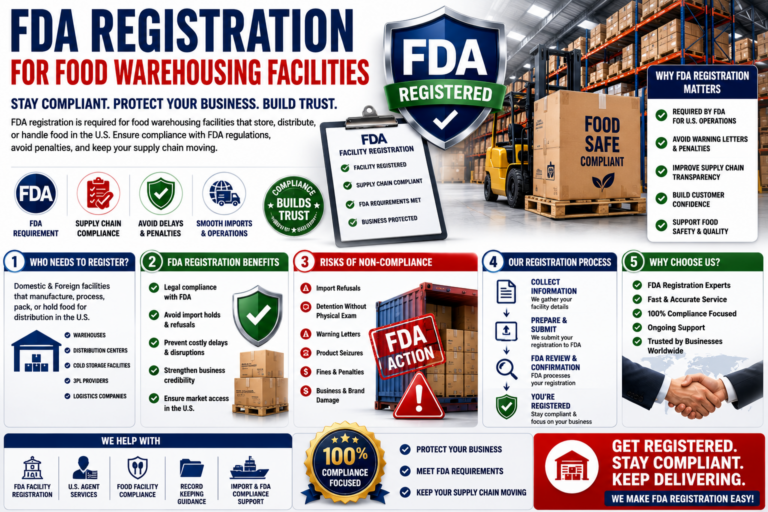
FDA Registration for Food Warehousing Facilities
This guide explains exactly which warehouses must register, which are exempt, the correct activity codes to select, what FSMA requires from food warehouses specifically, temperature monitoring obligations for cold storage, and what happens when a warehouse fails to register or renew.
Which Food Warehouses Must Register — and Which Are Exempt
The operative legal term is “holds.” Under 21 CFR 1.227, holding means storage of food. Any facility that stores food for consumption in the United States must register unless specifically exempt:
| Warehouse / Facility Type | Registration Required? | Key Notes |
|---|---|---|
| Dry ambient storage warehouse | Required | Stores packaged or bulk food. Activity code: Hold. Most straightforward warehouse registration scenario. |
| Refrigerated / cold storage warehouse | Required | Stores temperature-sensitive food. Activity code: Hold. Additional FSMA obligation: temperature monitoring as preventive control for food requiring temperature control for safety. |
| Third-party logistics (3PL) provider | Required | 3PL registers its own facility. Does not cover food brand clients’ own obligations. Each 3PL location is a separate registration. |
| Fulfillment center / eCommerce warehouse | Required | Holds food for order fulfillment. Amazon registers its own FCA fulfillment centers separately — does not cover sellers’ other warehouses. |
| Distribution center / distribution hub | Required | Receives and stages food for forward distribution. Activity code: Hold. Registration number may appear in FSVP supply chain documentation. |
| Bonded warehouse (imported food pre-customs) | Required | CBP bonded status and FDA registration are separate independent obligations. Both apply when the bonded facility stores food intended for U.S. consumption. |
| Foreign warehouse holding food for U.S. export | Required + U.S. Agent | Foreign holding facilities must register and designate a U.S. Agent under 21 CFR Part 1. Biennial renewal required same as domestic facilities. |
| Repackaging / relabeling operation | Required | Activity codes: Hold AND Pack. Repacked products must carry compliant FDA labels with repacker’s or distributor’s name and address. |
| Farm warehouse (on-farm, same ownership, farm-only product) | Possibly Exempt | Exempt only if the warehouse holds food exclusively from that farm, is under the same ownership, and meets the farm definition at 21 CFR 1.227. A separate warehouse holding food from multiple sources must register. |
| Retail food establishment back room | Exempt | Grocery stores and retail food establishments where food is sold directly to consumers are exempt. A separate off-site warehouse owned by a retailer may require registration. |
| Restaurant / food service storage | Exempt | Restaurants, cafeterias, hotels, and institutions are exempt. Storage areas within the establishment are part of the exempt operation. |
Activity Codes and FSMA Preventive Controls for Food Warehouses
Selecting the Correct Activity Code
During FDA FURLS registration, every facility must select activity codes reflecting what it does with food. For warehousing operations:
Hold
Storage of food. Primary activity code for all warehouses, cold storage facilities, distribution centers, and fulfillment centers. Nearly all food warehouses select Hold as their minimum activity code.
Pack
Placing food into packages. Required if the warehouse repackages bulk food into consumer-sized containers. Should be selected in addition to Hold for repacking operations.
Manufacture / Process
Making food or changing its properties. If the warehouse cuts, blends, cooks, or otherwise processes food, this code must also be selected. Triggers full FSMA preventive controls requirements.
FSMA Preventive Controls — Modified Requirements for Warehouses
FSMA’s Preventive Controls for Human Food rule at 21 CFR Part 117 applies to registered food facilities including warehouses. However, warehouses that only hold packaged food not exposed to the environment have modified requirements compared to manufacturing facilities:
Reduced Requirements — Hold-Only, Packaged Food
A warehouse storing only packaged food not exposed to the environment during storage does not need to implement the full range of FSMA Preventive Controls. No requirement for a Preventive Controls Qualified Individual (PCQI) overseeing process controls. Basic GMP requirements under 21 CFR Part 117 Subpart B still apply.
Temperature Control — Cold Storage Preventive Control
If a warehouse stores food requiring temperature control for safety — ready-to-eat refrigerated products, dairy, seafood, fresh produce, frozen meat — temperature monitoring is a required preventive control. The warehouse must: implement written temperature control procedures; monitor and record temperatures; take corrective action when deviations occur; and maintain records for 2 years.
How to Register a Food Warehouse with FDA
Step 1 — Confirm Registration Obligation
FDA Registration Assistance reviews the warehouse’s operations, ownership structure, and food inventory to confirm whether registration is required. Farm-operated warehouses and retail establishment storage areas may qualify for exemptions that must be evaluated before registration.
Step 2 — Obtain DUNS Number
A Unique Facility Identifier (currently a DUNS Number) is required for FDA registration. FDA Registration Assistance procures the DUNS Number for the warehouse facility. DUNS Number fees are separate from the $858 FDA registration service fee.
Step 3 — Select Activity Codes and Food Categories
The correct activity codes (Hold, Pack, and/or others) and food product categories must be selected. Multi-temperature warehouses typically select all applicable food product categories. Incorrect activity codes are one of the most common warehouse registration errors.
Step 4 — Submit and Manage Renewal
Registration is submitted through FDA FURLS. For foreign warehouses, U.S. Agent designation is completed simultaneously. FDA Registration Assistance tracks the Biennial Renewal window (October–December of even years) and manages renewal submissions automatically.
Ready to Register Your Food Warehouse with FDA?
FDA Registration Assistance provides complete FDA Food Facility Registration for all food warehousing operations — cold storage, dry storage, 3PL, fulfillment centers, distribution hubs, bonded warehouses, and foreign holding facilities. Complete service for $858. FDA charges $0. 1,000+ clients. 135+ countries. 15+ years of FDA regulatory experience.
Contact us at info@fdaregistrationassistance.com or call +1 (928) 275-8333.
Frequently Asked Questions — FDA Registration for Food Warehousing Facilities
1. Do food warehouses need FDA registration?
Yes — most food warehouses must register. Under 21 U.S.C. § 350d and 21 CFR 1.227, any facility that holds (stores) food for U.S. consumption must register. This covers refrigerated warehouses, cold storage, dry storage, 3PLs, fulfillment centers, distribution centers, bonded warehouses, and foreign holding facilities. Complete service: $858. FDA charges $0.
2. What does “holding” mean under FDA food facility registration rules?
Under 21 CFR 1.227, holding means storage of food. The definition is intentionally broad — any facility that stores food intended for U.S. consumers is a holding facility required to register, regardless of storage temperature, ownership, or whether it also performs manufacturing or processing.
3. What types of food warehouses must register with FDA?
Must register: refrigerated and cold storage warehouses; dry ambient storage warehouses; 3PL providers storing food; fulfillment centers storing food for eCommerce; distribution hubs; bonded warehouses storing food pre-customs entry; foreign warehouses holding food destined for the United States; and repackaging or relabeling operations.
4. What food warehouses are exempt from FDA registration?
Exempt: warehouses that are physically part of a farm and hold only that farm’s own products under the same ownership; retail food establishment back rooms where food is sold directly to consumers; and restaurant and food service storage areas. A separate warehouse owned by a farm that holds food from multiple sources typically must register.
5. What activity code should a food warehouse select during FDA registration?
Hold is the primary activity code for warehouses storing food. If the warehouse also repackages food, Pack should also be selected. If the warehouse processes food in any way (cutting, blending, cooking), Manufacture or Process must be added. Selecting the wrong activity code is a common warehouse registration error that can affect FDA inspection planning.
6. Do 3PL warehouses need FDA registration?
Yes. A 3PL storing food for food brand clients is a food-holding facility and must register with FDA. The 3PL registers its own facility — its registration does not cover clients’ manufacturing facilities. Each physical 3PL location is a separate registration.
7. Do cold storage and refrigerated warehouses need FDA registration?
Yes. Cold storage warehouses must register and — if holding food requiring temperature control for safety — must implement temperature monitoring as a required preventive control under 21 CFR Part 117. Temperature deviation records must be maintained for 2 years and available for FDA inspection.
8. What are the FSMA Preventive Controls requirements for food warehouses?
Warehouses holding only packaged food not exposed to the environment have modified Preventive Controls requirements compared to manufacturing facilities — no PCQI requirement for process controls. However, temperature control for food requiring refrigeration or freezing is a required preventive control. Basic GMP requirements at 21 CFR Part 117 Subpart B apply to all registered facilities.
9. Do fulfillment centers and eCommerce distribution warehouses need FDA registration?
Yes. A fulfillment center or eCommerce distribution warehouse storing and shipping packaged food to U.S. consumers is a food-holding facility. Amazon registers its own FCA fulfillment centers — this does not cover sellers’ separate storage locations or manufacturers.
10. Does Amazon’s FBA registration cover my food products?
No. Amazon registers its fulfillment centers for its own holding activity. This does not cover your food manufacturer’s registration, your 3PL warehouse, or any other part of your supply chain. See the Amazon food compliance guide.
11. Do foreign warehouses holding food for U.S. export need FDA registration?
Yes. A foreign warehouse holding food before export to the United States must register with FDA and designate a U.S. Agent under 21 CFR Part 1. Biennial renewal required same as domestic facilities.
12. Do bonded warehouses need FDA registration for food storage?
Yes. A bonded warehouse holding imported food before customs entry must register with FDA as a food-holding facility. CBP bonded warehouse approval and FDA food facility registration are separate and independent requirements that both apply when the facility stores food intended for U.S. consumption.
13. What is the $858 complete service for food warehouse registration?
FDA Registration Assistance charges $858 for the complete service — activity code and food product category selection, registration submission through FURLS, U.S. Agent designation for foreign warehouses, and Biennial Renewal management. FDA charges $0 in government fees. DUNS Number procurement is a separate step and fee. See the full cost breakdown.
14. What is the Biennial Renewal for food warehouse registration?
FDA Food Facility Registration renews every two years — October 1 through December 31 of every even-numbered year. Applies to all registered food facilities including warehouses. Missing the Biennial Renewal results in automatic cancellation — an unregistered warehouse can affect clients’ food shipments stored there.
15. Does a food warehouse need a DUNS Number for FDA registration?
Yes. A Unique Facility Identifier (currently a DUNS Number) is required for FDA registration for warehouses as well as manufacturing facilities. FDA Registration Assistance guides you through DUNS Number procurement as part of the registration process. Note that DUNS Number procurement fees are separate from the $858 FDA registration service fee.
16. Do distribution centers need FDA registration?
Yes — when the distribution center holds food. A distribution center receiving, staging, and storing food before forward distribution is holding food and must register. The distribution center’s FDA registration number may appear in FSVP supply chain documentation.
17. How does food warehouse registration differ from manufacturer registration?
Both use the same FDA FURLS system. The differences: activity codes (Hold vs. Manufacture or Process); food product category scope (warehouses may hold broader categories); and FSMA preventive controls (warehouses holding only packaged food have modified documentation requirements vs. full manufacturing preventive controls).
18. What food product categories should a food warehouse select during registration?
Select all categories the warehouse routinely holds. For multi-temperature 3PLs or grocery distribution centers handling diverse inventories, this may include multiple categories. Under 21 CFR 1.234, the registration must be updated within 60 days whenever the warehouse begins holding a new food product category.
19. Does a food warehouse need to update its registration when it starts holding new food categories?
Yes. Under 21 CFR 1.234, changes to food product categories held must be updated within 60 calendar days. A food warehouse that begins holding dietary supplements, a new food type, or expands into frozen food storage must update its FDA registration promptly.
20. Is temperature monitoring required for cold storage food warehouses under FSMA?
Yes — for warehouses storing food that requires temperature control for safety. Under 21 CFR Part 117, temperature monitoring for refrigerated or frozen food requiring temperature control for safety is a required preventive control. The warehouse must implement written procedures, monitor and document temperatures, take corrective actions on deviations, and maintain 2-year records.
21. Does a warehouse that only repackages food need to register with FDA?
Yes. A facility that repacks food into consumer-sized packages or relabels food packaging is both holding and packing food. Activity codes Hold and Pack should both be selected. Repacked products must carry compliant FDA labels with the repacker’s or distributor’s name and address under 21 CFR Part 101.
22. What is the qualified facility exemption and does it apply to food warehouses?
The qualified facility exemption at 21 CFR Part 117 Subpart F provides modified Preventive Controls requirements for very small food businesses with average annual food sales under $1 million. The exemption applies only to Preventive Controls implementation requirements — not to the FDA registration requirement. A very small food warehouse must still register.
23. Do alcohol beverage warehouses need FDA registration?
Alcoholic beverages are regulated by TTB, not FDA. A warehouse holding only wine, beer, or distilled spirits may not require FDA registration for that activity. A warehouse holding mixed inventories including both alcoholic and non-alcoholic food products must register with FDA for its food-holding activity.
24. Can FDA inspect a food warehouse facility?
Yes. FDA has authority to inspect registered food facilities including warehouses, cold storage, and distribution centers. During an inspection, FDA may review temperature monitoring records, food storage practices, pest control programs, allergen segregation procedures, and FSMA Preventive Controls documentation. Foreign facilities are also subject to FDA inspection authority.
25. How do I get started with FDA registration for my food warehouse?
Contact FDA Registration Assistance at info@fdaregistrationassistance.com or call +1 (928) 275-8333. Provide your warehouse facility name, address, the types of food products you hold, and any existing FDA registration information. FDA Registration Assistance will confirm your registration obligation, select the correct activity codes and food product categories, submit the registration, and manage Biennial Renewal. Complete service: $858. FDA charges $0. Note: DUNS Number procurement fees are separate.