FDA Registration for Bakery Products
Bread, rolls, cakes, cookies, crackers, pastries — the framework is standard food law, but bakery hits three wrinkles most food categories never touch.
Key Takeaways
- Commercial bakeries register as food facilities and follow preventive controls (Part 117).
- Bread names are standards of identity — "bread," "enriched," "whole wheat" (Part 136).
- "Enriched" = fortified — added B vitamins, iron, and folic acid.
- Allergen cross-contact is the top risk — wheat + egg, milk, soy, nuts, sesame.
- Raw flour carries Salmonella/E. coli — baking is usually the kill step.
- RACC sets the serving size on the Nutrition Facts label (101.12).
Some Bakery Names Are Regulated
Several bakery names aren't just descriptions — they're standards of identity. If you use the name, the product has to meet the standard:
| Name | What the standard requires | Cite |
|---|---|---|
| Bread / rolls / buns | Baked yeast-leavened wheat-flour dough; "bread" is a loaf (rolls/buns are smaller); defined minimum solids | 136.110 |
| Enriched bread | Made with enriched flour / added B vitamins, iron, and folic acid | 136.115 |
| Whole wheat bread | Made from 100% whole wheat flour | 136.180 |
| (Enriched) flour | Standardized flours, with fortification for "enriched" | Part 137 |
Bakery Is an Allergen Minefield
No food environment mixes more major allergens on shared equipment than a bakery. Wheat is inherent; the rest ride along:
Always present
Wheat — the base of most bakery products, and a major allergen in its own right.
Common add-ins
Egg, milk, soy, tree nuts, peanuts — in doughs, fillings, glazes, and toppings.
The newest one
Sesame — the 9th allergen (effective Jan 1, 2023); on buns, breads, crackers.
Raw Flour & Shelf Life
Shelf life shapes the rest of the food-safety picture:
Shelf-stable
Crackers and many cookies are low-moisture and ambient-stable. Lower pathogen risk; mold control and packaging matter most.
Perishable
Cream-, custard-, or cheese-filled items are higher-moisture and often need refrigeration. Water activity drives the controls.
The Label and the Registration
Bringing a Bakery Product to Market
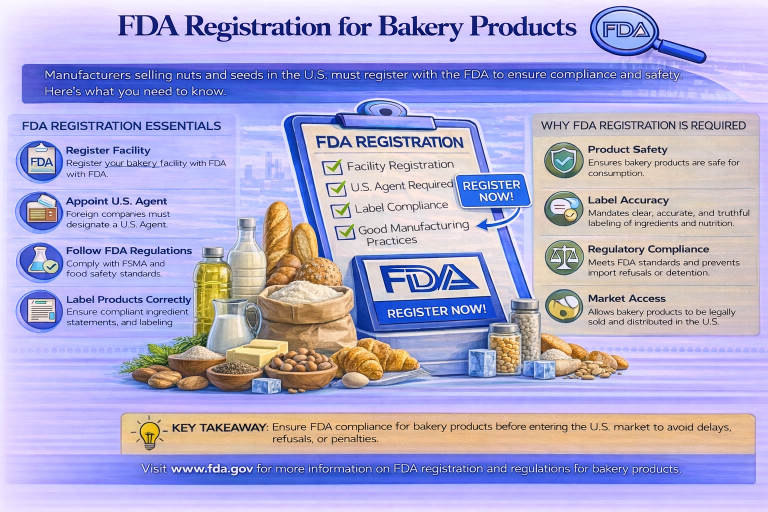
Register the facility
The bakery/facility registers; foreign facilities add a U.S. Agent.
Check standard-of-identity names
"Bread," "enriched," "whole wheat" must meet Part 136 — or use a different name.
Run the hazard analysis
Part 117: allergen cross-contact and raw-flour pathogens (Salmonella, E. coli).
Get allergen labeling right
Declare wheat, egg, milk, soy, nuts, sesame; control cross-contact.
Build the label
Set serving size from the RACC; complete Nutrition Facts and ingredients.
Handle imports & keep current
Prior notice + FSVP; renew every two years; revisit labels on change.
Get Your Bakery Products to Market
FDA Registration Assistance registers bakery facilities, serves as U.S. Agent, reviews labeling — standard-of-identity names, allergen declarations, and Nutrition Facts included — supports preventive-controls hazard analysis, and handles FSVP and prior notice for imports. Food Facility Registration is available as a service starting at $858.
Contact us at info@fdaregistrationassistance.com or call +1 (928) 275-8333. Trusted by companies across 135+ countries, with 15+ years of experience.
Frequently Asked Questions
1. Do bakery products need FDA registration?
A commercial bakery or facility that makes, packs, or holds bakery products registers as a food facility, and foreign facilities need a U.S. Agent. Retail bakeries selling directly to consumers can be treated differently. Registration identifies the facility — it isn't approval.
2. Is "bread" a regulated name?
Yes — "bread," "rolls," and "buns" have a standard of identity (21 CFR 136.110): a baked, yeast-leavened wheat-flour dough, with "bread" defined as a loaf and a minimum solids content. If a product doesn't meet the standard, it must use a different, accurate name.
3. What does "enriched" mean on bread or flour?
"Enriched bread" and "enriched flour" are standardized names requiring specific added nutrients — B vitamins, iron, and folic acid. You can't label a product "enriched" unless it meets the required fortification. Folic acid fortification of enriched grain products is a long-standing FDA requirement.
4. What makes "whole wheat bread" different?
The standard (21 CFR 136.180) requires it to be made from 100% whole wheat flour. A loaf that's only partly whole wheat can't be labeled simply "whole wheat bread" — the name must match what's in the product.
5. Why are allergens such a big deal in bakeries?
Bakeries are the classic shared-facility environment. Wheat is inherent, and egg, milk, soy, tree nuts, peanuts, and sesame share mixers, lines, and airborne flour dust. Undeclared allergens — from a missed declaration or cross-contact — are among the most common recall causes.
6. How does sesame affect bakeries?
Sesame became the 9th major allergen, effective January 1, 2023 — and it's especially relevant to bakeries that use it on buns, breads, and crackers. Any sesame present must be declared and cross-contact controlled, like the other major allergens.
7. Is raw flour a food-safety hazard?
Yes — raw flour is a raw agricultural product linked to Salmonella and E. coli, which is why FDA advises against eating raw dough or batter. Baking is usually the kill step, but products that aren't fully baked or use raw flour (some edible cookie doughs) need heat-treated flour or another validated control.
8. Do bakeries need a preventive controls plan?
Generally yes — under 21 CFR Part 117, the hazard analysis for bakeries typically centers on allergen cross-contact and raw-flour pathogens. Where a hazard needs a control, the plan documents it. Some small or qualified facilities have modified requirements.
9. How is the serving size on my label decided?
By the Reference Amount Customarily Consumed (RACC) for the product category (21 CFR 101.12), not an amount you pick. The RACC sets the serving-size basis on the Nutrition Facts label, so bread, cookies, muffins, and cakes each follow their category's reference amount.
10. Does shelf life change the requirements?
It changes the food-safety picture — low-moisture, shelf-stable products (crackers, many cookies) are handled differently than perishable, higher-moisture items (cream- or custard-filled) that need refrigeration. Water activity and moisture drive the controls.
11. Do imported bakery products need FSVP and prior notice?
Yes — a registered foreign facility with a U.S. Agent, prior notice per shipment, and an importer FSVP. The importer of record owns the FSVP; there's no separate "FSVP Agent" role required by the rule.
12. Is "FDA registered" the same as "FDA approved"?
No — registration tells FDA a facility exists and what it does; it isn't approval of the product. "FDA approved" based on registration is inaccurate.
13. How much does registration cost?
FDA doesn't charge a fee for food facility registration itself. FDA Registration Assistance offers Food Facility Registration as a service starting at $858, handling the filing and related setup. Contact the team for a quote covering your bakery and import needs.
14. How does FDA Registration Assistance help?
It registers bakery facilities, serves as U.S. Agent, reviews labeling (standard-of-identity names, allergens, Nutrition Facts), supports hazard analysis, and handles FSVP and prior notice for imports, for companies across 135+ countries. Contact info@fdaregistrationassistance.com or +1 (928) 275-8333.