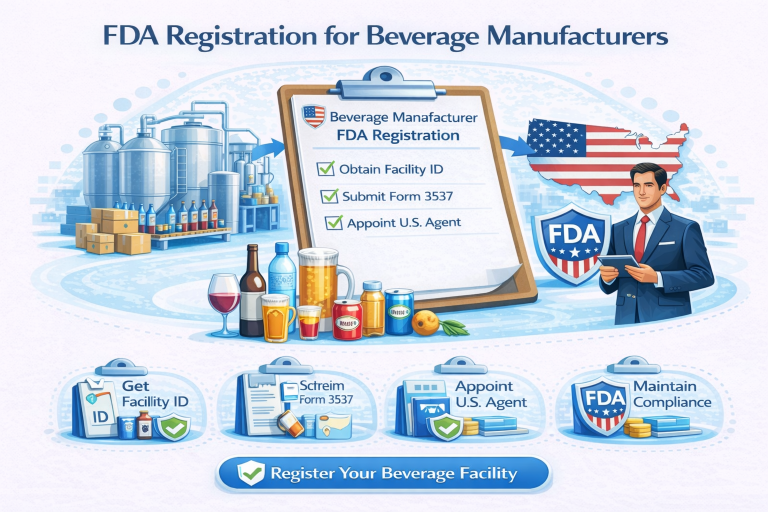
FDA Registration for Beverage Manufacturers
Registration is the easy part. The beverage-specific decisions above are where products get misclassified — and held.
Key Takeaways
- Beverages register as food facilities — biennial, no FDA fee; foreign facilities add a U.S. Agent.
- Beverage vs. dietary supplement is decided by name, packaging, serving size, and claims — and it changes everything.
- Juice needs HACCP (21 CFR 120, 5-log reduction) and a percent-juice label.
- Shelf-stable canned/acidified beverages need an FCE + process filing (108/113/114).
- Bottled water has its own standards (129 and 165.110).
- Some alcohol is TTB's, not FDA's — confirm jurisdiction before you register.
Beverage or Dietary Supplement?
FDA's guidance decides this by how a product is presented, not just what's in it. No single factor controls — FDA weighs them together:
Points to "beverage" (food)
Names or terms like "drink," "water," "soda," or "beverage"; typical soda/juice/water bottle or can packaging; beverage-size serving; positioned to quench thirst or refresh; Nutrition Facts panel.
Points to "dietary supplement"
Small serving/dose (not a beverage volume); "dietary supplement" in the statement of identity; supplement-style packaging; structure/function claims with a DSHEA disclaimer; Supplement Facts panel.
Beverage-Specific Requirements
| Beverage type | Extra requirements beyond registration |
|---|---|
| Juice & juice drinks | Juice HACCP (21 CFR 120), 5-log pathogen reduction, percent-juice label (101.30) |
| Bottled water | CGMP (21 CFR 129) + quality & identity standards (165.110) |
| Canned / shelf-stable teas & coffees | Acidified or low-acid canned: FCE + process filing (108/113/114) |
| Carbonated soft drinks | Food additive / GRAS ingredients, Nutrition Facts, allergens |
| Energy / functional drinks | Added-substance safety (caffeine, novel ingredients), claims scrutiny, beverage-vs-supplement |
| Plant-based & RTD drinks | Preventive controls (21 CFR 117), allergen controls, labeling |
Alcohol: FDA or TTB?
Before registering an alcohol product with FDA, confirm it isn't actually the Alcohol and Tobacco Tax and Trade Bureau's to regulate:
Usually TTB
Wine at 7% ABV or more, distilled spirits, and malt beverages made from malted barley and hops — regulated under the Federal Alcohol Administration Act by TTB.
Usually FDA
Alcohol beverages outside TTB's scope — such as wines under 7% ABV and certain beers not made from malted barley and hops — fall under FDA: food facility registration and food labeling apply.
How to Get Your Beverage FDA-Ready
Classify the product
Beverage or dietary supplement? That decides labeling, claims, and the whole pathway.
Confirm FDA (not TTB) regulates it
Check whether an alcohol product falls under FDA or TTB before registering.
Register & appoint a U.S. Agent
Complete food facility registration; foreign facilities designate a U.S. Agent with consent verification.
Meet beverage-specific process rules
Address Juice HACCP, acidified/LACF process filing, or bottled water standards, as applicable.
Get labeling & imports right
Confirm Nutrition Facts, ingredients, allergens, and percent-juice; handle FSVP if importing.
Maintain & renew
Keep the registration current with updates and the biennial renewal, and stay inspection-ready.
Register Your Beverage Facility — the Right Way
FDA Registration Assistance completes food facility registration and U.S. Agent designation, helps confirm your product's classification and jurisdiction, supports process filing and label review for juice, water, and canned beverages, and manages FSVP and biennial renewals.
Contact us at info@fdaregistrationassistance.com or call +1 (928) 275-8333. Trusted by beverage companies across 135+ countries, with 15+ years of FDA experience.
Frequently Asked Questions — Beverage Manufacturers
1. Do beverage manufacturers need FDA registration?
Yes. Beverages are regulated as conventional food, so facilities that manufacture, process, pack, or hold beverages for U.S. consumption must register. Foreign facilities also designate a U.S. Agent. Registration is biennial with no FDA fee.
2. Is my product a beverage or a dietary supplement?
It depends on presentation, not just ingredients. FDA weighs product/brand name, packaging, serving size, conditions of use, composition, and claims. Terms like "drink," "water," or "soda," or typical beverage packaging, generally make it a conventional beverage with a Nutrition Facts panel.
3. Why does that classification matter so much?
It changes the whole pathway. A beverage uses Nutrition Facts and food rules; a supplement uses Supplement Facts, DSHEA claims, and supplement GMP. Getting it wrong means the wrong label and potential misbranding.
4. Does bottled water require FDA registration?
Yes — bottled water is regulated as food, so facilities register (foreign ones with a U.S. Agent). Bottled water also has its own CGMP (21 CFR 129) and quality/identity standards (165.110).
5. Do juice and juice drinks have extra requirements?
Yes — Juice HACCP (21 CFR 120) with a 5-log pathogen reduction, and a percent-juice declaration (101.30) for juice-containing beverages, on top of registration and labeling.
6. What about canned or shelf-stable beverages?
Many are acidified or low-acid canned foods, requiring a Food Canning Establishment registration and process filing under 21 CFR 108/113/114, in addition to facility registration. See our FCE/SID checklist.
7. Are alcoholic beverages regulated by FDA?
It depends. Wine at 7%+ ABV, distilled spirits, and malt beverages from malted barley and hops are TTB's. Alcohol outside that scope — wines under 7% ABV, certain beers not from malted barley and hops — falls under FDA, so food registration and labeling apply. Confirm jurisdiction early.
8. Do energy and functional drinks have special rules?
They draw extra scrutiny — added substances like caffeine and novel ingredients must be safe (GRAS or approved), claims are watched, and many face the beverage-vs-supplement question based on how they're marketed.
9. Do foreign beverage companies need a U.S. Agent?
Yes — every foreign beverage facility designates a U.S. Agent as part of registration, with FDA consent verification. Domestic facilities don't.
10. What labeling do beverages need?
Nutrition Facts, ingredient list, allergen declaration where applicable, net quantity, and the firm's name and address — plus percent-juice for juice beverages. Claims must not misclassify the product or imply drug claims.
11. Is FSVP required for imported beverages?
If you're the U.S. importer, generally yes — you must verify foreign suppliers. It's separate from registration; a registered supplier doesn't make you FSVP-compliant. See our FSVP guide.
12. Do beverage facilities follow FSMA preventive controls?
Usually yes — registered beverage facilities generally fall under Preventive Controls for Human Food (21 CFR 117) with a food safety plan, unless an exemption or another rule (like Juice HACCP) applies.
13. How often is registration renewed?
Biennially — even-year Oct 1 to Dec 31 — with no FDA fee. Details must be updated within 60 days of any change.
14. Does registration mean my beverage is approved?
No. Registration notifies FDA of your facility; it isn't approval. The product still must meet the applicable safety, labeling, and process rules, and "FDA approved" is inaccurate.
15. How does FDA Registration Assistance help?
It completes registration and U.S. Agent designation, helps confirm classification and jurisdiction, supports process filing and label review for juice, water, and canned beverages, and manages FSVP and renewals — for beverage companies across 135+ countries.
16. How do I get started?
Contact FDA Registration Assistance at info@fdaregistrationassistance.com or call +1 (928) 275-8333 with your beverage type for a clear plan.