
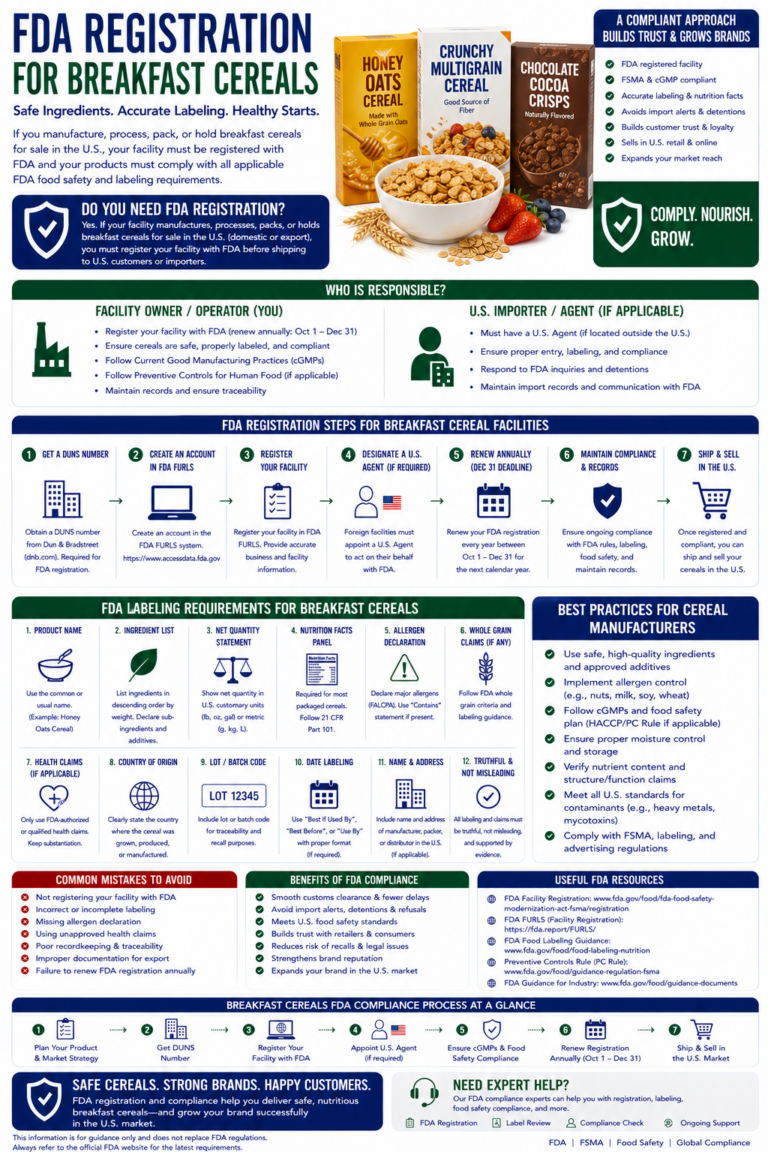
FDA Registration for Breakfast Cereals
The fortification and health-claim rules that make cereals different — plus added sugars and allergens.
Key Takeaways
- Fortification & claims define cereals — more than registration or filing.
- Cereals are the most fortified category — added vitamins and minerals throughout.
- The oat beta-glucan heart claim is authorized — but needs 0.75 g per serving.
- Health claims must be authorized — you can't invent your own.
- Added sugars must be declared — and match the claims you make.
- Dry cereal skips process filing — low-moisture, not LACF or acidified.
Fortification: Cereals Are the Most Fortified Food
More than almost any other food, breakfast cereals add nutrients — the long "vitamins and minerals" list on the box. Fortification is adding nutrients not naturally present (or restoring those lost in processing): folic acid, iron, B-vitamins, vitamin D, and more.
Because fortification adds nutrients, it also fuels the claims cereals are famous for — which is where the real compliance attention goes.
The Oat Beta-Glucan Heart-Disease Claim
The best-known cereal health claim — the one on oat cereals for decades — is an authorized health claim: soluble fiber from certain foods and risk of coronary heart disease, at 21 CFR 101.81. It isn't free-form marketing; it comes with hard conditions:
Eligible sources are specific — oat bran, rolled oats, whole oat flour, whole grain and dry-milled barley, and a few others. If your cereal doesn't hit the 0.75 g per serving, it can't carry the claim, however oat-forward the branding is.
The Three Kinds of Claims
Cereals use all three claim types, and each has its own rules — mixing them up is a top compliance risk:
| Claim type | What it is & the rule |
|---|---|
| Nutrient content claim | Describes a nutrient level — "high fiber," "good source of protein," "whole grain." Must meet the specific defined threshold. |
| Health claim | Links a food to reduced disease risk — like oat beta-glucan/CHD. Must be an authorized claim with its conditions met. |
| Structure/function claim | Describes an effect on the body ("supports digestion"). Must be truthful and not imply disease treatment. |
Added Sugars & Cereals for Children
Cereals can be high in added sugars while carrying health-oriented branding — which puts the added-sugars declaration and the claims in direct tension:
Registration, Filing & Allergens
- Facility registration — the maker registers; foreign facilities add a U.S. Agent
- Generally no process filing — dry cereal is low-moisture, not LACF or acidified (why)
- FSVP — held by the U.S. importer for imported cereals
- Allergens — wheat, soy, tree nuts, peanuts, sometimes milk; declare and manage cross-contact
- Oat cereals & gluten-free — cross-contamination applies; see the oats guide
Bring Your Breakfast Cereal to Market
FDA Registration Assistance handles facility registration and U.S. Agent, FSVP for imports, and a full label and claims review — including whether fortification is correctly declared, whether your nutrient and health claims (like the oat beta-glucan claim) are properly supported and worded, added-sugar accuracy, and allergens.
Contact us at info@fdaregistrationassistance.com or call +1 (928) 275-8333. Food Facility Registration is available starting at $858. Trusted by companies across 135+ countries, with 15+ years of experience.
Frequently Asked Questions
1. Do breakfast cereals need FDA registration?
Yes. Any facility that manufactures, processes, packs, or holds breakfast cereals must be registered with FDA, domestic or foreign, and foreign facilities need a U.S. Agent. As dry products, cereals generally don't need process filing (FCE/SID), so the focus is registration, labeling, and — what really defines this category — fortification and claims.
2. What makes breakfast cereals different from other grain products?
Cereals are the most heavily fortified and claim-driven food category. They routinely add vitamins and minerals (fortification), and they market on nutrient content and health claims far more than most foods. Both fortification and claims are tightly regulated, so for cereals the labeling and claims side is usually where compliance actually lives — more than registration or process filing.
3. What is fortification, and how is it regulated?
Fortification is adding nutrients that aren't naturally present (or restoring those lost in processing) — the added vitamins and minerals you see on most cereals, like folic acid, iron, B-vitamins, and vitamin D. FDA's fortification policy (21 CFR 104.20) sets out the principles for when fortification is appropriate, and added nutrients must be accurately reflected in the Nutrition Facts panel with correct percent Daily Values.
4. Can a cereal claim it reduces heart disease risk?
Only through an authorized health claim with specific conditions. The best-known is the soluble fiber and coronary heart disease claim (21 CFR 101.81): a whole oat or barley cereal can bear it if it contains at least 0.75 grams of beta-glucan soluble fiber per serving, and the claim must state the 3 grams per day of beta-glucan associated with reduced heart-disease risk. The soluble fiber also has to be declared on the label. It's the classic oat-cereal claim — but only if the product qualifies.
5. What is an "authorized health claim"?
It's a health claim FDA has formally reviewed and codified in regulation, with defined qualifying conditions — like the oat beta-glucan/heart-disease claim. You can use an authorized claim if your product meets its conditions, without seeking individual approval, but you can't invent your own health claim. Health claims that aren't authorized (or don't follow another defined pathway) are a common cause of enforcement.
6. What are the different types of claims on cereals?
Three main types. Nutrient content claims ("high fiber," "good source of protein," "whole grain") describe a nutrient level and have specific definitions. Health claims (like oat beta-glucan/CHD) link a food to a disease-risk reduction and must be authorized. Structure/function claims describe an effect on the body and must be truthful and not imply disease treatment. Cereals use all three, and each has its own rules.
7. How are added sugars handled on cereal labels?
Added sugars must be declared separately on the Nutrition Facts panel, with a percent Daily Value, under the 2020 format. This matters a lot for cereals, which can be high in added sugars even while carrying "healthy"-sounding claims. A claim that a high-sugar cereal can't support — or a mismatch between the marketing and the sugar content — is a frequent flag, especially on products aimed at children.
8. Are cereals marketed to children scrutinized more?
Yes. Products aimed at children draw closer attention from regulators and retailers, particularly around claims and nutrition content. Claims can't be misleading or exaggerated, and the nutritional profile has to genuinely support any health-oriented messaging. Given the added-sugar levels in many kids' cereals, claims and the sugar declaration need to line up carefully.
9. Do breakfast cereals need process filing (FCE/SID)?
Generally no. Cereals are shelf-stable because they're dry (low moisture), not because of heat or acid, so they fall outside the low-acid canned and acidified rules that require FCE and scheduled processes. Other food-safety requirements still apply, but the process-filing burden usually doesn't — the compliance effort goes into fortification, claims, and labeling instead.
10. What allergens matter for cereals?
Wheat is the most common, along with soy (in flavorings and ingredients), tree nuts and peanuts (in granola-style and topped cereals), and sometimes milk. Oat-based cereals raise the gluten-free question through cross-contamination. All major allergens present must be declared, and cross-contact managed — see the oats and granola guide for the gluten-free details.
11. Can I label my cereal "whole grain" or "high fiber"?
"High fiber" is a nutrient content claim with a specific threshold, so the product has to meet it. "Whole grain" isn't a formally defined FDA claim in the same way, but statements about whole grain content must be truthful and not misleading, and FDA has guidance on their use. Both are common on cereals and both need to accurately reflect the product.
12. Does registration mean FDA approved my cereal?
No. FDA doesn't pre-approve food or facilities — registration just puts the facility on record. Even an authorized health claim isn't a product approval; it's a claim you may use if your product qualifies. Your cereal still has to meet all applicable fortification, claim, allergen, and labeling requirements, and FDA can act on a noncompliant product.
13. How long does it take to get a cereal compliant?
There's no single fixed number — registration is quick, and because cereals usually don't need process filing, the timeline is driven by getting fortification, claims, added sugars, and allergens right on the label. If you're making a health claim, confirming the product qualifies (for example, the beta-glucan levels for the heart-disease claim) is the piece worth verifying first.
14. How does FDA Registration Assistance help cereal brands?
We handle facility registration and U.S. Agent, FSVP for imports, and a full label and claims review — including whether fortification is correctly declared, whether nutrient content and health claims (like the oat beta-glucan claim) are properly supported and worded, added-sugar accuracy, and allergens. Starting at $858 for registration, for companies across 135+ countries. Contact info@fdaregistrationassistance.com or +1 (928) 275-8333.