
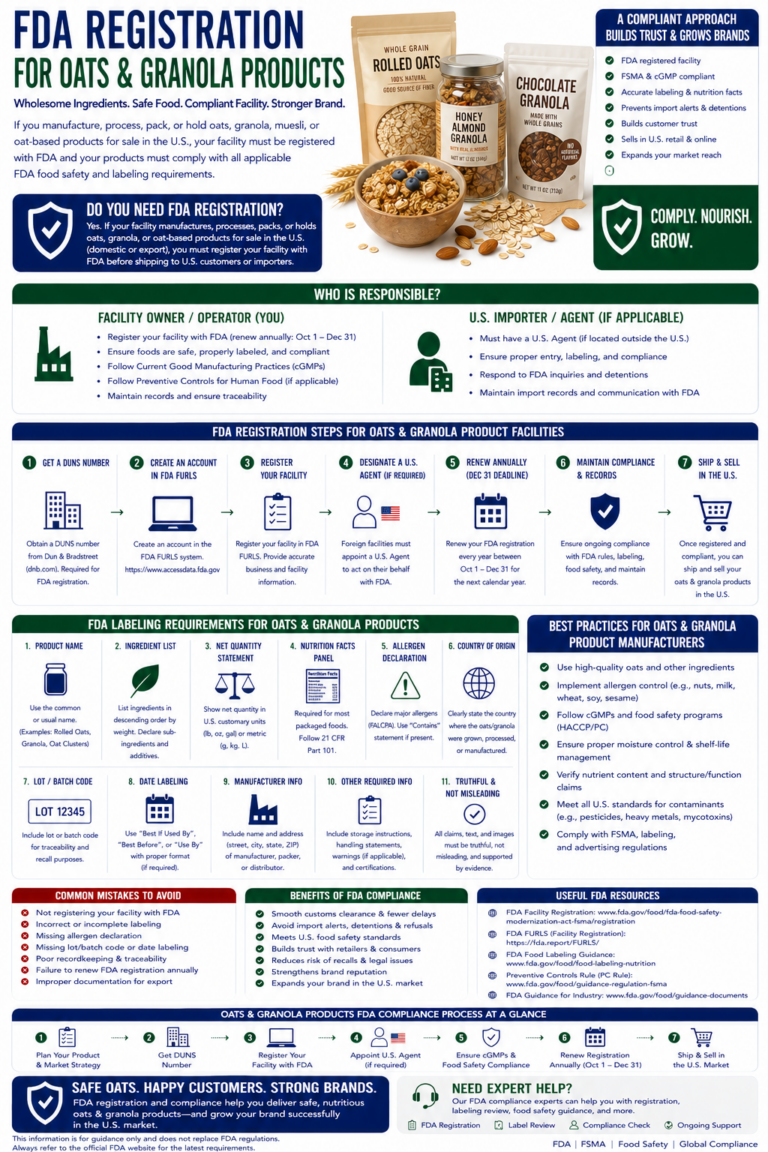
FDA Registration for Oats & Granola Products
What you probably don't need — and the three things that actually matter for oats and granola.
Key Takeaways
- Usually no process filing — dry/low-moisture, so not LACF or acidified.
- Gluten-free oats need proof — cross-contaminated by default; must test under 20 ppm.
- Granola is allergen-dense — tree nuts, peanuts, wheat, soy; watch cross-contact.
- Mind grain mycotoxins — aflatoxin and DON; a sourcing and testing issue.
- Claims are regulated — "high fiber," "heart healthy," "whole grain," added sugars.
- It's mostly a labeling category — get claims and allergens right.
What You Probably Don't Need
Unlike canned or jarred foods, oats and granola are shelf-stable because they're dry — low moisture, low water activity — not because of heat or acid. That keeps them outside the low-acid canned and acidified food rules:
So for oats and granola, the effort goes where it actually matters: the gluten-free claim, allergens, mycotoxins, and labeling.
The Gluten-Free Oats Trap
This is the one that catches oat producers most. Oats are naturally gluten-free — but that fact alone doesn't let you label them "gluten-free." The problem is cross-contamination: oats are commonly grown in rotation with wheat and barley, harvested with shared equipment, and processed alongside gluten grains, so ordinary oats regularly test above the gluten-free limit.
Granola Is Allergen-Dense
Granola packs more allergens into one product than almost any other snack — which makes allergen labeling a top risk area:
- Tree nuts — almonds, pecans, walnuts, cashews and more (FDA recognizes 12 tree nuts)
- Peanuts — common in clusters and bars
- Wheat — unless the product is gluten-free
- Soy — in lecithin, protein, and flavorings
- Sesame — in some seed blends (the ninth major allergen)
Grain Mycotoxins
Oats and other grains can carry mycotoxins — toxins from mold that can develop in the field or in storage. It's primarily a sourcing-and-testing issue rather than a labeling one:
Claims & Added Sugars
Granola markets hard on health, and every one of those claims is regulated:
- "High fiber," "good source of protein," "whole grain" — nutrient content claims with specific FDA definitions
- "Heart healthy" — a health claim with its own requirements
- "Healthy" — an FDA-defined term with conditions
- "Organic" — a USDA claim requiring certification, not an FDA one
- Added sugars — declared separately with a % Daily Value; granola is often high in them
Get Your Oats & Granola Market-Ready
FDA Registration Assistance handles facility registration and U.S. Agent, FSVP for imports, and a full label and claims review — including whether a gluten-free claim is properly supported, allergen declarations, added-sugar accuracy, and nutrient and health claims — plus guidance on mycotoxin controls.
Contact us at info@fdaregistrationassistance.com or call +1 (928) 275-8333. Food Facility Registration is available starting at $858. Trusted by companies across 135+ countries, with 15+ years of experience.
Frequently Asked Questions
1. Do oats and granola products need FDA registration?
Yes. Any facility that manufactures, processes, packs, or holds oats or granola must be registered with FDA, domestic or foreign, and foreign facilities need a U.S. Agent. The good news is that as dry, low-moisture products, oats and granola generally don't need the process filing (FCE/SID) that canned and acidified foods do — so registration, labeling, and a few product-specific issues are the main focus.
2. Do oats and granola need process filing (FCE/SID)?
Generally no. Process filing applies to low-acid canned and acidified foods, which are shelf-stable because of heat or acid. Oats and granola are shelf-stable because of low moisture (low water activity), so they typically fall outside the low-acid canned and acidified rules. Other food-safety requirements still apply, but the FCE and scheduled process burden usually doesn't.
3. Can I label my oats "gluten-free"?
Only if the product actually meets FDA's gluten-free standard — under 20 parts per million of gluten. Here's the catch specific to oats: oats are naturally gluten-free, but they're very commonly cross-contaminated with wheat, barley, or rye during growing, transport, and processing. So you can't simply call oats "gluten-free" — you need gluten-free sourcing (a purity protocol) and testing to confirm the product is under 20 ppm.
4. Why are oats a special case for gluten-free claims?
Because they're naturally gluten-free but easily contaminated. Oats are often grown in rotation with, or handled on equipment shared with, gluten-containing grains, so ordinary oats regularly test above the gluten-free threshold. Making a gluten-free oat product requires controlling that cross-contact from the field through processing and verifying it with testing — not just relying on the fact that oats themselves contain no gluten.
5. What allergens are common in granola?
Granola is allergen-dense: tree nuts, peanuts, soy, and wheat (unless gluten-free) are all common, and sesame appears in some blends. Allergens can also be hidden in compound ingredients like flavored clusters or coatings. All of the nine major allergens present must be clearly declared, and cross-contact risk — shared lines with nut-containing products — has to be managed and communicated.
6. Do I need to worry about mycotoxins in oats?
It's worth attention. Grains, including oats, can carry mycotoxins from mold in the field or storage. FDA has an action level for aflatoxin of 20 ppb in food and an advisory level for deoxynivalenol (DON, or vomitoxin) of 1 ppm in finished wheat products. Sourcing from reliable suppliers and testing where appropriate is the practical control — it's part of a supplier's food-safety plan and an importer's FSVP.
7. What claims do granola products commonly make — and are they regulated?
Very much so. "High fiber," "good source of protein," and "whole grain" are nutrient content claims with specific FDA definitions; "heart healthy" is a health claim with its own requirements; "healthy" is an FDA-defined term; and "organic" is a USDA claim requiring certification. Granola markets heavily on these, and unsupported claims are a common reason products get flagged, so each claim needs to meet its definition.
8. How are added sugars handled on granola labels?
Granola often contains significant added sugars — honey, syrups, dried-fruit coatings — and the Nutrition Facts panel must declare added sugars separately, with a percent Daily Value, under the current 2020 format. Because "healthy"-positioned granola can be high in added sugars, getting this declaration right (and not making claims the sugar content undercuts) matters.
9. Do bulk oats have different requirements than retail?
Yes. Bulk oats shipped to a manufacturer for further processing can qualify for a labeling exemption under 21 CFR 101.100, so they may not need a full retail label — but registration, ingredient lawfulness, and (for imports) FSVP still apply. Retail packaged oats and granola need the full label. There's a dedicated guide on bulk food ingredients for the details.
10. Do imported oats and granola need FSVP?
Yes. If imported, the U.S. importer holds FSVP and must verify the foreign supplier meets U.S. standards, with records available to FDA. For oats and granola, FSVP is a natural place to address supplier controls for gluten (if gluten-free) and mycotoxins, since both are supplier-driven risks.
11. What are the most common compliance issues for oats and granola?
Unverified gluten-free claims, incomplete allergen declarations (especially tree nuts and cross-contact), unsupported nutrient or health claims, added-sugar declarations that don't match the formulation, and ingredient lists that don't reflect the actual product. Most are labeling and claim issues rather than process-filing ones, which is typical for this dry-goods category.
12. Does registration mean FDA approved my granola?
No. FDA doesn't pre-approve food or facilities — registration just puts the facility on record. It doesn't certify your gluten-free claim, your allergen labeling, or your nutrient claims; those remain your responsibility. Registering is one required step, not an approval of the product.
13. How long does it take to get oats or granola compliant?
There's no single fixed number — registration is quick, and because these products usually don't need process filing, the timeline is driven mostly by label and claim review. If you're making a gluten-free claim, the sourcing and testing to support it is the piece that takes planning, so start there rather than at the label stage.
14. How does FDA Registration Assistance help oats and granola brands?
We handle facility registration and U.S. Agent, FSVP for imports, and a full label and claims review — including whether a gluten-free claim is properly supported, allergen declarations, added-sugar accuracy, and nutrient/health claims — plus guidance on mycotoxin controls. Starting at $858 for registration, for companies across 135+ countries. Contact info@fdaregistrationassistance.com or +1 (928) 275-8333.