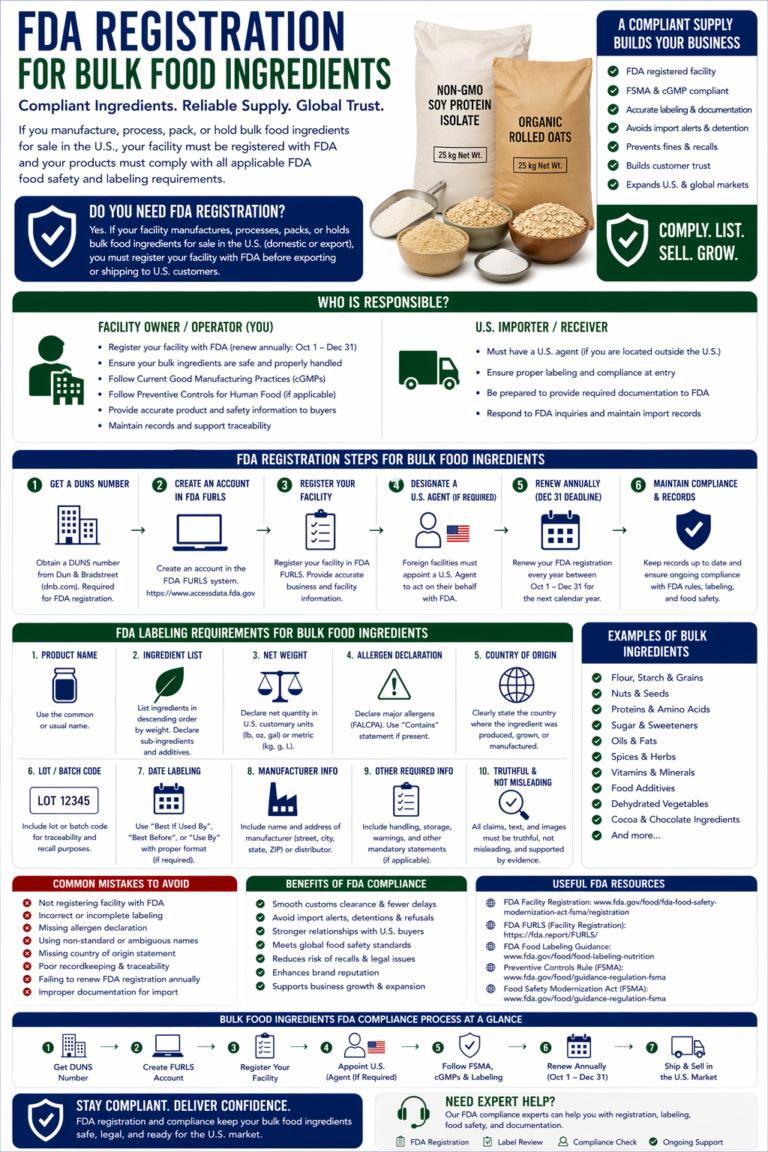
FDA Registration for Bulk Food Ingredients
What stays the same, what's different about bulk labeling, and where businesses trip up.
Key Takeaways
- The maker's facility registers — bulk or retail, registration is facility-based.
- The ingredient must be lawful — food additive, GRAS, or approved color additive.
- Bulk can skip retail labeling — under 21 CFR 101.100(d), conditionally.
- The exemption is labeling only — not registration, FSVP, or lawfulness.
- Allergens still travel — communicated to the buyer via documentation.
- Imports still need FSVP + prior notice — the bulk rule doesn't change that.
Bulk Ingredients vs Finished Products
Most of the compliance picture is identical to a finished product. One piece — labeling — is where "bulk" changes things:
Same as any food
- Facility registration — the maker registers
- U.S. Agent — for foreign facilities
- Ingredient lawfulness — additive, GRAS, or color additive
- FSVP & prior notice — for imports
Different for bulk
- Retail labeling — may be exempt if shipped for further processing
- Nutrition Facts panel — not required on the bulk container
- Conditions apply — operator match or written agreement
- Info travels differently — on the container or in documents
The Bulk Labeling Exemption — and Its Conditions
Under 21 CFR 101.100(d), a shipment of food that is, in the practice of the trade, to be processed, labeled, or repacked in substantial quantity at another establishment is exempt from the retail labeling requirements — including the consumer Nutrition Facts panel — if one of two conditions is met:
The exemption applies only if…
- Operator match — the person who introduced the shipment is the operator of the establishment where the food will be processed, labeled, or repacked; or
- Written agreement — the shipment is made under a signed written agreement (with addresses and specifications) ensuring the food won't be adulterated or misbranded after processing.
The Ingredient Still Has to Be Lawful
The labeling exemption says nothing about whether your ingredient is allowed. Every food ingredient must be lawful for its intended use, in one of these ways:
- An approved food additive — cleared for the use, within any limits
- Generally recognized as safe (GRAS) — for that use, on adequate scientific basis
- An approved color additive — listed and, where required, batch-certified
Common Bulk-Ingredient Mistakes
Get Your Bulk Ingredient Compliant
FDA Registration Assistance handles the full picture for bulk ingredient suppliers and importers: facility registration and U.S. Agent, a review of whether the ingredient is lawful for its intended use, FSVP for imports, and guidance on bulk versus retail labeling so you apply the 21 CFR 101.100 exemption correctly.
Contact us at info@fdaregistrationassistance.com or call +1 (928) 275-8333. Food Facility Registration is available starting at $858. Trusted by companies across 135+ countries, with 15+ years of experience.
Frequently Asked Questions
1. Do bulk food ingredients need FDA registration?
Yes. FDA Food Facility Registration is facility-based, so the facility that manufactures, processes, packs, or holds the bulk ingredient must be registered — foreign facilities also need a U.S. Agent. Selling in bulk to manufacturers rather than to consumers doesn't remove the registration requirement; the facility registers just as it would for a finished product.
2. What counts as a bulk food ingredient?
A food ingredient or input sold in large quantities — drums, totes, sacks, or bulk containers — to food manufacturers for use in making finished products, rather than packaged for retail sale to consumers. Flours, sweeteners, oils, proteins, extracts, and additives sold business-to-business are typical examples. The "bulk" element is about the trade channel and packaging, not the ingredient itself.
3. Do bulk ingredients need a full retail label?
Often not. Under 21 CFR 101.100(d), a shipment of food that is, in the practice of the trade, to be processed, labeled, or repacked in substantial quantity at another establishment can be exempt from the retail labeling requirements — like the consumer Nutrition Facts panel. But the exemption is conditional, and it doesn't remove registration, FSVP, or the requirement that the ingredient be lawful.
4. What are the conditions for the bulk labeling exemption?
Under 21 CFR 101.100(d), either the person who introduced the shipment is the operator of the establishment where the food will be processed, labeled, or repacked, or the shipment is made under a signed written agreement with specifications ensuring the food won't be adulterated or misbranded after processing. If neither condition is met, the exemption doesn't apply — and it becomes void if the food is adulterated or misbranded when it leaves that establishment.
5. Can I import unlabeled bulk ingredients?
In defined circumstances, yes. FDA's compliance policy allows unlabeled foods to be imported under the 21 CFR 101.100(d) exemption if the foreign shipper is the operator of the U.S. establishment where the food will be processed, labeled, or repacked, or the shipment is under a written agreement — and the U.S. operator is subject to FDA jurisdiction. It's a specific, conditional path, not a blanket allowance.
6. Does the bulk exemption apply to further processing a finished food?
No. The exemption is for ingredients to be processed, labeled, or repacked — not for additional processing of an already-finished food. For example, dried beans that will simply be canned aren't covered by the exemption, because that's further processing of a finished food. The distinction matters, so it's worth confirming your product actually qualifies.
7. Does the ingredient itself have to be lawful?
Yes, and this doesn't change for bulk. Every ingredient must be lawful for its intended use — an approved food additive, generally recognized as safe (GRAS), or an approved color additive. A novel ingredient may need a GRAS conclusion or a food additive petition before use. Selling in bulk doesn't exempt an ingredient from the lawfulness requirement; if anything, it puts it into many downstream products.
8. Do allergens still need to be communicated for bulk ingredients?
Yes. Even when a bulk container is exempt from the retail allergen label, allergen information still has to be communicated to the receiving manufacturer — typically through specifications, the certificate of analysis, or accompanying documents. The downstream manufacturer needs accurate allergen information to label its own finished product, so this can't be dropped just because the bulk container skips the retail format.
9. Do imported bulk ingredients need FSVP?
Yes. If the bulk ingredient is imported, the U.S. importer holds FSVP and must verify that the foreign supplier produces the ingredient to U.S. standards. Prior notice is also required before each shipment arrives. The bulk labeling exemption is separate from — and doesn't affect — these import obligations.
10. What information should be on a bulk container?
Even under the exemption, a bulk container generally needs enough information to identify the product and its handling — the ingredient identity, net quantity, lot, and the manufacturer or distributor — with the fuller information available on the container or in accompanying documents. The goal is that the receiving establishment has what it needs to use and later label the product correctly.
11. What are the common mistakes with bulk ingredients?
Assuming the labeling exemption applies without meeting its conditions; treating registration, FSVP, or ingredient lawfulness as if the bulk exemption covered them (it doesn't); failing to communicate allergen information downstream; and using an ingredient that isn't lawful for its intended use. Each of these can lead to detained shipments or misbranded downstream products.
12. Does registration mean my bulk ingredient is FDA approved?
No. FDA doesn't pre-approve foods, ingredients as a class, or facilities — registration simply puts the facility on record. Whether an ingredient is lawful depends on its additive, GRAS, or color-additive status, which is a separate question from registration. Registering doesn't certify or approve the ingredient; it's one required step among several.
13. How long does bulk ingredient compliance take?
There's no single fixed number — registration itself is relatively quick, but confirming ingredient lawfulness (especially for a novel ingredient needing a GRAS conclusion or food additive petition) can take much longer. The practical approach is to confirm the ingredient's status early, since that's the piece most likely to hold things up, not the registration.
14. How does FDA Registration Assistance help with bulk ingredients?
We handle the full picture for bulk ingredient suppliers and importers: facility registration and U.S. Agent, a review of whether the ingredient is lawful for its intended use, FSVP for imported ingredients, and guidance on bulk labeling versus retail labeling so you apply the 21 CFR 101.100 exemption correctly. Starting at $858 for registration, for companies across 135+ countries. Contact info@fdaregistrationassistance.com or +1 (928) 275-8333.