
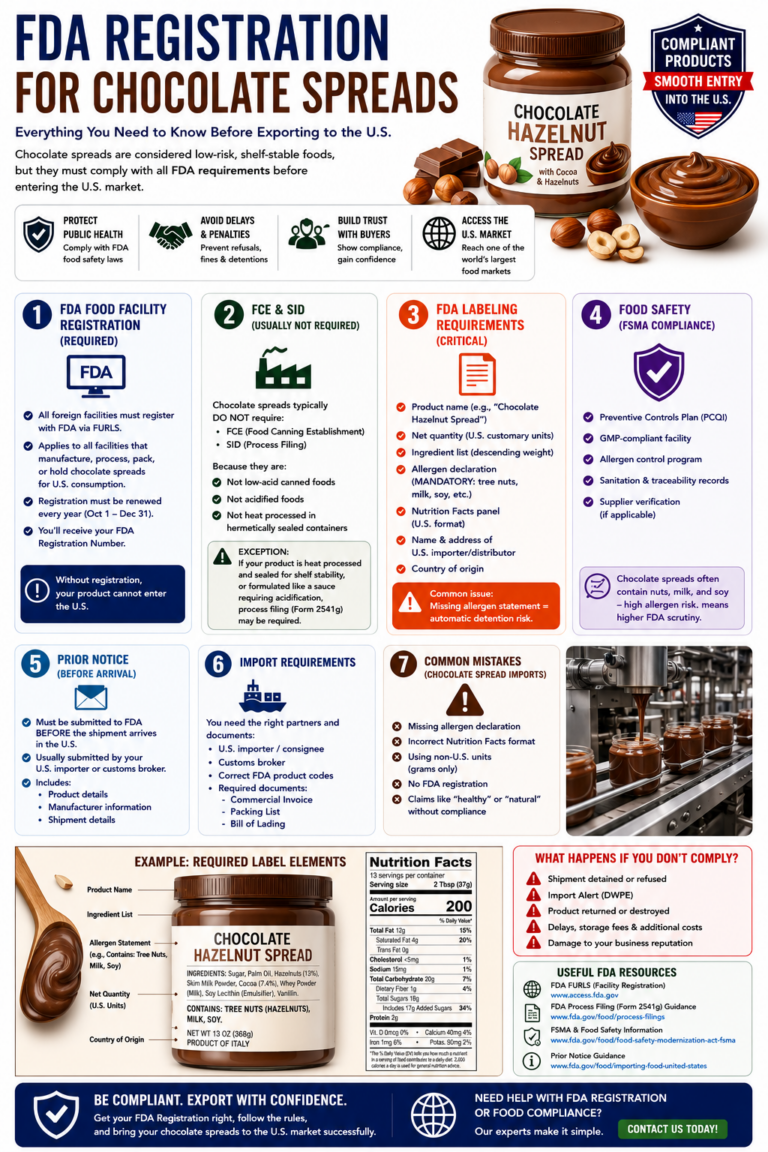
FDA Registration for Chocolate Spreads
Allergen density and the legal meaning of "chocolate" — the two things that decide a chocolate spread's compliance.
Key Takeaways
- No FCE/SID — low-moisture, shelf-stable, like nut butters.
- Allergen-dense — tree nuts, milk, and soy lecithin all commonly present.
- "Chocolate" is a legal term — only for a cacao-standard-compliant component.
- Milk/white/dark chocolate have minimums — composition standards in Part 163.
- Vegetable oil ≠ cocoa butter — then it's a coating or "chocolate flavored."
- No partially hydrogenated oils — PHOs are no longer GRAS.
Chocolate Spreads Are Allergen-Dense
This is why chocolate spreads are so strictly scrutinized: a single jar often carries three major allergens. A typical chocolate-hazelnut spread contains:
- Tree nuts — hazelnut (and sometimes almond or others); each must be named specifically
- Milk — from milk chocolate or added milk powder
- Soy — from soy lecithin, the common emulsifier
- Cross-contact — many spreads share equipment with other nut products, so advisory ("may contain") statements need careful, truthful handling
"Chocolate" Is a Legal Term
The word "chocolate" has a defined meaning. Under FDA's cacao product standards (21 CFR Part 163) and labeling policy, you may use "chocolate" only when the chocolate-flavoring ingredient complies with a cacao standard of identity:
| If your product's chocolate part… | You can call it… |
|---|---|
| Uses real cocoa / chocolate made with cocoa butter (meets a cacao standard) | "chocolate" (and "milk/dark chocolate" if it meets those composition minimums) |
| Uses vegetable oil instead of cocoa butter | a vegetable-fat coating (§163.150–163.155) or "chocolate flavored" — not plain "chocolate" |
| Uses real cocoa powder as the flavoring | chocolate/cocoa flavoring terms, used accurately |
No Partially Hydrogenated Oils
Chocolate spreads often use added fats and oils (palm oil is common), so this one matters:
Sugar, Claims & Imports
- Added sugars — spreads are high in sugar; declare Total and Added Sugars accurately (see added sugars)
- "Organic" — requires USDA organic certification; "natural" and "no palm oil" must be truthful and match the formula
- No disease claims — a spread is a food, not a health product
- FCE/SID not required — low-moisture, shelf-stable; no process filing
- FSVP for imports — verify allergen controls, PHO-free oils, and correct U.S. chocolate naming before the shipment arrives
Get Your Chocolate Spread U.S.-Ready
FDA Registration Assistance focuses on the two areas that catch chocolate spreads — a thorough allergen review (tree nuts, milk, soy, cross-contact) and the chocolate naming/standard-of-identity question (whether you can use "chocolate," "milk chocolate," etc., or need vegetable-fat-coating naming) — confirms your oils are PHO-free, reviews added sugars and claims, and handles registration, U.S. Agent, and FSVP for imports.
Contact us at info@fdaregistrationassistance.com or call +1 (928) 275-8333. Food Facility Registration is available starting at $858. Trusted by companies across 135+ countries, with 15+ years of experience.
Frequently Asked Questions
1. Do chocolate spreads need FDA registration?
Yes. Any facility that manufactures, processes, packs, or holds chocolate spreads for the U.S. market must be registered with FDA, and foreign facilities need a U.S. Agent. Chocolate spreads are low-risk from a processing standpoint, but registration, labeling (especially allergens), and (for imports) FSVP are all mandatory before sale.
2. Do chocolate spreads need FCE or SID filing?
No. Chocolate spreads are low-moisture, high-fat, shelf-stable foods — neither low-acid canned foods nor acidified foods — so they don't require Food Canning Establishment (FCE) registration or a scheduled process (SID). Like nut butters, their compliance effort is concentrated on allergen labeling, chocolate naming, ingredient lawfulness, and import verification rather than process filing.
3. What allergens do chocolate spreads have to declare?
Chocolate spreads are allergen-dense, which is why they're strictly scrutinized. A typical chocolate-hazelnut spread contains tree nuts (hazelnut, and sometimes almond or others), milk (from milk chocolate or milk powder), and soy (from soy lecithin, a common emulsifier). All major allergens present must be declared. Given how many spreads share equipment with other nut products, cross-contact and any advisory ("may contain") statements also need careful, truthful handling.
4. Can I call my product "chocolate" spread?
Only if the chocolate component qualifies. Under FDA's cacao product standards (21 CFR Part 163) and its labeling policy, you can use "chocolate" when the chocolate-flavoring ingredient complies with a cacao standard of identity — real cocoa or chocolate made with cocoa butter. A spread whose "chocolate" portion is made with vegetable oil instead of cocoa butter generally can't just be called "chocolate"; it has to use the vegetable-fat coating naming or be labeled "chocolate flavored." The word "chocolate" has a legal definition.
5. What are the standards for milk, dark, and white chocolate?
Each is standardized in Part 163. Milk chocolate must contain not less than 10% chocolate liquor and not less than 12% milk solids; white chocolate must contain at least 20% cocoa butter, at least 14% total milk solids, and not more than 55% sweetener; sweet and dark chocolates have their own minimums. So you can't label a component "milk chocolate," "white chocolate," or "dark chocolate" unless it meets the applicable composition — mislabeling here draws warning letters and detentions.
6. What if my spread uses vegetable oil instead of cocoa butter?
Then the chocolate portion generally isn't "chocolate" in FDA's sense. FDA has standards for "sweet chocolate and vegetable fat coating" and "milk chocolate and vegetable fat coating" (21 CFR 163.153 and 163.155) and for cocoa-and-vegetable-fat coatings — products that use vegetable fat other than cocoa butter. A spread using palm or other vegetable oil in place of cocoa butter should be named accordingly (a coating, or "chocolate flavored"), not simply "chocolate."
7. Can chocolate spreads contain partially hydrogenated oils?
No. Partially hydrogenated oils (PHOs) — the main dietary source of artificial trans fat — are no longer generally recognized as safe (GRAS), so they can't be used in food, including chocolate spreads. Fully hydrogenated oils are still permitted, but partially hydrogenated ones are not. Some older or imported formulations still contain PHOs, so it's worth confirming your oils and your supplier's specs are PHO-free.
8. How are added sugars handled on a chocolate spread?
Chocolate spreads are typically high in sugar, and the Nutrition Facts panel must declare Total Sugars and Added Sugars accurately (the sugar and any syrups added are added sugars). Serving size follows the reference amount for the category. Accurate sugar declarations matter both for compliance and because sugar content is a common area of consumer and regulatory attention for these products.
9. What claims can a chocolate spread make?
"Organic" requires USDA organic certification. Nutrient content claims ("reduced sugar," "good source of...") must meet their FDA definitions, and "natural," "no palm oil," or "hazelnut" claims have to be truthful and reflected in the formulation. A spread can't make disease claims. And the product name and any "chocolate" representation must match what the product actually is — the naming and the claims are both enforced.
10. Do imported chocolate spreads need FSVP?
Yes. Many chocolate-hazelnut spreads are imported, so the U.S. importer holds FSVP and must verify the foreign supplier meets U.S. standards, with prior notice before each shipment. For these products, verification should focus on allergen controls, the chocolate/oil ingredients (PHO-free, cocoa-vs-vegetable-fat), and correct U.S. naming and labeling — the areas most likely to cause an import problem.
11. Does registration mean FDA approved my chocolate spread?
No. FDA doesn't pre-approve food or facilities — registration just puts the facility on record. It doesn't certify your allergen labeling, your chocolate naming, or your ingredients; those remain your responsibility. A chocolate spread can be registered and still be misbranded (wrong "chocolate" naming or missing allergens) or adulterated (a non-permitted oil). FDA enforces at import and in the marketplace.
12. What are the most common compliance mistakes for chocolate spreads?
Missing or incomplete allergen declarations (especially soy lecithin or a secondary tree nut); calling a vegetable-oil product "chocolate" or "milk chocolate" when it doesn't meet the cacao standard; using partially hydrogenated oils; inaccurate added-sugars declarations; and unsupported "organic" or "no palm oil" claims. Allergens and chocolate naming are the two biggest, and both are strictly enforced.
13. Is a chocolate spread the same as a candy or confection?
Regulatorily it's treated as a conventional food and labeled by its common name (e.g., "chocolate hazelnut spread"), following the same registration, labeling, allergen, and ingredient rules. The chocolate naming standards and the allergen rules apply whether you think of it as a spread, a topping, or a confection. What matters is accurate identity, ingredients, and allergens — not the marketing category.
14. How does FDA Registration Assistance help with chocolate spreads?
We focus on the two areas that catch chocolate spreads: a thorough allergen review (tree nuts, milk, soy, and cross-contact) and the chocolate naming/standard-of-identity question (whether you can use "chocolate," "milk chocolate," etc., or need vegetable-fat-coating naming). We also confirm your oils are PHO-free, review added sugars and claims, and handle facility registration, U.S. Agent, and FSVP for imports. Starting at $858 for registration, for companies across 135+ countries. Contact info@fdaregistrationassistance.com or +1 (928) 275-8333.
