
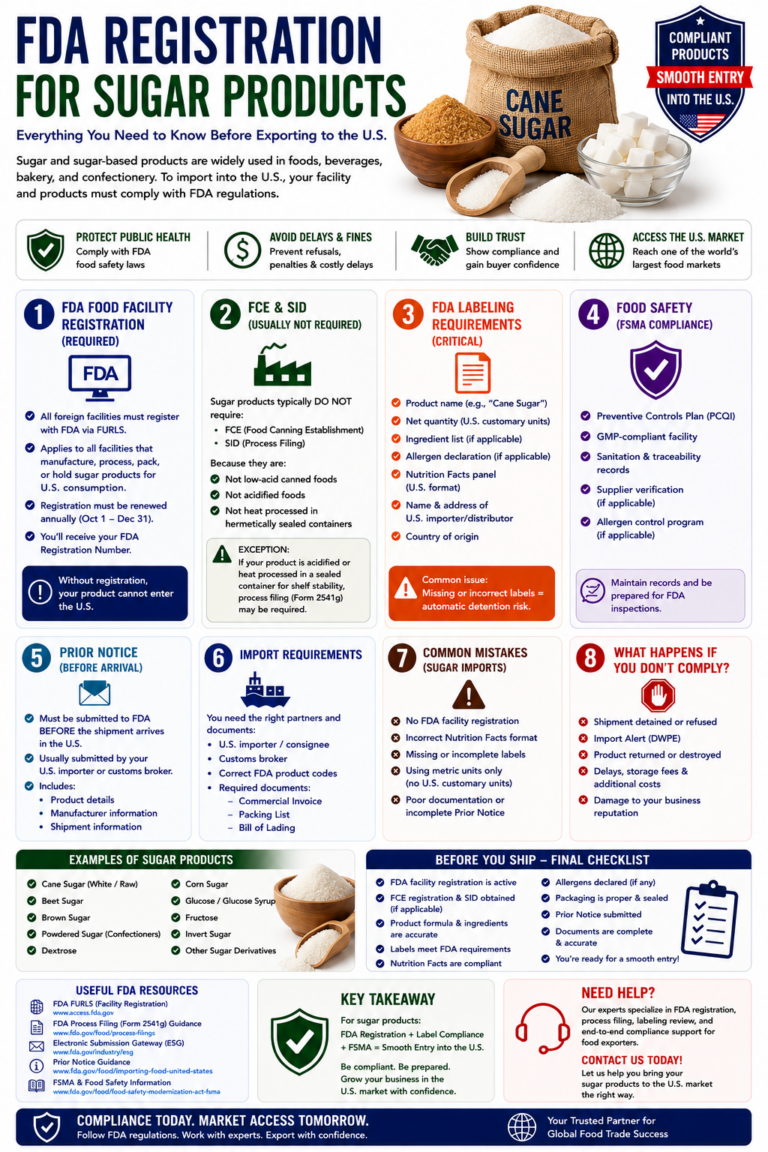
FDA Registration for Sugar Products
Why sugar skips process filing, the Added Sugars catch, and the syrup naming rules most sellers don't know.
Key Takeaways
- Sugar registers as a conventional food — facility registration + U.S. Agent if foreign.
- No FCE or SID — sugar isn't low-acid canned or acidified.
- The Added Sugars line applies — a single-ingredient sugar is added sugar.
- Syrups have standards of identity — 21 CFR Part 168 governs the name.
- Powdered sugar isn't single-ingredient — the cornstarch must be declared.
- "Raw sugar" and "organic" need care — accurate naming; USDA certification.
Sugar Skips Process Filing
Good news worth stating plainly, and the same as salt: sugar does not require FCE registration or a scheduled process (SID). It's neither a low-acid canned food nor an acidified food, and it doesn't rely on thermal processing for safety.
The Added Sugars Line
Here's the catch the "sugar is simple" assumption misses. The 2016 Nutrition Facts rule added an "Added Sugars" line to the panel — and a single-ingredient sugar or syrup you sell is, by definition, the added sugar someone puts in their food. So a package of sugar must address the Added Sugars line, not just Total Sugars.
Syrups Have Standards of Identity
If you make a syrup, its name has real legal content. 21 CFR Part 168 (Sweeteners and Table Sirups) sets standards of identity — a defined composition and required name — for each of these. You can't use the name unless the product meets the standard:
| Syrup / sweetener | Standard of identity |
|---|---|
| Cane sirup / sugar cane sirup | 21 CFR 168.130 |
| Maple sirup | 168.140 — ≥ 66% soluble solids from maple sap |
| Sorghum sirup | 168.160 |
| Table sirup | 168.180 — the standard for blended/flavored table syrups |
| Glucose sirup / dried glucose sirup | 168.120 / 168.121 |
| Dextrose (anhydrous / monohydrate) | 168.110 / 168.111 |
Powdered, Raw, Brown & Organic
- Powdered / confectioners' sugar — usually contains a small amount of cornstarch (anticaking) that must be declared; it isn't a single-ingredient product
- "Raw sugar" — true raw sugar isn't sold for direct consumption (not sufficiently purified), so "raw" products (turbinado) are partially refined; the name must be truthful — "turbinado sugar" is the accurate way
- Brown sugar — labeled as brown sugar with an accurate ingredient statement; added molasses is declared
- Liquid / invert sugar — its own product with its own naming; identity must match what it is
- "Organic" — requires USDA organic certification; you can't use it without it. "Natural" must be truthful
Get Your Sugar Products U.S.-Ready
FDA Registration Assistance handles facility registration and U.S. Agent, and reviews your labeling against the sugar-specific rules — the Added Sugars declaration, the Part 168 standard of identity for any syrup, additive declarations (like the starch in powdered sugar), product identity and "raw sugar" naming, and claims — plus FSVP and import documentation for imported sugar.
Contact us at info@fdaregistrationassistance.com or call +1 (928) 275-8333. Food Facility Registration is available starting at $858. Trusted by companies across 135+ countries, with 15+ years of experience.
Frequently Asked Questions
1. Do sugar products need FDA registration?
Yes. Sugar is a conventional food, so any facility that manufactures, processes, packs, or holds sugar for the U.S. market must be registered with FDA, and foreign facilities need a U.S. Agent. Sugar is low-risk from a processing standpoint, but registration, labeling, and (for imports) FSVP are still mandatory before it can be sold.
2. Do sugar products need FCE registration or a scheduled process?
No. Sugar is neither a low-acid canned food nor an acidified food, and it doesn't rely on thermal processing for safety — so it doesn't require Food Canning Establishment (FCE) registration or a scheduled process (SID). Like salt, sugar is one of the simpler food categories: the compliance effort is on facility registration, labeling, and import verification rather than process filing.
3. How is sugar shown on the Nutrition Facts panel?
This is the sugar-specific catch the 2016 Nutrition Facts rule created: the panel now has an "Added Sugars" line, and a single-ingredient sugar or syrup you sell is, by definition, an added sugar. So a package of sugar has to address the Added Sugars line, not just Total Sugars. FDA has specific guidance on how single-ingredient sweeteners handle this — including a footnote option for pure honey and pure maple syrup — but the added-sugars declaration can't simply be ignored.
4. What is the footnote option for honey and maple syrup?
For single-ingredient packages of pure honey and pure maple syrup, FDA allows a symbol (a "dagger") next to the Added Sugars percent Daily Value leading to a truthful footnote — because listing a gram amount of "added" sugars on a pure, single-ingredient product could mislead consumers into thinking sugar was added. The percent Daily Value still appears. This accommodation is specific to those pure single-ingredient products; blends and most other sugar products declare added sugars in the standard way.
5. Are there standards of identity for syrups?
Yes — and this catches syrup makers. 21 CFR Part 168 (Sweeteners and Table Sirups) sets standards of identity for cane sirup, maple sirup, sorghum sirup, table sirup, glucose sirup, dried glucose sirup, and dextrose. Each has a defined composition and a required name. You can't call a product "cane syrup," "glucose syrup," or "maple syrup" unless it meets the applicable standard — so the name you use on a syrup has real legal content behind it. ("Sirup" and "syrup" are interchangeable in the regulations.)
6. What does the maple syrup standard require?
Under 21 CFR 168.140, maple sirup is derived by concentration and heat treatment of maple tree sap (or by dissolving maple sugar made from that sap) and must contain not less than 66 percent by weight of soluble solids derived solely from that sap. So a product labeled "maple syrup" has to genuinely be maple and meet the solids standard — a maple-flavored table syrup is a different, separately standardized product (table sirup) and has to be named accordingly.
7. Does powdered or confectioners' sugar have extra ingredients?
Usually yes. Powdered (confectioners') sugar typically contains a small amount of an anticaking agent — most often cornstarch — to keep it free-flowing, and that ingredient must be declared in the ingredient list. So powdered sugar generally isn't a single-ingredient "sugar" product; its label has to name the added starch (or other anticaking agent). It's a common labeling miss.
8. Can I label my sugar as "raw sugar"?
Be careful with "raw sugar." True raw sugar isn't sold for direct human consumption because it isn't sufficiently purified, so products marketed as "raw sugar" (like turbinado) are actually partially refined. The name has to be truthful and not misleading about what the product is. Descriptive names like "turbinado sugar" or "washed raw sugar" are common ways to represent these products accurately.
9. What about brown sugar and liquid sugar?
Brown sugar (sugar with molasses, or partially refined) is labeled as brown sugar with an accurate ingredient statement; if molasses is added back, it's declared. Liquid sugar (sucrose dissolved in water) and invert sugar are their own products with their own naming and, in the case of standardized syrups, their own identity standards. Whatever the form, the product identity has to match what it actually is, and any added ingredients must be listed.
10. What claims are regulated on sugar products?
"Organic" requires USDA organic certification — you can't use it without it. "Natural" has to be truthful and not misleading. Nutrient content and health claims are limited on a pure sugar product (you're not going to make a "low sugar" claim on sugar), but claims about processing, source, or purity still have to be accurate. Misleading product identity or unsupported "organic" claims are among the most common sugar-label problems.
11. Do imported sugar products need FSVP?
Yes. If sugar is imported, the U.S. importer holds FSVP and must verify the foreign supplier meets U.S. standards, with records available to FDA, plus prior notice before each shipment. Sugar is low-risk, so the verification is usually straightforward, but the importer still needs the FSVP program in place and the foreign facility must be registered.
12. Does FDA approve sugar products before sale?
No. FDA doesn't pre-approve food or facilities — registration just puts the facility on record. Your sugar product still has to meet all applicable requirements, and FDA enforces compliance at import and in the marketplace. There's no "FDA approved" sugar; there's compliant sugar, produced in a registered facility with correct labeling and identity.
13. What are the most common compliance mistakes for sugar products?
Ignoring the Added Sugars line; naming a syrup that doesn't meet its standard of identity (calling something "maple syrup" or "cane syrup" when it isn't); failing to declare the cornstarch in powdered sugar; misusing "raw sugar"; and unsupported "organic" claims. Most are simple to avoid once you know sugar's specific labeling rules — the Added Sugars declaration and the Part 168 syrup standards especially.
14. How does FDA Registration Assistance help with sugar products?
We handle facility registration and U.S. Agent, and review your labeling against the sugar-specific rules — the Added Sugars declaration, the Part 168 standard of identity for any syrup, additive declarations (like the starch in powdered sugar), product identity and "raw sugar" naming, and claims — plus FSVP and import documentation for imported sugar. Starting at $858 for registration, for companies across 135+ countries. Contact info@fdaregistrationassistance.com or +1 (928) 275-8333.
