
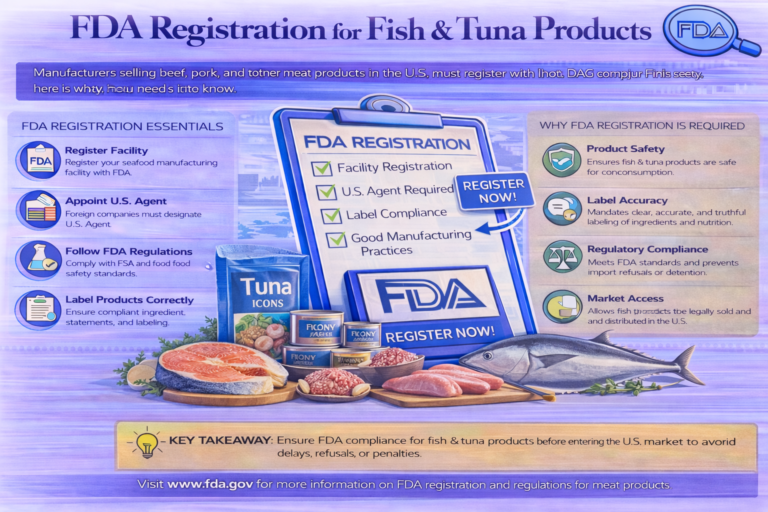
FDA Registration for Fish & Tuna Products
If you import or process fish and tuna, this page is the short version of what actually keeps your product moving — and where we come in.
Key Takeaways
- Histamine is tuna's #1 hazard — and it's heat-stable; you can't cook, freeze, or can it out.
- FDA guidance level: 50 ppm — a signal of temperature abuse, not just a number.
- Control is the cold chain from catch — verified at receiving with temp history + testing.
- Canned tuna isn't exempt — histamine survives the retort, so raw material must be clean.
- Tuna is a SIMP species — harvest-to-entry traceability runs alongside FDA rules.
- We build the program — Seafood HACCP, registration, U.S. Agent, SIMP, and FSVP.
Scombrotoxin: The Toxin You Can't Cook Out
Tuna and other scombroid fish carry high levels of the amino acid histidine in their muscle. Once the fish dies, if it isn't chilled fast, bacteria produce an enzyme that converts that histidine into histamine. Eat enough and you get scombroid poisoning — a rapid, allergic-type reaction (flushing, rash, burning, headache) that appears within minutes to a couple of hours.
The histamine level FDA uses for tuna, mahi-mahi, and related fish.
Not destroyed by freezing, cooking, smoking, curing, or canning.
Scombroid poisoning is consistently one of the most reported.
The Cold Chain, Starting at Catch
Since histamine can't be removed, HACCP for tuna is about keeping it from ever forming. That means controlling temperature at every step and proving it:
On the boat & in transit
Chill fish quickly after death and keep it cold. HACCP critical limits cover cooling rate, maximum fish size, time before chilling, and brine/ice ratios — whatever it takes to stop histamine-forming bacteria from getting started.
At receiving
Verify each lot with temperature history, sensory evaluation, and histamine testing against the 50 ppm guidance level. Receiving is your last chance to catch a temperature-abused lot before it enters your process.
Canned Tuna & the Parasite Exemption
Canned tuna isn't off the hook
Histamine formed in the raw fish survives the can, so canned-tuna safety depends on clean raw material and cold-chain control before the cook. And canned tuna is also a thermally processed low-acid canned food — so it carries commercial-sterility requirements too. See LACF and shelf-stable foods.
Raw tuna and parasites
Unlike most raw-consumption fish, certain large tuna species are exempt from parasite-destruction freezing — their parasite risk is considered negligible. It's a real exception (most other raw fish must be frozen to set parameters). For tuna, histamine, not parasites, stays the priority. See frozen foods.
Mercury & SIMP Traceability
Methylmercury
Large, long-lived tuna — bigeye, bluefin, albacore — carry more methylmercury; skipjack (canned "light" tuna) less. FDA and EPA publish eating-fish advice for pregnant women and children. It shapes sourcing and consumer advisories rather than a processing step.
SIMP traceability
Tuna is a priority species under NOAA's Seafood Import Monitoring Program, requiring harvest-to-entry records to fight illegal fishing and fraud. SIMP runs in parallel with FDA rules — see our SIMP guide.
From Catch to Cleared
Register & appoint a U.S. Agent
FDA facility registration; foreign facilities add a U.S. Agent.
Build a Seafood HACCP plan
Part 123 plan with species hazards — histamine first for tuna.
Control histamine at the cold chain
Chill from catch; verify at receiving (temp history, sensory, testing vs 50 ppm).
Handle SIMP & imports
Traceability for tuna; prior notice + supplier verification via the seafood importer route.
Label accurately
Correct Seafood List market name; fish allergen; Nutrition Facts & identity.
Verify & keep records
HACCP, histamine, and temperature records; renew every two years.
Build Your Seafood Compliance With Us
FDA Registration Assistance registers your facility, serves as U.S. Agent, and structures your Seafood HACCP plan around the real hazards — histamine control first for tuna — plus SIMP traceability, correct labeling, prior notice, and supplier verification. One team for the whole program.
Contact us at info@fdaregistrationassistance.com or call +1 (928) 275-8333. Food Facility Registration is available starting at $858. Trusted by companies across 135+ countries, with 15+ years of experience.
Frequently Asked Questions
1. Do fish and tuna products need FDA registration?
Yes. Facilities that manufacture, process, pack, or hold fish and tuna register with FDA, and a foreign facility also names a U.S. Agent. Seafood also carries extra requirements — mandatory Seafood HACCP, and for tuna, SIMP traceability — on top of facility registration.
2. What is the biggest hazard with tuna?
Histamine, also called scombrotoxin. Tuna is rich in histidine, and when the fish is temperature-abused after catch, bacteria convert that histidine into histamine. It causes scombroid poisoning — a rapid-onset reaction with flushing, rash, and burning — and it's consistently among the most reported seafood illnesses.
3. Can you cook or can histamine out of tuna?
No — this is the key point. Histamine is heat-stable: FDA states it is not destroyed by freezing, cooking, smoking, curing, or canning. Once it forms, it stays through every processing step, which is why it can't be fixed downstream and must be prevented from the moment of catch.
4. What is FDA's histamine limit for tuna?
FDA has set a guidance level of 50 ppm (50 mg/kg) for histamine in tuna, mahi-mahi, and related fish. If 50 ppm shows up in one section of a lot, other parts may be higher, so it signals a handling problem. Codex cites a 200 ppm health threshold internationally, but the U.S. decision level is 50 ppm.
5. How is histamine actually controlled?
Through the cold chain, starting at catch. Fish must be chilled quickly after death and kept cold, because histamine-forming bacteria grow when fish warms. In HACCP, controls include on-board handling limits (cooling rate, fish size, time before chilling) and checks at receiving: temperature history, sensory evaluation, and histamine testing.
6. Which fish are histamine formers?
Mainly the Scombridae family — tunas and mackerels — plus non-scombroid relatives like mahi-mahi (dolphinfish), bluefish, amberjack, sardines, herring, and anchovies. Tuna is the best-known because of its high histidine content, but the same control principles apply across all scombrotoxin-forming species.
7. Does canned tuna avoid the histamine problem?
No. Because histamine survives canning, any that formed in the raw fish before processing stays in the finished can. Good operations control it through high-quality raw material and cold-chain maintenance before the cook. Canned tuna is also a thermally processed low-acid canned food, so it carries commercial-sterility requirements too.
8. What about mercury in tuna?
Methylmercury is a real consideration, especially in large, long-lived tuna like bigeye, bluefin, and albacore; skipjack (canned "light" tuna) is lower. FDA and EPA publish advice about eating fish for pregnant women and young children. It informs sourcing and consumer advisories rather than a processing control.
9. Does raw tuna for sushi need to be frozen for parasites?
Generally no — certain large tuna species are specifically exempted from the parasite-destruction freezing that other raw-consumption fish require, because their parasite risk is considered negligible. For most other raw fish, freezing for parasite destruction is required (see our frozen foods page). For tuna, histamine remains the primary concern.
10. Is tuna covered by SIMP?
Yes. Tuna species are priority species under NOAA's Seafood Import Monitoring Program, which requires harvest-to-entry traceability to fight illegal fishing and fraud. SIMP is separate from FDA's requirements and runs in parallel — see our SIMP page.
11. Why is tuna so often mislabeled?
Seafood is one of the most substituted food categories, and tuna is a frequent target — for example, escolar sold as "white tuna." Using the correct market name from FDA's Seafood List and accurate species labeling matters: mislabeling can make a product misbranded and is a common enforcement issue.
12. Do fish importers use standard FSVP?
Not the standard version. Seafood importers whose foreign suppliers follow Seafood HACCP verify under the seafood-specific import rule (21 CFR 123.12) rather than general FSVP — through a compliant-country arrangement or written supplier verification. Our seafood importer page explains this distinction.
13. Why are tuna shipments detained so often?
The usual reasons are histamine control gaps (missing temperature or testing records), incomplete HACCP documentation, missing SIMP traceability, or labeling errors. Nearly all of them are preventable with a properly built plan — which is exactly what we set up.
14. How does FDA Registration Assistance help?
We register your facility, serve as U.S. Agent, and structure your Seafood HACCP plan around the real hazards — histamine first for tuna — plus SIMP traceability, correct Seafood List labeling, prior notice, and supplier verification. Starting at $858, for companies across 135+ countries. Contact info@fdaregistrationassistance.com or +1 (928) 275-8333.