
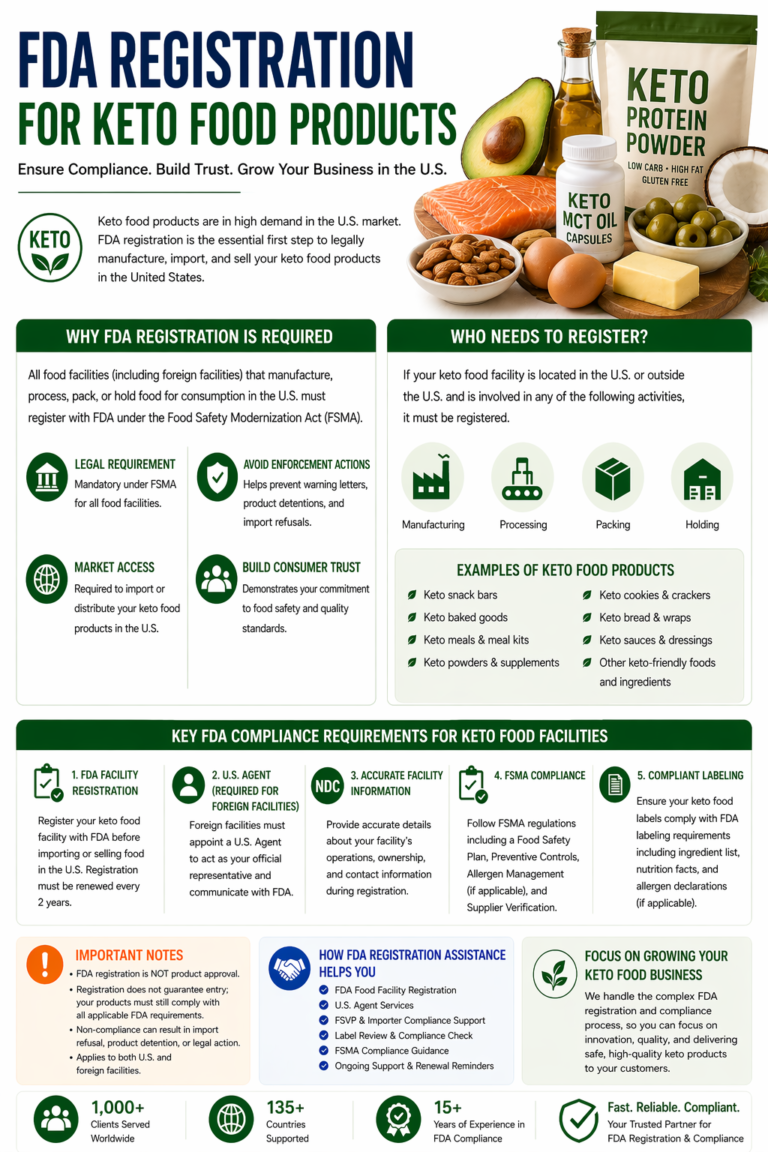
FDA Registration for Keto Food Products
Why "low carb" and "net carbs" aren't FDA claims, how the defined claims work, sweetener and allulose labeling, and the disease-claim line.
Key Takeaways
- FDA doesn't define "keto" — it's marketing; the claim must be truthful and not misleading.
- "Low carb" is not an authorized FDA claim — no threshold; implied-claim + litigation risk.
- "Net carbs" isn't FDA-recognized — not on the Nutrition Facts panel; marketing only.
- "Sugar free" / "no added sugar" ARE defined — meet them exactly (21 CFR 101.60).
- Allulose has its own rule — excluded from Total/Added Sugars, 0.4 kcal/g, still a carb.
- Disease claims = unapproved drug — "treats diabetes/epilepsy" is the bright line.
The Risk Is in the Claims, Not the Registration
Registering a keto food facility is the same as registering any food facility — "keto" positioning changes nothing. What makes keto products distinct is that they market themselves almost entirely through carbohydrate and sugar claims, and that's an area FDA has largely left undefined. The result is a mix of terms with very different legal footing, and it's easy to treat a marketing word as if it were a regulated fact.
What Each Keto Term Means to FDA
| Label term | FDA status |
|---|---|
| "Keto" / "keto-friendly" | Marketing term — no FDA definition; must be truthful & not misleading |
| "Low carb" / "low carbohydrate" | Not an authorized claim — no threshold; implied-claim + litigation risk |
| "Net carbs" | Not FDA-recognized — not on Nutrition Facts; marketing only, must be truthful |
| "Sugar free" | Defined: <0.5 g sugars per serving (21 CFR 101.60) — meet it exactly |
| "No added sugar" | Defined: strict conditions (101.60(c)(2)) — meet it exactly |
| Disease claim (treats diabetes/epilepsy) | Turns the food into an unapproved drug — prohibited |
Sugar Alcohols & Allulose
Keto products swap sugar for sweeteners, and each carries its own labeling:
- Sugar alcohols (erythritol, xylitol, sorbitol, maltitol) — declared under Total Carbohydrate, ~2–3 kcal/g; a laxative-effect statement may be needed where overconsumption is foreseeable. They aren't counted as "sugars," so a product can be "sugar free" while containing them
- Allulose — under 2020 FDA guidance, you may exclude it from Total Sugars and Added Sugars and use a calorie value as low as 0.4 kcal/g — but it must still be included in Total Carbohydrate and the ingredient statement
- High-intensity sweeteners (stevia, monk fruit, sucralose) — declared in the ingredient list
- Dietary fiber — only FDA-recognized fibers can be listed as "dietary fiber"; others count as total carbohydrate (which matters for any net-carb math)
Don't Turn a Food Into a Drug
The most serious keto mistake isn't a carb miscount — it's a health claim. Claiming that your product treats, prevents, or manages a disease (diabetes, epilepsy, and so on) makes it an unapproved new drug in FDA's eyes and misbranded — no matter what the clinical literature on ketogenic diets says.
- Disease claims are prohibited — on a conventional food or a supplement alike
- Weight-loss claims are heavily scrutinized — keep them substantiated and modest
- Exogenous ketones / MCT / "keto pills" — usually dietary supplements (Supplement Facts), a different framework with the same disease-claim limits
Get Your Keto Products Compliant
FDA Registration Assistance handles registration and — where the real risk is — reviews the label: making sure your Nutrition Facts are correct, your sugar/sweetener claims meet their FDA definitions, your sugar alcohols and allulose follow the guidance, your "keto / low carb / net carb" marketing stays truthful and not misleading, and you steer clear of disease claims. Plus U.S. Agent and FSVP for imports.
Contact us at info@fdaregistrationassistance.com or call +1 (928) 275-8333. Food Facility Registration is available starting at $858. Trusted by companies across 135+ countries, with 15+ years of experience.
Frequently Asked Questions
1. Do keto food products require FDA registration?
Yes — keto foods are regulated as ordinary food, so a facility that manufactures, processes, packs, or holds them for the U.S. registers with FDA (foreign facilities also need a U.S. Agent). "Keto" positioning doesn't reduce any requirement. But registration is the easy part; for keto brands the real regulatory exposure is on the label, in the claims — because most keto buzzwords aren't FDA-authorized claims.
2. Does the FDA define "keto"?
No. FDA does not define "keto" or "keto-friendly" — they're marketing terms. That means there's no FDA threshold you meet to earn the word; instead, the claim is judged by the general standard that applies to everything on a label: it must be truthful and not misleading. If a "keto-friendly" product would blow past a normal daily carb budget in a couple of servings, the claim can be challenged as misleading in context.
3. Can I put "net carbs" on my label?
"Net carbs" is not an FDA-recognized measurement. There is no FDA definition for it, it does not appear on the Nutrition Facts panel, and the common calculation (total carbohydrate minus fiber and sugar alcohols) is not standardized. You can reference net carbs as a marketing term, but it cannot replace the required Nutrition Facts data, and it must be truthful and not misleading — the only FDA-regulated carbohydrate figures are Total Carbohydrate, Dietary Fiber, and Total/Added Sugars. Treat "net carbs" as marketing, not a regulated fact.
4. Is "low carb" an approved FDA claim?
No — and this surprises people. FDA has defined nutrient content claims for things like "low fat" and "low sodium," but it has never set a threshold for "low carbohydrate." So total carbs must be disclosed on every label, yet the product may not be characterized as "low" carb under an authorized claim. FDA can still evaluate "low carb" as an implied nutrient content claim, and the FTC and class-action plaintiffs have been active on misleading low-carb claims. It's a real litigation risk, not a safe default.
5. Which claims keto products use ARE defined by FDA?
The sugar claims. "Sugar free" means less than 0.5 g of sugars per serving (21 CFR 101.60), and "no added sugar" / "no sugar added" has strict conditions — essentially no sugars or sugar-containing substitutes added in processing. These are the claims you must meet to the letter. Note that sugar alcohols aren't counted as "sugars," so a sugar-alcohol-sweetened product can be "sugar free" — but you still declare the sugar alcohols and, if the product isn't low-calorie, add the required calorie disclosure.
6. How do I label sugar alcohols and sweeteners?
Sugar alcohols (erythritol, xylitol, sorbitol, maltitol) are declared under Total Carbohydrate and provide roughly 2–3 kcal/g; when overconsumption is reasonably foreseeable, a laxative-effect statement may be needed. High-intensity sweeteners (stevia, monk fruit, sucralose) are declared in the ingredient list. Each of these is a distinct labeling task — see our sweeteners guide for the specifics.
7. How is allulose treated on the label?
Allulose has its own FDA rule. Under 2020 FDA guidance, you may exclude allulose from Total Sugars and Added Sugars, and use a calorie value as low as 0.4 kcal/g — but allulose must still be included in Total Carbohydrate and declared in the ingredient statement. It's a favorite keto sweetener precisely because of this treatment, but the label has to follow the guidance exactly.
8. Can I say my keto product helps with diabetes or weight loss?
Be very careful. Claiming that a food treats, prevents, or manages a disease — diabetes, epilepsy, and so on — turns it into an unapproved new drug in FDA's eyes and makes it misbranded, regardless of whether a ketogenic diet has clinical uses. Weight-loss claims are heavily scrutinized too. General structure/function-style statements have more room, but the disease line is bright and crossing it is one of the most serious mistakes a keto brand can make.
9. Are exogenous ketones and MCT products regulated the same way?
Often they're dietary supplements, not conventional foods. Exogenous ketone drinks/powders, MCT oil capsules, and "keto pills" are frequently marketed and formulated as supplements, which means Supplement Facts labeling and the supplement regulatory framework rather than the conventional-food one. The classification determines the rules, so settle it early — and the disease-claim limits apply just as strongly to supplements.
10. What allergens matter for keto products?
Keto formulations lean on almond and coconut flour, dairy, eggs, and nuts — so major allergens are common and must be fully declared (sesame is now the 9th). Because keto baked goods and snacks swap conventional flour and sugar for these ingredients, allergen mapping is often more involved than for the conventional version of the same product.
11. Does importing keto food require anything extra?
Yes — the standard import requirements: the foreign facility registers with FDA and keeps a U.S. Agent, and the U.S. importer runs FSVP with prior notice for each shipment. Keto positioning changes none of this. And imported keto products must carry U.S.-compliant labels, which is where foreign "low carb"/"net carb" labeling frequently fails to meet U.S. rules.
12. Does FDA approve keto foods?
No. FDA doesn't pre-approve food products or their labels. You register your facility, make sure your Nutrition Facts and claims comply, and keep marketing terms truthful; FDA (and the FTC) enforce afterward. Because keto claims sit in an area FDA has largely left undefined, the burden is on you to keep them defensible — there's no approval to hide behind.
13. What are the most common mistakes keto brands make?
Treating "net carbs" as a regulated figure; assuming "low carb" is a safe authorized claim; missing the exact conditions for "sugar free" or "no added sugar"; mislabeling sugar alcohols or allulose; and drifting into disease claims (diabetes, weight loss). The pattern is the same: keto's regulatory risk lives in the claims, and the claims are mostly governed by truthful-labeling standards rather than a neat keto rulebook.
14. How does FDA Registration Assistance help with keto food products?
We handle registration and, just as importantly, review the label where the real risk is: making sure your Nutrition Facts are correct, your sugar/sweetener claims meet their FDA definitions, your sugar alcohols and allulose are labeled to the guidance, your "keto/low carb/net carb" marketing stays truthful and not misleading, and you steer clear of disease claims. Plus U.S. Agent and FSVP for imports. Registration is available starting at $858, for companies across 135+ countries. Contact info@fdaregistrationassistance.com or +1 (928) 275-8333.
