
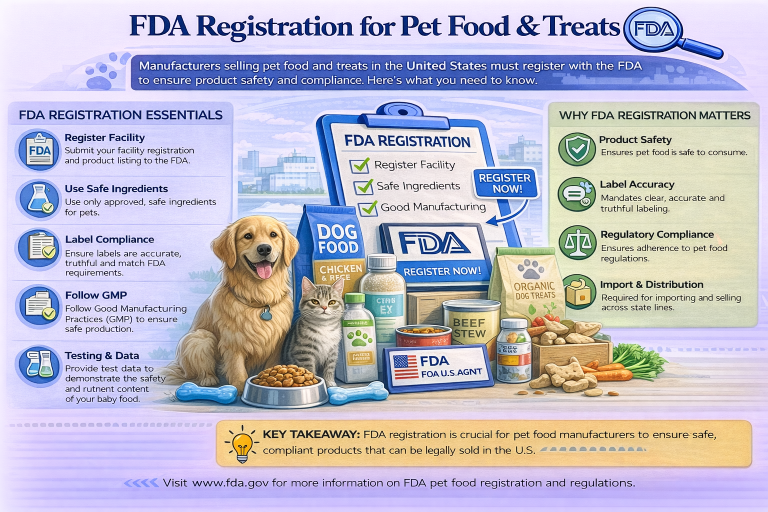
FDA Registration for Pet Food & Treats
"It's just a treat" is exactly the mindset FDA flags at the border. Treats carry real requirements — they're just different ones.
Key Takeaways
- Treats are animal food — same framework as pet food, not a lighter one.
- Facility registers (foreign + U.S. Agent); production follows 21 CFR Part 507.
- Treats aren't "complete and balanced" — they're intermittent/supplemental.
- Health claims are a trap — disease/function claims can make a treat a "new animal drug."
- Ingredients must be lawful — approved additive, GRAS, prior-sanctioned, or AAFCO-defined.
- The FDA-AAFCO MOU expired Oct 1, 2024 — new-ingredient review is shifting to FDA.
Treat vs. Complete Food
Complete & balanced food
- Provides full daily nutrition
- Must meet AAFCO nutrient profiles or pass feeding trials
- Carries a nutritional adequacy statement
Treat / snack / chew
- Given occasionally — not a whole diet
- Labeled for intermittent or supplemental feeding
- Not required to be "complete and balanced"
What Goes on a Treat Label
| Element | Notes | Source |
|---|---|---|
| Product identity | What the product is (e.g. "dog treats") | Federal (FDA) |
| Net quantity | Amount of product | Federal (FDA) |
| Ingredient list | Common/usual names, descending by weight | 21 CFR 501.4 |
| Firm name & address | Manufacturer, packer, or distributor | Federal (FDA) |
| Guaranteed analysis | Min/max of key nutrients | State / AAFCO model |
| Intended-use & feeding | "Treat," "intermittent feeding," directions | State / AAFCO model |
Claims & Ingredients
The drug-claim trap
A claim to treat, prevent, or cure disease — or to affect the body beyond normal nutrition — can make a treat an unapproved "new animal drug." "Relieves anxiety," "cures itching," and strong "joint repair" claims are frequent triggers. Nutritive and taste statements are fine; disease claims are not.
Lawful ingredients only
Every ingredient must be an approved additive, GRAS for that use/species, prior-sanctioned, or AAFCO-defined. Not every human-food ingredient qualifies for animal food, and some — such as CBD — aren't approved for animal food at all.
Bringing a Treat to Market
Register the facility
The maker/packer/holder registers as an animal food facility; foreign facilities add a U.S. Agent.
Meet preventive controls
Evaluate how 21 CFR Part 507 applies — CGMPs plus hazard analysis and controls where needed.
Confirm ingredients are lawful
Approved additive, GRAS, prior-sanctioned, or AAFCO-defined for the species and use.
Build a compliant label
Identity, net quantity, ingredients, guaranteed analysis, intended use, firm info — no drug claims.
Handle imports
Registration, U.S. Agent, FSVP, and prior notice all in place before shipping.
Keep it current
Renew every two years and revisit labels and ingredients as products change.
Get Your Pet Treats to Market Compliantly
FDA Registration Assistance registers pet food and treat facilities, serves as U.S. Agent, reviews treat labels and claims, checks ingredient status, and supports FSVP and prior notice for imports — so nothing surfaces at the border.
Contact us at info@fdaregistrationassistance.com or call +1 (928) 275-8333. Trusted by companies across 135+ countries, with 15+ years of experience.
Frequently Asked Questions
1. Do pet treats need FDA registration?
The facility that makes, packs, or holds treats registers with FDA as an animal food facility, and foreign facilities need a U.S. Agent. Treats, chews, and snacks are animal food, so the pet-food framework applies. Registration isn't product approval.
2. Are treats regulated less strictly than pet food?
No — same core rules: registration, preventive controls (21 CFR Part 507), safe ingredients, truthful labeling. The difference is nutritional — treats are "intermittent/supplemental," so they aren't labeled "complete and balanced." That's a labeling distinction, not a lighter standard.
3. Why aren't treats "complete and balanced"?
That claim means the product is full daily nutrition and must meet AAFCO nutrient profiles or feeding trials. Treats are occasional, so they're labeled for intermittent/supplemental feeding instead. A treat claiming complete and balanced would have to meet those standards.
4. What has to be on a pet treat label?
Federally: product identity, net quantity, an ingredient list by common name in descending weight order (21 CFR 501.4), and firm name/address. State rules based on the AAFCO model add a guaranteed analysis, intended-use statement, and feeding directions. Nothing false or misleading.
5. Can a treat make health claims?
Be careful — a claim to treat, prevent, or cure disease, or to affect the body beyond nutrition, can make a treat an unapproved "new animal drug." "Supports joint health" or "calming" claims are frequent triggers. Nutritive and taste statements are generally fine.
6. What ingredients can I use?
Only lawful ones — an approved additive, GRAS for that use/species, prior-sanctioned, or AAFCO-defined. Not every human-food ingredient is cleared for animal food, and some (e.g., CBD) aren't approved for animal food.
7. Did the FDA-AAFCO relationship change?
Yes — the FDA-AAFCO MOU expired October 1, 2024. Ingredients already defined in AAFCO's Official Publication generally remain acceptable per their definitions (FDA's GFI #293), but FDA now reviews new animal food ingredients itself, which can make clearing a novel ingredient slower.
8. Do treats fall under preventive controls?
Generally yes — treat makers are among the facilities that must evaluate 21 CFR Part 507: CGMPs plus hazard analysis and preventive controls where needed. Some small or qualified facilities have modified requirements.
9. Do I need a Nutrition Facts panel?
No — treats don't use the human Nutrition Facts panel. They use animal-food labeling: identity, net quantity, ingredients, and (under AAFCO-based state rules) a guaranteed analysis and feeding info.
10. What about importing pet treats?
Imported treats need a registered foreign facility with a U.S. Agent, prior notice per shipment, compliant labeling, and an importer FSVP. Jerky treats and chews draw particular scrutiny at import.
11. Who's responsible — me or my supplier?
If you import, you carry the U.S.-side responsibility. Assuming the manufacturer handles it is a costly mistake — FSVP, prior notice, and confirming registration fall on the importer. See our food importer guide.
12. Is "FDA registered" the same as "FDA approved"?
No — registration tells FDA a facility exists and what it does; it isn't approval of the treat. "FDA approved" based on registration is inaccurate.
13. Is compliance a one-time task?
No — registration renews every two years, records stay current, and each import needs prior notice. New products or reformulations mean revisiting labels and ingredient checks.
14. How does FDA Registration Assistance help?
It registers pet food and treat facilities, serves as U.S. Agent, reviews labels and claims, checks ingredient status, and supports FSVP and prior notice, for companies across 135+ countries. Contact info@fdaregistrationassistance.com or +1 (928) 275-8333.