
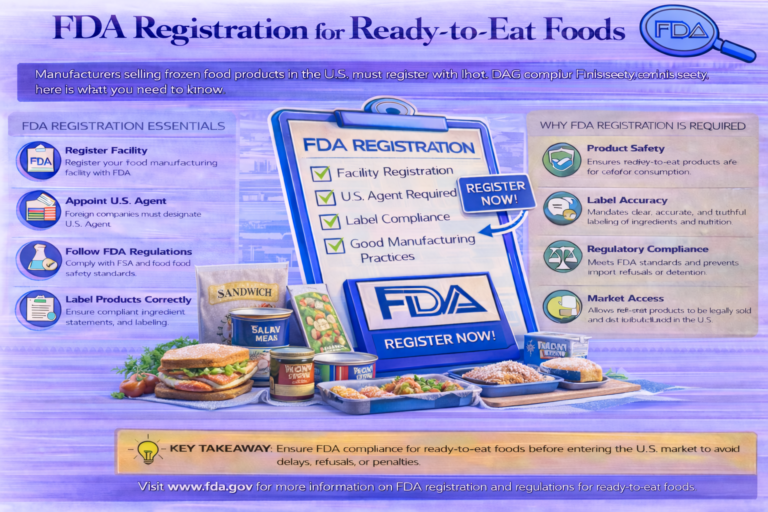
FDA Registration for Ready-to-Eat Foods
Yes — FDA-regulated RTE foods need facility registration. But registration is the easy part. The real work is keeping Listeria out of a food that will never be cooked again.
Key Takeaways
- No consumer kill step — whatever's at packaging reaches the plate.
- Listeria is the whole game — grows cold, persists in the plant, severe illness.
- Zero tolerance — presence of L. monocytogenes = adulterated (§402).
- Two questions set your controls: post-lethality exposure? supports growth?
- Environmental monitoring, Zones 1–4 — find harborage before it finds product.
- Most RTE is FDA — deli meats, hot dogs, pâté are USDA (9 CFR 430).
Why Listeria Owns Ready-to-Eat
Plenty of pathogens matter in food. Only one combines all three of the traits that make RTE uniquely dangerous — which is why FDA built an entire control philosophy around it:
Unlike most pathogens, it multiplies slowly at refrigeration temps, across the whole shelf life.
It persists in drains, floors, and equipment, then recontaminates finished product.
Listeriosis has a high hospitalization and fatality rate in pregnant, elderly, and immunocompromised people.
Two Questions That Set Your Controls
FDA's approach turns on two questions about your specific product and process. The answers decide how much control — and how much monitoring — you need.
| Question | If yes… | If no… |
|---|---|---|
| 1. Exposed to the environment after the lethality step, before packaging? | Higher risk — "post-lethality exposed." Environmental monitoring and strict sanitation become central. | Lower risk — a listericidal treatment in the sealed package largely closes the recontamination door. |
| 2. Does the food support L. monocytogenes growth? | You need a growth-limiting (listeristatic) control and get more scrutiny over shelf life. | Growth is inherently limited by the product itself, lowering the concern. |
Environmental Monitoring & the Zone System
Environmental monitoring means swabbing and testing the plant, not just the product — hunting for Listeria harborage before it can contaminate food. FDA's guidance organizes the plant into risk zones:
| Zone | What it is | Examples |
|---|---|---|
| Zone 1 | Food-contact surfaces | Slicer blades, conveyor belts, filler nozzles, utensils |
| Zone 2 | Non-food-contact, near the product | Equipment framing and housings, adjacent surfaces |
| Zone 3 | Broader processing area | Floors, drains, walls, forklifts, wheels |
| Zone 4 | Outside processing | Hallways, entryways, locker rooms, cafeterias |
Listericidal vs Listeristatic Controls
Listericidal — kill it
A validated step that destroys L. monocytogenes — cooking, pasteurizing, or a post-lethality treatment. The controls must be adequate under the conditions of manufacture 117.80(a)(4) and validated.
Listeristatic — starve it
Formulation that prevents growth — controlling pH or water activity, or adding antimicrobials like lactate and diacetate. Foods are generally treated as non-growth when pH is ~4.4 or lower, aw is ~0.92 or lower, or the product is frozen.
Most RTE Is FDA — But Not All
FDA
- Salads, dips, hummus, prepared meals
- Smoked fish, soft cheeses, RTE snacks
- Facility registration + Part 117 — the path we handle
USDA
- Deli meats, hot dogs, pâté (RTE meat & poultry)
- The "Listeria Rule" — 9 CFR 430, three Alternatives
- See the meat products guide
From Product to Compliant
Confirm FDA vs USDA
Most RTE is FDA; deli meats, hot dogs, and pâté are USDA.
Answer the two questions
Post-lethality exposure? Supports growth? These set your control level.
Build the Listeria controls
Sanitation, hygienic zoning, and a listericidal and/or listeristatic control — validated.
Run environmental monitoring
Zone 1–4 sampling; seek and destroy harborage before it reaches product.
Register, label & import
FDA registration + U.S. Agent; allergen labeling; prior notice + FSVP for imports.
Verify, react & record
Act on positives, keep records, renew every two years, reassess on change.
Get Your RTE Food Compliant
FDA Registration Assistance registers your facility, serves as U.S. Agent, and helps you frame the Listeria preventive controls — environmental monitoring, zoning, sanitation, and growth controls — inside your food-safety plan, along with labeling, prior notice, and FSVP.
Contact us at info@fdaregistrationassistance.com or call +1 (928) 275-8333. Food Facility Registration is available starting at $858. Trusted by companies across 135+ countries, with 15+ years of experience.
Frequently Asked Questions
1. Do ready-to-eat foods need FDA registration?
Yes, for FDA-regulated RTE foods — salads, dips, hummus, smoked fish, soft cheeses, prepared snacks, and most packaged RTE items. The facility registers with FDA, and a foreign facility also names a U.S. Agent. The main exception is RTE meat and poultry (deli meats, hot dogs, pâté), which are USDA-regulated.
2. What makes ready-to-eat foods different?
There's no consumer kill step. RTE foods are eaten without further cooking that would significantly reduce biological hazards, so whatever is present at packaging reaches the consumer. That makes Listeria monocytogenes — not a cook step — the central compliance concern.
3. Why is Listeria the defining RTE hazard?
Three reasons: it grows even at refrigeration temperatures throughout shelf life; it persists in the processing environment (drains, floors, equipment) and recontaminates product; and listeriosis is severe, with high hospitalization and fatality rates in vulnerable groups. No other common foodborne pathogen combines all three.
4. What is FDA's zero-tolerance policy?
For RTE foods, the presence of Listeria monocytogenes makes the food adulterated under section 402 of the FD&C Act — there's no acceptable level. That's why prevention (sanitation and environmental control) matters far more than end-product testing alone. FSMA kept zero tolerance in place.
5. What two questions set my level of control?
First: is the food exposed to the environment after the lethality step, before packaging? (Post-lethality exposure is higher-risk.) Second: does the food support L. monocytogenes growth? Together they determine whether you need environmental monitoring, sanitation controls, and a listericidal or listeristatic control — and how intensive each must be.
6. What is environmental monitoring, and what are the zones?
It's swabbing and testing the plant — not just product — to find Listeria harborage before it contaminates food. FDA's zone system: Zone 1 (food-contact surfaces), Zone 2 (non-food-contact near product), Zone 3 (broader processing area — floors, drains), Zone 4 (outside processing). Under 117.165(a)(3), it's required when environmental-pathogen contamination of an RTE food is a hazard requiring a preventive control.
7. What is "seek and destroy"?
Aggressively hunting Listeria harborage — many samples, tracing positives back to their source (vector swabbing), and physically eliminating the niche — rather than testing to "pass." A positive is information to act on, not a failure to hide. FDA's 2017 guidance incorporates this approach.
8. Listericidal vs listeristatic — what's the difference?
A listericidal control kills L. monocytogenes (a validated cook or post-lethality treatment). A listeristatic control prevents growth through formulation (controlling pH, water activity, or adding antimicrobials like lactate and diacetate). Many RTE plans use both.
9. Which foods "support growth" of Listeria?
It depends on product characteristics. Foods are generally treated as not supporting growth when pH is about 4.4 or lower, water activity is about 0.92 or lower, or the product is frozen — or when a validated formulation holds growth in check. Foods that do support growth need a growth-limiting control and get more scrutiny.
10. Are RTE deli meats and hot dogs FDA or USDA?
USDA. RTE meat and poultry — deli meats, hot dogs, pâté — are regulated by USDA/FSIS under the "Listeria Rule" (9 CFR 430), which sets post-lethality controls through three Alternatives. Most other RTE foods are FDA. See our meat products page for the full split.
11. What is the 2017 FDA Listeria guidance?
FDA's 2017 draft guidance, "Control of Listeria monocytogenes in Ready-To-Eat Foods," updates the 2008 version and helps Part 117 facilities control L. monocytogenes when an RTE food is exposed to the environment before packaging without a downstream listericidal or listeristatic control. It's a nonbinding draft, but reflects FDA's current thinking on monitoring, zoning, and sanitation.
12. How does RTE fit into a Part 117 plan?
The hazard analysis identifies L. monocytogenes as a hazard requiring a preventive control; the plan then specifies sanitation controls, hygienic zoning, environmental monitoring, and any listericidal or listeristatic control — each validated and verified, with corrective actions defined in advance.
13. Do RTE importers need a U.S. Agent and FSVP?
Yes. A foreign RTE facility needs a U.S. Agent, each import needs prior notice, and the importer maintains an FSVP — which for RTE should verify the supplier's Listeria controls and environmental monitoring, not just finished-product paperwork.
14. How does FDA Registration Assistance help?
We register your facility, serve as U.S. Agent, and help frame the Listeria preventive controls — environmental monitoring, zoning, sanitation, growth controls — inside your Part 117 plan, plus labeling, prior notice, and FSVP. Starting at $858, for companies across 135+ countries. Contact info@fdaregistrationassistance.com or +1 (928) 275-8333.
