
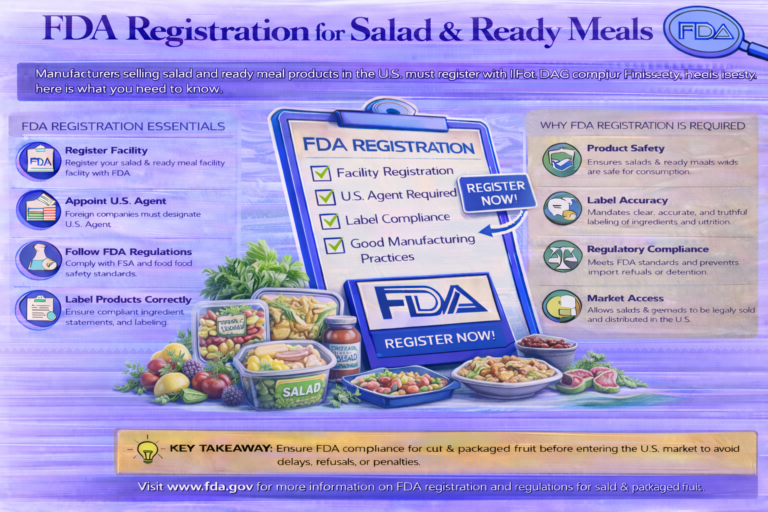
FDA Registration for Salad & Ready Meals
Why fresh-cut leafy greens are the highest-risk RTE food — and the Produce Safety Rule, Listeria controls, and traceability that come with them.
Key Takeaways
- Highest-risk RTE food — no kill step, built on outbreak-prone leafy greens.
- Produce Safety Rule (21 CFR 112) — governs the growing/harvesting side.
- Preventive controls + Listeria monitoring — the fresh-cut facility's core duty.
- FSMA 204 traceability — leafy greens, fresh-cut, and deli salads are on the FTL.
- Compliance extended to July 20, 2028 — from the original Jan 2026 date.
- Fresh-cut processor registers — a retail salad bar is generally exempt.
The Highest-Risk Ready-to-Eat Food
Packaged salads combine the two things that most worry food-safety regulators. They're ready-to-eat with no kill step — nothing cooks out a pathogen before the consumer eats them — and they're built on fresh leafy greens, the commodity most frequently implicated in serious outbreaks. Romaine lettuce alone has been tied to five or more E. coli O157:H7 outbreaks since 2017, and leafy greens are also linked to Listeria, Salmonella, and Cyclospora.
Three Layers of Oversight
A salad business usually touches all three — from field to finished pack:
| Layer | What it covers | Rule |
|---|---|---|
| Produce Safety Rule | Growing, harvesting, packing, holding of the greens (water, worker hygiene) | 21 CFR 112 (farm side) |
| Preventive controls + Listeria EM | Fresh-cut processing, sanitation, environmental monitoring, cold chain | 21 CFR 117 (facility) |
| FSMA 204 traceability | Lot-level records for leafy greens, fresh-cut produce, RTE deli salads | 21 CFR Part 1, Subpart S |
FSMA 204 Traceability & Salads
Salads are squarely in scope for FDA's Food Traceability Rule. Fresh leafy greens, fresh-cut fruits, and fresh-cut vegetables are all on the Food Traceability List (FTL) — and so are ready-to-eat deli salads (potato, pasta, egg salad). Foods that contain a listed food as an ingredient are covered too, which pulls in most composed salads.
- Lot-level linked records — Key Data Elements captured at Critical Tracking Events across your supply chain
- Produce to FDA within 24 hours — of a request, in a sortable electronic form; retain records for two years
- Extended compliance date — originally January 20, 2026, now proposed July 20, 2028, with FDA not intending to enforce before then
- Use the extra time — a salad recall is exactly the scenario this rule targets, so build the records now
Salad Kits Are Multi-Component
- Greens — produce-safety and traceability rules
- Dressing — may be an acidified or shelf-stable product with its own controls
- Croutons — a wheat allergen; cheese — dairy; protein — meat/poultry can pull in USDA
- Allergens across the whole kit — wheat, milk, egg, soy, tree nuts, fish (in some dressings); sesame is now the 9th
Get Your Salads & Ready Meals Compliant
FDA Registration Assistance handles registration and U.S. Agent, reviews your label (identity, allergens across all components, keep-refrigerated), and helps align what makes salads distinct: preventive controls with Listeria environmental monitoring, the produce-safety and cold-chain expectations, and FSMA 204 traceability recordkeeping — plus FSVP for imports.
Contact us at info@fdaregistrationassistance.com or call +1 (928) 275-8333. Food Facility Registration is available starting at $858. Trusted by companies across 135+ countries, with 15+ years of experience.
Frequently Asked Questions
1. Do salads and ready meals require FDA registration?
Yes — a facility that processes, packs, or holds packaged salads or salad-based ready meals for the U.S. registers with FDA (foreign facilities also need a U.S. Agent). A fresh-cut or salad-assembly operation is a food facility, not just a farm. The exception is a retail salad bar selling directly to consumers, which is generally a retail food establishment and exempt from FDA registration — though still governed by state/local food-safety rules.
2. Why are packaged salads considered the highest-risk food?
Because they combine two risk factors: they're ready-to-eat with no kill step (the consumer doesn't cook them), and they're built on fresh leafy greens, the single food category most often tied to serious outbreaks. Romaine lettuce alone has driven five or more E. coli O157:H7 outbreaks since 2017, and leafy greens are also linked to Listeria, Salmonella, and Cyclospora. Cutting and bagging create moist, exposed surfaces where any surviving pathogen can spread.
3. Does "triple-washed" make a salad safe?
Washing reduces but does not eliminate pathogens — there's no wash step that reliably sterilizes leafy greens, which is exactly why they're high-risk RTE foods. "Triple-washed" or "ready to eat" tells the consumer no further washing is expected, but it doesn't remove your food-safety obligations. Safety comes from controlling contamination upstream (growing, water, handling) and from sanitation and Listeria control at the facility, not from the wash alone.
4. What is the Produce Safety Rule and does it apply?
The Produce Safety Rule (21 CFR 112) sets standards for the growing, harvesting, packing, and holding of covered produce — including leafy greens — covering things like agricultural water, worker hygiene, and equipment. It governs the farm side of your supply chain. Once produce is cut, bagged, or assembled into salads, that processing step is a facility activity subject to preventive controls, so most salad operations touch both frameworks.
5. What food-safety plan does a fresh-cut salad facility need?
A preventive-controls food-safety plan under 21 CFR 117, built around the RTE nature of the product. The centerpiece is Listeria monocytogenes control: because Listeria grows even at refrigeration and there's no kill step, facilities run rigorous sanitation and environmental monitoring programs, plus cold-chain control and date marking. Hazard analysis should also address the incoming produce (pathogens from the field) and any other components.
6. Are salads covered by the FSMA 204 traceability rule?
Yes — prominently. Fresh leafy greens, fresh-cut fruits, and fresh-cut vegetables are all on FDA's Food Traceability List, and so are ready-to-eat deli salads (potato, pasta, egg salad). Foods that contain a listed food as an ingredient are also covered. That means salad businesses must keep enhanced, lot-level records — Key Data Elements at Critical Tracking Events — and be able to produce them to FDA within 24 hours of a request, retaining them for two years.
7. When does FSMA 204 traceability take effect?
The original compliance date was January 20, 2026, but in March 2025 FDA proposed a 30-month extension to July 20, 2028, and has said it doesn't intend to enforce before then. The requirement itself isn't going away, so the practical advice is to use the extra time to build the lot-level linked records now — especially since a salad recall is exactly the scenario the rule is designed for.
8. How are salad kits with multiple components handled?
Each component on its own, then as an assembly. A salad kit might combine leafy greens (produce/traceability rules), a dressing (which may be an acidified or shelf-stable product with its own controls), croutons (a wheat allergen), cheese (dairy), and a protein (which, if it's meat or poultry, can pull in USDA). Allergens must be captured across the whole kit. For the broader ready-meal analysis, see our ready meals guide.
9. What labeling do packaged salads need?
A compliant Nutrition Facts panel, full ingredient list, allergen declaration, and accurate product identity — plus, in practice, clear handling/keep-refrigerated and use-by information given the perishability. Salad kits with dressings and toppings often carry several allergens (wheat, milk, egg, soy, tree nuts, fish in some dressings), so allergen accuracy across all components is essential.
10. Is temperature control really that critical?
Yes. These are refrigerated RTE foods where Listeria can grow during storage and transport, so an unbroken cold chain is central to both safety and shelf life. That extends to shipping: the FSMA Sanitary Transportation rule expects temperature control and documentation in transit. Temperature abuse is one of the most common reasons salad shipments are detained or spoil.
11. Does importing salads require anything extra?
Yes. The foreign facility registers with FDA and keeps a U.S. Agent, and the U.S. importer runs FSVP with prior notice for each shipment. On top of that, imported leafy greens and fresh-cut produce are FSMA 204 traceability foods, so the traceability records must extend across the border — and the cold chain has to hold through international transit, which is a frequent failure point.
12. Does FDA approve salads or ready meals?
No. FDA doesn't pre-approve food. You register your facility, implement the preventive-controls plan (with Listeria control), keep the traceability records, label correctly, and maintain the cold chain; FDA enforces at the facility and, for imports, at the border. Given the outbreak history of leafy greens, these products are among the most closely watched — so the compliance has to be real, not just documented.
13. What's the most common mistake with salad products?
Underestimating the Listeria/environmental-monitoring burden and the traceability recordkeeping. Many operators treat a salad like any packaged food, when in fact it's a high-risk RTE product built on the most outbreak-prone commodity there is, with both a facility food-safety plan and lot-level traceability to maintain. Treating produce safety, Listeria control, and traceability as one integrated program is what keeps these products compliant.
14. How does FDA Registration Assistance help with salads and ready meals?
We handle registration and U.S. Agent, review your label (identity, allergens across all components, keep-refrigerated), and help align the pieces that make salads distinct: preventive controls with Listeria environmental monitoring, the produce-safety and cold-chain expectations, and FSMA 204 traceability recordkeeping — plus FSVP for imports. Registration is available starting at $858, for companies across 135+ countries. Contact info@fdaregistrationassistance.com or +1 (928) 275-8333.
