
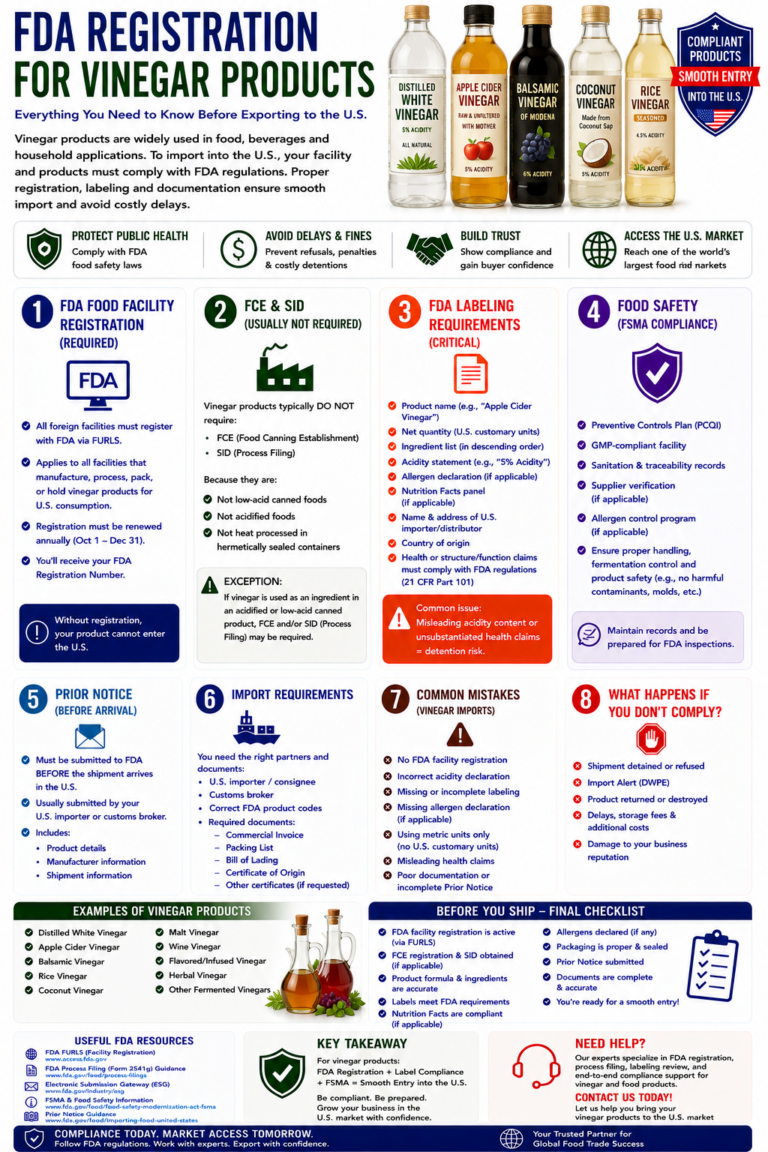
FDA Registration for Vinegar Products
What FDA actually requires for vinegar — the facility registration, the vinegar labeling rules, and where pickled products cross into acidified foods.
Key Takeaways
- Vinegar = food → food facility registration (free, biennial, DUNS; U.S. Agent if foreign).
- Facility, not product — FDA doesn't register or approve the vinegar itself.
- Must be fermented — diluted synthetic/glacial acetic acid isn't "vinegar" (CPG 525.825).
- Label by type & strength — cider/wine/malt/distilled; ≥4% acetic acid ("40 grain"); dilution statement if reduced.
- Plain vinegar ≠ acidified food; but vinegar-based pickled products (pH ≤ 4.6) = acidified foods → FCE + scheduled process.
- Imports add U.S. Agent + FSVP + Prior Notice.
Vinegar Is a Food — Register the Facility
- Food facility registration — free ($0), renewed every two years, with a DUNS number
- U.S. Agent — required if your vinegar facility is foreign (U.S. Agent)
- Facility, not product — FDA doesn't register or approve the vinegar itself (facility vs product)
- A number, not a certificate — don't buy an "FDA vinegar certificate"
Vinegar Labeling & Identity (CPG 525.825)
- Must be fermented — vinegar is made by acetic fermentation; diluted synthetic/glacial acetic acid is not vinegar and can't be labeled as such
- Label by type — cider/apple, wine/grape, malt, sugar, glucose, spirit/distilled/grain; blends list each type in order of predominance
- ≥4% acetic acid — about 4% acidity, the "40 grain" standard
- Dilution statement — if diluted with water, label "diluted with water to ___ percent acid strength" (never below 4%)
- Standard food label elements — identity, net quantity, ingredients, responsible party, Nutrition Facts where required
Plain Vinegar vs. Vinegar-Based Products
| What you make | What applies |
|---|---|
| Vinegar itself (cider, white distilled, wine) | Food facility registration + correct vinegar labeling. Not an acidified food — no FCE/scheduled process just for being vinegar |
| Vinegar-based acidified products (pickles, some salsas, chow-chow, hot sauces) | Food facility registration PLUS acidified-foods requirements: FCE registration + scheduled process (21 CFR 114), reviewed by a process authority |
| Fermented foods (sauerkraut, kimchi, kombucha) | A separate category — acid comes from fermentation, generally not treated as "acidified foods" |
The Import Layer
- Foreign facility registration + U.S. Agent
- FSVP — your U.S. importer verifies the foreign supplier
- Prior Notice — for each shipment before arrival
- Compliant U.S. labeling — correct vinegar type, acidity, English
- Acidified-foods FCE/scheduled process — if it's a vinegar-based pickled/acidified product
Vinegar Compliance, Handled
FDA Registration Assistance handles the whole picture for vinegar and vinegar-based products: food facility registration (and U.S. Agent for foreign producers), DUNS, a labeling review against FDA's vinegar policy (type, acidity/"grain," dilution statements, fermented-not-synthetic), and — for vinegar-based pickled/acidified products — the acidified-foods FCE and scheduled process filing, plus FSVP/Prior Notice for imports. We keep our fee separate from the $0 government registration fee and are clear that registration isn't approval.
Contact us at info@fdaregistrationassistance.com or call +1 (928) 275-8333. An independent compliance firm serving 1,000+ companies across 135+ countries, with 15+ years of experience.
Frequently Asked Questions — Vinegar Products
1. Does vinegar need FDA registration?
Vinegar is a food, so the facility that makes/processes/packs/holds it generally must have FDA food facility registration (free, renewed every two years, with a DUNS number; foreign facilities also need a U.S. Agent). Note it's facility registration - FDA doesn't register or approve the vinegar product itself. So "FDA registration for vinegar" means registering your facility, plus making sure the product is compliant (labeling, identity) - and, for vinegar-based pickled products, possibly an acidified-foods filing.
2. Is my vinegar "FDA approved"?
No - FDA doesn't "approve" vinegar (or most food). Registration is administrative and facility-based, and FDA issues a number, not a certificate. So you can't market vinegar as "FDA approved" or buy an "FDA vinegar certificate." The accurate description is that your facility is registered and your product is compliant. See our food product registration explainer for the facility-vs-product distinction.
3. What are FDA's labeling rules for vinegar?
FDA's Compliance Policy Guide for vinegar (CPG 525.825) is the key reference. There's no formal standard of identity, but the CPG sets labeling policy: vinegar should contain at least 4 grams of acetic acid per 100 mL (about 4% acidity, "the 40 grain" standard); it must be labeled by type (cider, wine, malt, distilled/spirit, etc.) based on how it's made; and if it's diluted with water, the label must state "diluted with water to ___ percent acid strength" (never below 4%). Blends list each vinegar type in order of predominance.
4. Does vinegar have to be fermented?
Yes - to be called "vinegar." FDA recognizes that diluted synthetic (glacial) acetic acid is NOT vinegar: vinegar is produced by acetic fermentation. FDA considers it misleading to label or imply a food is vinegar (or made with vinegar) when it actually contains diluted acetic acid, and acetic acid should not be substituted for vinegar in pickled foods. So a water-and-acetic-acid solution can't be sold as "vinegar" - that's a misbranding/adulteration issue.
5. What types of vinegar does FDA recognize?
The CPG lists varieties classified by starting material and method: cider/apple vinegar, wine/grape vinegar, malt vinegar, sugar vinegar, glucose vinegar, and spirit/distilled/grain vinegar - plus blends and "vinegar made from dried apples/cores/peels" (labeled accordingly). More specialized types (balsamic, rice, flavored/seasoned vinegars like garlic or tarragon) are also sold. The point is to label the vinegar by what it actually is, so the name isn't misleading.
6. Is vinegar an "acidified food" that needs an FCE and scheduled process?
Plain vinegar on its own is a naturally high-acid, fermented food - it is NOT an "acidified food," so simply making vinegar doesn't trigger the acidified-foods requirements. BUT if you use vinegar to acidify low-acid foods - pickled vegetables, some salsas, chow-chow, many hot sauces - and the finished product reaches an equilibrium pH of 4.6 or below, that product is an acidified food, which requires registering a Food Canning Establishment (FCE) and filing a scheduled process (reviewed by a process authority). See our acidified foods page.
7. So where's the line — vinegar vs. vinegar-based products?
Think of it in two buckets. Bucket 1 - bottling/selling vinegar itself (cider, white distilled, wine vinegar): food facility registration + correct vinegar labeling; no acidified-foods filing just for being vinegar. Bucket 2 - making products that use vinegar to acidify low-acid ingredients (pickles, salsas, hot sauces, dressings with low-acid components): food facility registration PLUS the acidified-foods requirements (FCE + scheduled process). Which bucket you're in determines the filings. We help you figure out which applies.
8. What about fermented products like sauerkraut or kimchi?
Those are a different category. Fermented foods (sauerkraut, kimchi, kombucha, some pickles) get their acidity from microorganisms producing acid during fermentation - they're generally treated as fermented foods, not "acidified foods" (which are low-acid foods to which acid like vinegar is added). The distinction matters because it changes whether the acidified-foods FCE/scheduled-process requirements apply. If you ferment rather than add vinegar/acid, the analysis is different - we help classify it correctly.
9. What has to be on a vinegar label?
A compliant food label: the statement of identity (the correct vinegar type, e.g., "Apple Cider Vinegar"), net quantity of contents, ingredient declaration (naming each vinegar type used; blends in order of predominance), the acidity if applicable (and the "diluted with water to ___%" statement if reduced), Nutrition Facts where required, allergen info if any, and a responsible-party name/address. For vinegar-based products, the ingredients and any acidified-food considerations also apply. See our food product registration page.
10. Do I need a DUNS number and U.S. Agent for vinegar?
A DUNS number: yes - it's the Unique Facility Identifier required for food facility registration (free, must match your facility). A U.S. Agent: only if your facility is foreign - foreign vinegar producers must designate a U.S. Agent as part of registration. A domestic vinegar maker needs the DUNS and registration but not a U.S. Agent. We can obtain/verify the DUNS and serve as your U.S. Agent if you're overseas.
11. What do I need to import vinegar into the U.S.?
For imported vinegar: the foreign facility registered with FDA (with a U.S. Agent); FSVP (your U.S. importer verifies the foreign supplier); Prior Notice for each shipment; compliant U.S. labeling (correct vinegar type, acidity, English); and, if it's a vinegar-based acidified product, the FCE/scheduled process. Vinegar itself is usually straightforward, but vinegar-based pickled imports carry the acidified-foods layer. See our food import regulations page.
12. What are "vinegar eels" and does FDA care?
Vinegar eels (Turbatrix aceti) are harmless nematodes that can appear in unfiltered or unpasteurized vinegar - they feed on the "mother" of vinegar. FDA's vinegar CPG addresses them as a filth/adulteration concern: while not a health hazard, their presence is an aesthetic/quality defect FDA considers adulteration. Filtration and pasteurization control them. It's a niche point, but it's literally in the title of FDA's vinegar guidance, so quality-minded producers manage for it.
13. Does flavored or infused vinegar change anything?
Flavored/infused vinegars (garlic, herb, fruit) are still vinegar-based, but added ingredients can matter: the label must declare them, allergens must be flagged, and if low-acid ingredients are added such that the product behaves like an acidified food (or raises safety concerns like botulism risk with garlic-in-oil-type products), additional controls or acidified-foods requirements may apply. So a simple herb vinegar is usually fine, but check formulations with low-acid add-ins. We can review yours.
14. Is "cleaning vinegar" regulated by FDA?
If a vinegar is sold strictly as a cleaning product (not food), it falls outside FDA's food rules and into consumer-product/EPA territory depending on claims - but if it's marketed for food use or as food-grade, the food rules apply. The Vinegar Institute's position is that a product labeled "cleaning vinegar" should actually contain vinegar. If you straddle food and non-food uses, the classification (and which agency applies) depends on how you market it - we can help sort that out.
15. Does registering mean I can skip the labeling/acidified rules?
No - registration and product compliance are separate. Registering your facility is necessary, but it doesn't make a mislabeled vinegar compliant, and it doesn't substitute for the acidified-foods FCE/scheduled process if you make vinegar-based pickled products. You need both: the facility registered AND the product (labeling, identity, acidified-foods filing where applicable) correct. We handle both sides so nothing falls through.
16. How does FDA Registration Assistance help vinegar producers?
We handle the whole picture for vinegar and vinegar-based products: food facility registration (and U.S. Agent for foreign producers), DUNS, a labeling review against FDA's vinegar CPG (type, acidity/"grain," dilution statements, fermented-not-synthetic), and - where you make vinegar-based pickled/acidified products - the acidified-foods FCE and scheduled process filing with a process authority, plus FSVP/Prior Notice for imports. We keep our fee separate from the $0 government registration fee and are clear that registration isn't approval. We're an independent compliance firm serving 1,000+ companies across 135+ countries with 15+ years of experience. Contact info@fdaregistrationassistance.com or +1 (928) 275-8333.
