
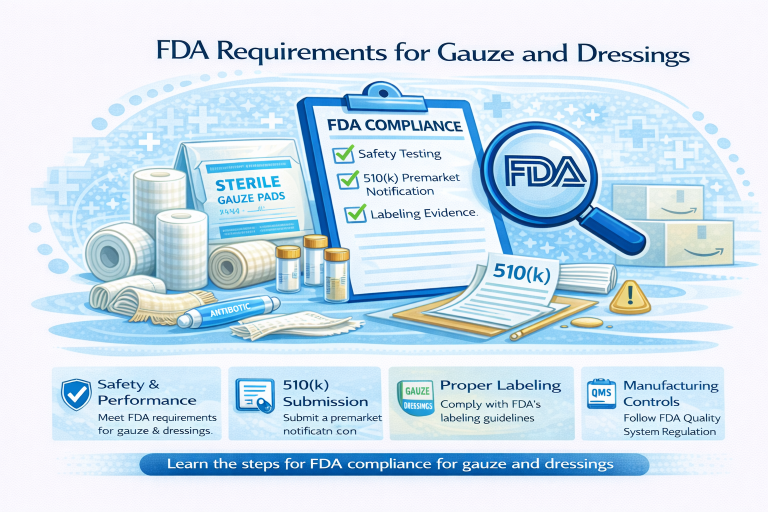
FDA Requirements for Gauze and Wound Dressings
Which dressings are exempt Class I devices, what pushes them to Class II, III, or a combination product, and how to register.
Key Takeaways
- Basic dressings = Class I, 510(k)-exempt — gauze, hydrophilic, occlusive, hydrogel/burn.
- Added drugs/biologics/animal materials are excluded — they escalate the class.
- Antimicrobial (silver/PHMB) = 510(k) — Class II, not exempt.
- With a drug/biologic = combination product; skin substitute/heals = Class III.
- Claims decide — "cover/absorb/protect" vs "heals/treats infection."
- Exempt still registers; sterile = full quality system; exempt/cleared ≠ approved.
Dressing Types & Their FDA Class
| Dressing | Class / pathway |
|---|---|
| Nonresorbable gauze/sponge (878.4014) | Class I, 510(k)-exempt |
| Hydrophilic wound dressing (878.4018) | Class I, 510(k)-exempt |
| Occlusive wound dressing (878.4020) | Class I, 510(k)-exempt |
| Hydrogel wound / burn dressing (878.4022) | Class I, 510(k)-exempt |
| Antimicrobial dressing (silver, PHMB, chemicals) | Class II — 510(k) required |
| Dressing with pDADMAC additive (878.4015) | Class II |
| Dressing with a drug or biologic (antibiotic, growth factor) | Combination / drug / biologic |
| Healing-accelerating / skin substitute / third-degree burn | Class III (often PMA) |
Added Drugs, Biologics & Animal Materials Are Excluded
This is the single most important detail. Each of the four Class I dressing classifications explicitly says it does not include a dressing that:
- Contains added drugs — such as antimicrobial agents (silver, PHMB) or antibiotics
- Contains added biologics — such as growth factors
- Is composed of materials derived from animal sources
"Cover & Absorb" vs "Heal & Treat"
| Claim | Where it lands |
|---|---|
| Covers the wound; absorbs exudate; protects | Basic Class I (often exempt) |
| Antimicrobial / inhibits bacteria in the dressing | 510(k) (Class II) |
| Treats infection / contains an antibiotic | Drug / combination product |
| Heals wounds faster / skin substitute / treats 3rd-degree burns | Class III (often PMA) |
Registration, Listing & the Sterile Wrinkle
A 510(k)-exempt dressing is not free of FDA obligations:
- Establishment registration & device listing — 21 CFR Part 807, via FURLS/DRLM
- Compliant labeling — 21 CFR Part 801; MDR — 21 CFR Part 803
- Quality system — reduced for non-sterile Class I; full for sterile
- U.S. Agent — for foreign establishments
Common Wound Dressing Mistakes
- Assuming any dressing is exempt — antimicrobial/drug/biologic/animal dressings aren't
- Adding silver or a healing claim without recognizing the class jump
- Selling a sterile dressing without the full quality system
- Skipping registration/listing because a plain dressing is "exempt"
- Calling a Class I dressing "FDA approved"; missing UDI
- Missing the U.S. Agent (foreign manufacturers)
Dressings & Device Compliance
Get Your Gauze & Dressings Compliant
FDA Registration Assistance classifies the dressing across the full range — basic Class I (gauze/hydrophilic/occlusive/hydrogel), antimicrobial 510(k), drug/biologic combination, or Class III skin substitute — reviews the claims and ingredients that drive the class, and handles establishment registration and device listing, the 510(k) where required, labeling, and U.S. Agent service for foreign makers.
Contact us at info@fdaregistrationassistance.com or call +1 (928) 275-8333 for a quote. An independent compliance firm serving 1,000+ companies across 135+ countries, with 15+ years of experience.
Frequently Asked Questions — Gauze & Dressings
1. Are gauze and wound dressings FDA medical devices?
Yes. A dressing intended to cover, absorb from, or protect a wound is a medical device. The basic ones are Class I: nonresorbable gauze/sponge for external use (21 CFR 878.4014), hydrophilic wound dressing (878.4018), occlusive wound dressing (878.4020), and hydrogel/burn dressing (878.4022). These are generally 510(k)-exempt. But that only covers plain dressings - adding an antimicrobial, a drug, a biologic, or a healing claim moves the product to a higher class or a different pathway.
2. Which wound dressings are Class I and 510(k)-exempt?
The four basic types: nonresorbable gauze/sponge (878.4014), hydrophilic wound dressing (878.4018), occlusive wound dressing (878.4020), and hydrogel wound dressing and burn dressing (878.4022) are Class I (general controls) and generally exempt from 510(k), subject to the limitations in 878.9. They're intended simply to cover a wound, absorb exudate, control fluid loss/bleeding, and protect - without added drugs, biologics, or animal-derived materials.
3. What's excluded from the Class I dressing classifications?
This is the key line: each of those Class I classifications specifically excludes a dressing that contains added drugs (such as antimicrobial agents), added biologics (such as growth factors), or is composed of materials derived from animal sources. So the moment you add silver or another antimicrobial, an antibiotic, a growth factor, or use an animal-sourced material, your dressing is no longer the exempt Class I device - it's on a higher/different pathway.
4. How are antimicrobial (e.g., silver) dressings regulated?
Antimicrobial and/or chemical-containing wound dressings were not part of the Class I classifications and generally require a 510(k) (FDA has regulated them under product codes such as FRO, GER, MGP, MGQ, and EFQ, and has been formalizing their classification through recent rulemaking). So a silver, PHMB, or similar antimicrobial dressing typically needs a 510(k) clearance - it's not exempt like a plain gauze. Confirm the current product code and requirements for your specific antimicrobial dressing.
5. What if my dressing contains a drug or a biologic?
It changes category. A wound dressing with an added drug (e.g., an antibiotic) or a biologic (e.g., a growth factor) is generally handled as a combination product or under the drug/biologic pathway - not the simple device route - because the drug/biologic component carries its own requirements. These are excluded from the Class I device classifications for exactly this reason. If your dressing delivers a drug or biologic, expect a substantially more involved pathway.
6. Are "healing" dressings and skin substitutes higher class?
Yes. FDA has determined that wound dressings intended to accelerate the normal rate of wound healing that serve as a replacement for full-thickness skin grafting (e.g., an artificial skin substitute) or that treat full-thickness (third-degree) burns are Class III devices - the most stringent pathway (often PMA). So a dressing that claims to actively heal or replace skin is very different from a plain gauze that just covers and absorbs. The healing/skin-replacement claim drives the high class.
7. How do claims change a dressing's classification?
Decisively. "Covers the wound," "absorbs exudate," and "protects" keep a dressing in the basic Class I lane. "Antimicrobial"/"kills bacteria" pushes it to a 510(k) (Class II) dressing; "treats infection" or containing an antibiotic pushes it toward a drug/combination product; and "heals wounds faster"/"skin substitute"/"treats third-degree burns" pushes it to Class III. Review your labeling and marketing carefully, because the claim can raise the class - and the required submission.
8. Is a 510(k)-exempt dressing free of FDA requirements?
No. Even an exempt Class I dressing requires FDA establishment registration and device listing (21 CFR Part 807) and compliance with general controls: labeling (21 CFR Part 801), Medical Device Reporting (21 CFR Part 803), the applicable quality system, and the prohibitions against misbranding/adulteration. "Exempt from 510(k)" is not "exempt from FDA" - registering and listing are still required for a plain gauze or basic dressing.
9. Does a sterile dressing have extra requirements?
Yes. Many Class I devices are exempt from most of the quality system/GMP regulation except records and complaint files - but that reduced exemption does not apply to devices labeled or represented as sterile. A sterile dressing must comply with the full quality system, including sterilization validation and controls. Since most wound dressings are sold sterile, this often means the complete quality system applies even to an otherwise-exempt Class I dressing.
10. What registration does a wound dressing company need?
For a basic Class I dressing: FDA establishment registration and device listing (21 CFR Part 807), compliant labeling, the applicable quality system (full system if sterile), Medical Device Reporting, and a U.S. Agent if foreign - typically no 510(k). For an antimicrobial dressing: add the 510(k). For a drug/biologic dressing or a skin substitute: the combination/drug or Class III (PMA) pathway. Classification determines which set applies, so confirm it first.
11. Are surgical gauze and sponges different?
Surgical gauze/sponges for external use are covered by the nonresorbable gauze/sponge classification (878.4014, Class I). However, sponges intended to be used internally during surgery - and especially X-ray detectable (radiopaque) surgical sponges designed to be located if retained - can fall under different, higher-control classifications given the retained-object risk. So assess a surgical sponge on its specific intended use and features rather than assuming it's the same as external gauze.
12. Is an adhesive bandage a wound dressing?
An adhesive bandage (a dressing with an adhesive backing to cover a minor wound) is a device generally handled within the wound-dressing framework - typically Class I for a plain bandage. But the same escalation applies: an adhesive bandage with an antimicrobial pad, an added drug, or a healing claim moves up in class or category. A plain "cover and protect" bandage stays low; features and claims raise it.
13. Do foreign dressing manufacturers need to register?
Yes. A foreign maker of gauze or wound dressings must complete FDA establishment registration and device listing, comply with general controls (and the full quality system if sterile), obtain a 510(k) for antimicrobial or other non-exempt dressings, and appoint a U.S. Agent - even for exempt Class I dressings. Many dressings are imported, so this is common; each foreign establishment registers for its role and needs a valid U.S. Agent before it can complete registration and import.
14. Is a wound dressing "FDA approved"?
Usually not the right word. A basic Class I dressing is registered/listed (and, if exempt, has no premarket submission); an antimicrobial dressing is 510(k)-cleared; only a Class III dressing (e.g., a skin substitute) goes through PMA and is "approved." So don't call a gauze or basic dressing "FDA approved." Describe it accurately: registered and listed (Class I), FDA-cleared (510(k)), or, for a Class III device, approved.
15. What are the most common wound dressing mistakes?
Assuming any dressing is exempt (antimicrobial/drug/biologic/animal-sourced dressings are not); adding silver or a healing claim without recognizing the class jumps; selling a sterile dressing without the full quality system; skipping registration/listing because a plain dressing is "exempt"; calling a Class I dressing "FDA approved"; missing UDI; and (for foreign makers) missing the U.S. Agent. Most trace back to a claim or an ingredient quietly moving the product out of the basic Class I lane.
16. How does FDA Registration Assistance help dressing companies?
We classify the dressing across the full range - basic Class I (gauze/hydrophilic/occlusive/hydrogel), antimicrobial 510(k), drug/biologic combination, or Class III skin substitute - review the claims and ingredients that drive the class, and handle FDA establishment registration and device listing, the 510(k) where required, labeling, and U.S. Agent service for foreign makers. We're an independent compliance firm serving 1,000+ companies across 135+ countries with 15+ years of experience. Contact info@fdaregistrationassistance.com or +1 (928) 275-8333.
