How to Determine Medical Device Classification
A step-by-step method for finding your device's class, product code, and pathway — starting with the question most people skip: is it even a device?
Key Takeaways
- Start with "is it a device?" — chemical/metabolic primary effect points to a drug, not a device.
- Intended use drives everything — read from all claims, not just the label.
- The product code is the anchor — it links to class, regulation, panel, and pathway.
- Read the 21 CFR regulation — not a competitor's listing.
- Technology can change the class — even with the same intended use.
- Classify before you register — a wrong product code looks registered but is noncompliant.
Six Steps to Determine Your Device's Class
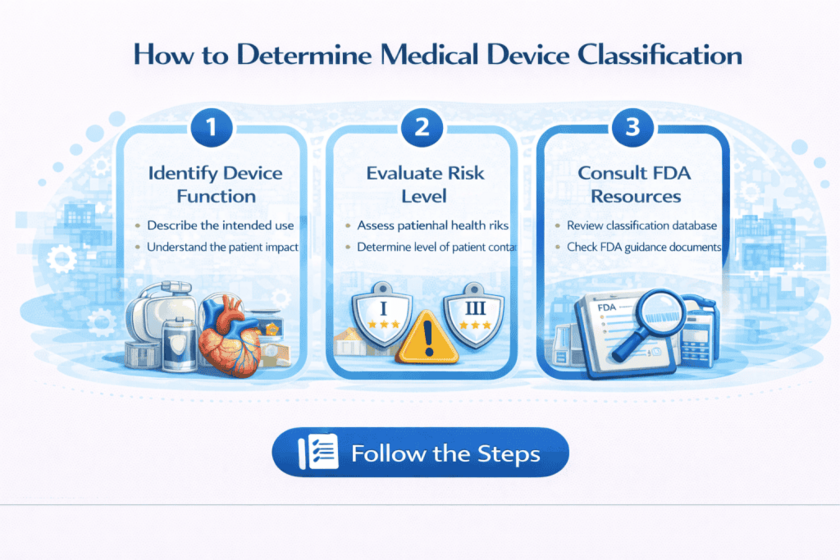
- Confirm it's a medical device. Does it diagnose, cure, mitigate, treat, or prevent disease, or affect the structure/function of the body — without achieving its primary purpose through chemical action or metabolism? If the primary effect is chemical/metabolic, it's likely a drug, not a device.
- Define the intended use & indications for use. Set out exactly what the device is meant to do and for whom — drawn from labels, instructions, website, listings, and marketing. Small wording changes can change the analysis.
- Find the FDA product code. Search FDA's Product Classification Database using the intended use and technology. The product code links to the class, regulation number, specialty panel, submission type, and exemption status.
- Read the 21 CFR classification regulation. The regulation tied to the product code (Parts 862–892) describes the device type and states the class, special controls, and any 510(k) exemption and its limits.
- Compare technological characteristics. Confirm your device's technology, materials, software, energy source, sterility, and patient contact actually fit that code — differences can change the risk and pathway.
- Determine the pathway. Exempt, 510(k) (substantial equivalence to a predicate), De Novo (novel, no predicate), or PMA (high-risk Class III). Classification and pathway are connected but not identical.
Is It Even a Medical Device?
This is the step people skip — and the one that saves the most trouble. A product is a medical device if it's intended for a medical purpose (diagnose, cure, mitigate, treat, or prevent disease) or to affect the body's structure or function, and does not achieve its primary intended purpose through chemical action within or on the body, or by being metabolized.
Getting this threshold right first prevents building an entire device strategy for something that is actually a drug, cosmetic, or combination product.
What the Class Tells You (Quick Recap)
Once the method lands you on a class, here's what it means in brief:
- Class I — low risk; general controls; most 510(k)-exempt
- Class II — moderate risk; general + special controls; most require a 510(k)
- Class III — high risk; general controls + PMA (premarket approval)
Classify Before You Register
Classification should be completed before establishment registration and device listing. Companies that register or list first often discover later that the product code was wrong, the device needed a 510(k), or a claim exceeded an exemption.
- A device listed under the wrong product code can look registered while still being noncompliant
- Review labeling and website claims before U.S. launch — claims can change the class
- Align registration, listing, U.S. Agent, and importer records with the classification
- Re-check classification when the device changes — design, materials, software, sterility, claims, indications, or population
Common Determination Mistakes
- Skipping "is it a device?" — building a device plan for what's actually a drug or combination product
- Using a competitor's listing as the only evidence
- Picking a product code by appearance, not intended use and technology
- Ignoring website/label claims that raise the risk or change the code
- Confusing registration with clearance
- Not re-checking after a design, material, or claim change
Device Classification & Registration
Get Your Device Classification Reviewed
FDA Registration Assistance reviews your device's intended use, indications, claims, and technology, identifies candidate product codes and the matching 21 CFR regulations, confirms the likely class, and flags the pathway (exempt, 510(k), De Novo, or PMA) — then handles establishment registration, device listing, and U.S. Agent support so everything aligns with the classification.
Contact us at info@fdaregistrationassistance.com or call +1 (928) 275-8333 for a quote. An independent compliance firm serving 1,000+ companies across 135+ countries, with 15+ years of experience.
Frequently Asked Questions — Determining Classification
1. How do I determine my medical device's FDA classification?
Work through a method, not a guess: (1) confirm the product is actually a medical device; (2) define its intended use and indications for use from all your claims; (3) find the FDA product code in the Product Classification Database; (4) read the matching 21 CFR classification regulation (it states the class, special controls, and any exemption); (5) compare technological characteristics to confirm the match; and (6) determine the pathway (exempt, 510(k), De Novo, or PMA). The result gives you the class, product code, regulation number, and pathway - do this before registering, listing, or labeling.
2. How do I know if my product is even a medical device?
A product is a medical device if it's intended to diagnose, cure, mitigate, treat, or prevent disease, or to affect the structure or function of the body - and does not achieve its primary intended purpose through chemical action within or on the body or by being metabolized. That last part is the key line: if the primary effect is chemical/metabolic, it's likely a drug, not a device. Intended use (from labels, website, listings, and marketing) is what determines device status - so a simple product can become a regulated device based on its claims.
3. Why does intended use matter so much?
Because FDA classification starts with what the device is intended to do, and FDA reads intended use from the whole presentation - labels, instructions, website claims, brochures, online listings, distributor and training materials. Small wording differences can change the classification analysis, and a disease/diagnostic/treatment claim can move a product into a higher class or a different product code. Pin down the intended use and indications before drafting claims or picking a product code.
4. What is the FDA Product Classification Database?
It's FDA's searchable database of device types, each with a product code that connects to the device's class, classification regulation number, medical specialty panel, submission type, and exemption status. You search it using your device's intended use and technology to find the matching product code - which is the anchor for confirming the class and pathway. It's the primary tool for a classification determination.
5. How do I use the 21 CFR regulation once I find a product code?
Each product code links to a classification regulation in 21 CFR (organized by specialty panel, Parts 862–892). Read it carefully: it describes the device type, states the class, lists any special controls, and notes whether a 510(k) exemption applies (and the limitations on that exemption). The regulation - not a competitor's listing - is the authoritative statement of the class and controls for that device type.
6. Why compare technological characteristics?
Because two devices with a similar intended use can still classify differently if their technology, materials, software functions, energy source, sterility status, measuring features, or patient-contact characteristics differ. Those differences can change the risk and the pathway. So after matching intended use to a product code, confirm your device's technological characteristics actually fit that code - a mismatch can mean a different code, class, or submission.
7. How do I determine the premarket pathway?
Once you've confirmed the class and product code, the pathway follows: many Class I (and some Class II) devices are 510(k)-exempt; most Class II devices require a 510(k) (substantial equivalence to a predicate); a novel low-to-moderate-risk device with no predicate may use De Novo; and most Class III devices require PMA. Classification and pathway are connected but not identical - the regulation and product code tell you which applies.
8. What's the difference between class and product code?
The class (I, II, or III) is the risk-based category. The product code is FDA's specific identifier for the device type, and it links to the class, regulation number, panel, submission type, and controls. You use the product code to determine and document the class - so the product code is the practical anchor of a classification determination. Using the wrong product code causes listing, import, and strategy problems even if the class seems right.
9. Should I classify before registering with FDA?
Yes. Classification should be completed before establishment registration and device listing. Many companies register or list first and discover later that the product code was wrong, the device needed a 510(k), or a claim exceeded an exemption. A device listed under the wrong product code can look registered while still being noncompliant. Determine the class and pathway first, then register and list to match.
10. Can I rely on a competitor's classification?
A competitor's listing can be a useful starting point for finding candidate product codes, but it's not proof that your device has the same intended use, technology, claims, labeling, or pathway - and it's not evidence that the competitor's own classification is correct. Use it as a lead, then verify against the FDA database, the 21 CFR regulation, and your device's actual intended use and characteristics.
11. Can marketing claims change the classification?
Yes. FDA evaluates intended use from how the product is promoted, so disease, diagnostic, treatment, prevention, monitoring, or clinical-performance claims can change how FDA views the device - potentially moving it to a higher class or a different product code, or even making a non-device into a device. Review website copy, listings, packaging, and social content as part of the classification, because claims can change the answer.
12. Does registration mean my device is cleared or approved?
No. Establishment registration and device listing are administrative - they don't mean FDA cleared, approved, certified, or endorsed the device, and they don't replace a required 510(k), De Novo, or PMA. A company can be registered while its device isn't lawfully marketed because a required premarket submission hasn't been obtained. Registration is not clearance, and neither is the same as approval.
13. When should I review classification again?
Review it up front - before marketing claims, label design, packaging, registration, listing, imports, or distributor onboarding - and again whenever the device changes: a new design, material, software function, sterility status, claim, indication, target population, or method of operation can change the classification or pathway. Classification isn't a one-time box to tick; it should be re-checked when the product or its claims change.
14. What information do I need for a classification review?
Typically: the device description, intended use, indications for use, labeling and instructions for use, website/marketing claims, materials, specifications, any software features, sterility status, photos, and any competitor or predicate information. That lets you (or a consultant) match the device to the right product code and regulation and confirm the class and pathway. The more accurately the intended use and claims are described, the more reliable the determination.
15. What if I'm still not sure which class applies?
Don't guess. Re-check FDA's classification database, the applicable 21 CFR regulations, your intended use and claims, and possible predicates. If uncertainty remains - for example, no clear product code fits, or your device may be novel - options include a De Novo request (for a genuinely novel low/moderate-risk device) or getting regulatory support before you register, list, import, or market. Guessing and correcting later is the expensive path.
16. How does FDA Registration Assistance help determine classification?
We review the device's intended use, indications, claims, and technology, identify candidate product codes and the matching 21 CFR regulations, confirm the likely class, and flag the pathway (exempt, 510(k), De Novo, or PMA) and any special controls - then handle establishment registration, device listing, and U.S. Agent support so everything aligns with the classification. We're an independent compliance firm serving 1,000+ companies across 135+ countries with 15+ years of experience. Contact info@fdaregistrationassistance.com or +1 (928) 275-8333.