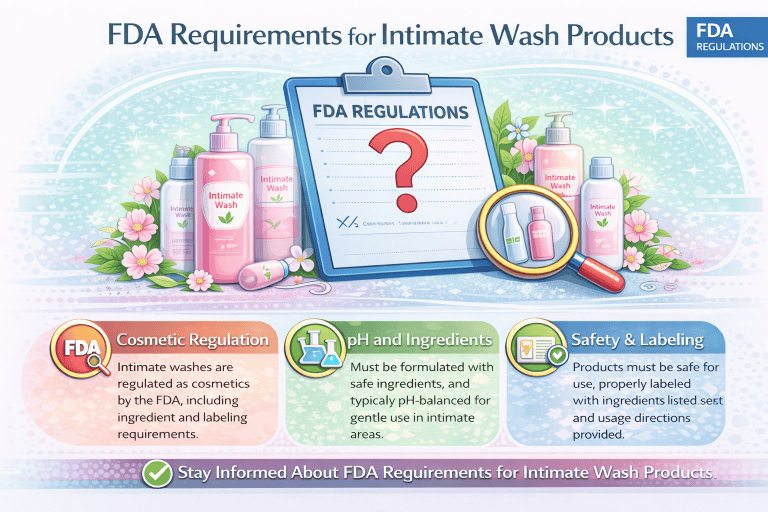
FDA Requirements for Intimate Wash Products
When an intimate wash is a cosmetic, the claims that turn it into a drug, and how to register on each path.
Key Takeaways
- Cleansing/freshening wash = cosmetic — MoCRA facility registration + product listing.
- "pH-balanced" is a cosmetic claim — as a gentleness descriptor, not tied to treating a condition.
- Antibacterial/antifungal = drug — "kills germs," "treats BV/yeast," "prevents infection."
- The claims decide the category — the intimate area is where they cross fast.
- Sensitive-area safety data — preservative efficacy, microbial, compatibility.
- Registration ≠ approval — on either path.
Cosmetic-Safe vs Drug-Triggering Claims
| Cosmetic-safe (cleanse / freshen) | Drug-triggering (treat / prevent / antimicrobial) |
|---|---|
| Gentle cleanser for external intimate hygiene | Antibacterial / antimicrobial |
| pH-balanced (as a gentleness descriptor) | Restores pH to prevent/treat infection |
| Freshens; helps control odor | Antifungal / treats yeast |
| For sensitive skin; daily use | Treats or prevents BV (bacterial vaginosis) |
| Moisturizing; soothing feel | Restores healthy vaginal flora |
When It Becomes a Drug
Intimate washes tip into drug territory faster than most washes, because the claims that sell them are often therapeutic. Any of these puts the product on the drug pathway:
- Antibacterial / antimicrobial — reducing or killing microorganisms is a drug claim (like antibacterial soap)
- Antifungal / "treats yeast" — an OTC drug; vaginal antifungals sit under a separate monograph
- "Treats or prevents infection / BV" — treating or preventing a condition is a drug claim
- "Restores flora / corrects pH to prevent infection" — affecting a body function to prevent a condition
The Cosmetic (MoCRA) Path
- Facility registration — via Cosmetics Direct, with an FEI (and a U.S. Agent if foreign); renews biennially
- Product listing — each formulation/variant, updated at least annually
- Responsible Person & safety substantiation — with emphasis, for a sensitive-area rinse-off, on preservative efficacy, microbial limits, and skin compatibility
- Adverse-event reporting — serious events within 15 business days; records kept
- Compliant labeling — INCI, net quantity, the adverse-event contact; no drug claims, no "FDA Approved"
Common Intimate Wash Mistakes
- An antibacterial/antifungal claim without realizing it makes the product a drug
- Tying pH language to preventing/treating infection — crosses into a drug claim
- Assuming "natural" means exempt — it doesn't
- Registering the facility but not listing all variants
- Thin preservative/compatibility data for a sensitive-area rinse-off
- Missing the U.S. Agent (foreign); "FDA approved" claims
Get Your Intimate Wash Compliant
FDA Registration Assistance confirms the classification first — reviewing the claims and ingredients to determine cosmetic (a cleansing/pH-balanced wash) or drug (antibacterial/antifungal/infection-treatment) — then handles the right registration: MoCRA facility registration and product listing (with Responsible Person, U.S. Agent, safety, and labeling) for a cosmetic wash, or drug establishment registration, NDC listing, and Drug Facts for a medicated one.
Contact us at info@fdaregistrationassistance.com or call +1 (928) 275-8333 for a quote. An independent compliance firm serving 1,000+ companies across 135+ countries, with 15+ years of experience.
Frequently Asked Questions — Intimate Wash
1. Are intimate wash products regulated by the FDA?
Yes. An intimate wash intended for external cleansing or freshening — including pH-balanced and "natural" formulas — is a cosmetic, so it's regulated under MoCRA: facility registration, product listing, a Responsible Person, safety substantiation, adverse-event reporting, and compliant labeling (foreign facilities also need a U.S. Agent). What changes that is an antibacterial, antifungal, or infection-treatment claim, which makes it an OTC drug. The claims decide the category.
2. When is an intimate wash a cosmetic?
When it's for external cleansing or freshening and stays with appearance/hygiene claims: "gentle cleanser," "pH-balanced," "freshens," "for daily intimate hygiene," "odor-controlling." pH-balanced and "natural" or "sensitive" formulas are still cosmetics and still must comply with MoCRA. The key is that it cleans/freshens externally without claiming to treat or prevent a condition or affect the body's structure or function.
3. When is an intimate wash a drug?
When it makes a therapeutic or antimicrobial claim: "antibacterial," "antimicrobial," "antifungal," "treats or prevents infection," "treats bacterial vaginosis (BV) or yeast," "restores healthy flora," or similar. Those are drug claims (treating/preventing a condition or affecting a body function), so the product is an OTC drug on the drug pathway — not a MoCRA cosmetic. The intimate-care space is where these claims most often creep in.
4. Is "pH-balanced" a drug claim?
No — on its own, "pH-balanced" is a cosmetic claim about the product being gentle/compatible for the area. It doesn't claim to treat or prevent a condition, so it keeps the wash a cosmetic. But "restores vaginal pH to prevent infection" or "corrects pH to treat BV" crosses into a drug claim. So pH language is fine as a formulation/gentleness descriptor and a problem when it's tied to treating or preventing a condition.
5. Is an antibacterial intimate wash a drug?
Yes. An antibacterial or antimicrobial claim is a drug claim (reducing or killing microorganisms), so an antibacterial intimate wash is an OTC drug, like antibacterial soap or hand sanitizer — not a cosmetic. That means the drug pathway: drug establishment registration, NDC listing, a Drug Facts label, applicable actives/monograph, cGMP, and a U.S. Agent if foreign. If you don't intend a drug, drop the antibacterial claim.
6. What about antifungal or "yeast" intimate washes?
Antifungal claims (or treating yeast infections) make the product an OTC drug — vaginal antifungals sit under a vaginal antifungal monograph, distinct from a cosmetic wash. A wash that says it "treats yeast" or is "antifungal" is a drug, and a genuine intravaginal antifungal treatment is a specific, separate product category. A cosmetic intimate wash simply cleanses; it doesn't treat yeast.
7. What is the cosmetic (MoCRA) path for an intimate wash?
Register the manufacturing facility with FDA (via Cosmetics Direct, with an FEI, and a U.S. Agent if foreign), list each product, designate a Responsible Person, maintain safety substantiation, set up adverse-event reporting, and use compliant labeling. Facility registration renews every two years and listings update at least annually. This is the path for a standard cleansing/pH-balanced intimate wash.
8. What safety data does an intimate wash need?
MoCRA requires adequate safety substantiation for every cosmetic. Because an intimate wash is a water-based, rinse-off product used on a sensitive area, the scientifically robust data typically centers on preservative-efficacy (challenge) testing, microbial limits, and skin-compatibility/irritation data, plus stability and ingredient/toxicological safety. Preservation and compatibility are especially important here, and the records must be available to FDA.
9. How does this relate to feminine hygiene products generally?
An intimate wash is one product within the broader feminine hygiene space, which spans three FDA categories: washes and wipes are cosmetics; tampons, pads, and menstrual cups are medical devices; and vaginal antifungals and medicated products are drugs. So an intimate wash brand that also sells, say, a yeast-infection treatment or menstrual products has products on more than one pathway. See our feminine hygiene overview for the full map.
10. Do foreign intimate wash brands need to register?
Yes. Any intimate wash marketed in the U.S. must comply regardless of where it's made, and foreign facilities need a U.S. Agent on either pathway. A foreign cosmetic intimate wash registers under MoCRA with a U.S. Agent; a foreign antibacterial/antifungal wash registers as a drug establishment with a U.S. Agent. Home-country classification doesn't transfer — a product treated as a cosmetic abroad may be a drug here.
11. Does "natural" or "organic" intimate wash still need to comply?
Yes. "Natural," "clean," and "organic" are marketing terms that don't change regulatory status. A natural intimate wash is still a cosmetic under MoCRA and needs the same registration, listing, safety substantiation, and labeling — and if it claims to be antibacterial or to treat a condition, it's still a drug. These terms describe positioning, not compliance.
12. What labeling does an intimate wash need?
A cosmetic intimate wash needs cosmetic labeling: a Principal Display Panel (statement of identity, net quantity) and an information panel (INCI ingredient declaration, responsible-party name/address, any required warnings, and the MoCRA adverse-event contact) — with no drug claims and no "FDA Approved." An antibacterial/antifungal wash (a drug) needs a Drug Facts panel instead. The label must match the classification.
13. What are the most common intimate wash mistakes?
Adding an antibacterial/antimicrobial/antifungal claim without realizing it makes the product a drug; tying pH language to preventing or treating infection; assuming "natural" means exempt; registering the facility but not listing all variants; thin preservative/compatibility data for a sensitive-area rinse-off; missing the U.S. Agent (foreign); and "FDA approved" claims. Most trace back to not settling the cosmetic-vs-drug classification first.
14. Does registering my intimate wash mean it's FDA-approved?
No. FDA doesn't approve cosmetics. Registration and listing make you compliant and put your facility and products in FDA's system — they aren't approval or an endorsement. Calling an intimate wash "FDA-approved" because it's registered is misleading and can be a labeling problem. The accurate statement is that your facility is registered and your products are listed.
15. Are intimate wipes treated the same as intimate washes?
The analysis is the same. A cosmetic intimate wipe that cleanses/freshens is a cosmetic under MoCRA; a wipe making antibacterial/antifungal or infection claims is a drug. The format (wipe vs liquid wash) doesn't change the category — the claims and ingredients do. So classify a wipe exactly as you would a wash, and list each product on the appropriate pathway.
16. How does FDA Registration Assistance help intimate wash brands?
We confirm the classification first — reviewing the claims and ingredients to determine cosmetic (a cleansing/pH-balanced wash) or drug (antibacterial/antifungal/infection-treatment) — then handle the right registration: MoCRA facility registration and product listing (with Responsible Person, U.S. Agent, safety, and labeling) for a cosmetic wash, or drug establishment registration, NDC listing, and Drug Facts for a medicated one. We're an independent compliance firm serving 1,000+ companies across 135+ countries with 15+ years of experience. Contact info@fdaregistrationassistance.com or +1 (928) 275-8333.