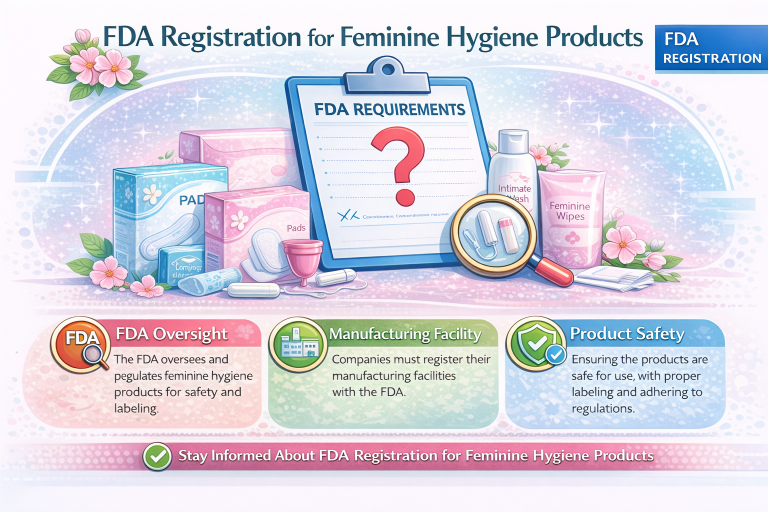
FDA Registration for Feminine Hygiene Products
Which feminine hygiene products are devices, which are cosmetics, and which are drugs — with the device classes and the registration path for each.
Key Takeaways
- Three categories, one shelf — devices, cosmetics, and drugs across feminine care.
- Tampons = Class II device — need a 510(k); pads (Class I) and cups (Class II) generally don't.
- Washes & wipes = cosmetics — MoCRA facility registration + product listing.
- Vaginal antifungals = OTC drugs — the drug pathway.
- A line can span all three — each product on its own registration.
- "FDA approved" is usually wrong — a tampon is "cleared," a wash is "registered/listed."
Product → FDA Category
| Product | Category | Class / basis & 510(k) |
|---|---|---|
| Menstrual tampons (scented / unscented) | Medical device | Class II (884.5460 / 884.5470) — 510(k) required |
| Menstrual pads / sanitary napkins | Medical device | Class I (884.5425 / 884.5435) — 510(k)-exempt |
| Menstrual cups | Medical device | Class II (884.5400) — generally 510(k)-exempt |
| Feminine washes, wipes, external deodorant sprays | Cosmetic | MoCRA (registration + listing) |
| Vaginal antifungals, anti-itch, medicated products | OTC drug | Drug pathway (monograph) |
| Douches | Cosmetic or drug | By claims (cleanse = cosmetic; antimicrobial/treat = drug) |
The Medical Device Pathway (Tampons, Pads, Cups)
Tampons, pads, and cups are devices — a different system from cosmetics and drugs. Every device needs:
- Device establishment registration — 21 CFR Part 807; renews annually; foreign establishments add a U.S. Agent
- Device listing — each device listed by its product code
- Quality System — 21 CFR Part 820
- Medical Device Reporting (MDR) — adverse-event reporting
- 510(k) premarket notification — for tampons (Class II): substantial equivalence to a predicate, before marketing
- Labeling — including tampon absorbency labeling (21 CFR 801.430)
The Cosmetic & Drug Pathways
Cosmetics — feminine washes, wipes, external sprays. These cleanse or freshen externally, so they're cosmetics under MoCRA:
- Facility registration + product listing + Responsible Person — via Cosmetics Direct; biennial renewal; U.S. Agent if foreign
- Safety substantiation, adverse-event reporting, and labeling — plus a specific warning on feminine deodorant sprays
Drugs — vaginal antifungals, anti-itch, medicated products. These treat a condition, so they're OTC drugs:
- Drug establishment registration + NDC listing — annual renewal; U.S. Agent if foreign
- Drug Facts label + applicable monograph + cGMP — e.g., the vaginal antifungal monograph for yeast-infection treatments
"Approved," "Cleared," "Registered" — Get It Right
- Tampon (510(k) device) → "FDA cleared" (substantial equivalence) — not "approved"
- Pad / cup (510(k)-exempt device) → "registered and listed" — not "approved"
- Feminine wash (cosmetic) → "registered/listed" — FDA doesn't approve cosmetics
- Vaginal antifungal (monograph drug) → "compliant with the monograph" — not "approved"
Common Feminine Hygiene Mistakes
- Misclassifying the product — treating a tampon (device) like a cosmetic, or a whole line as one category
- Skipping the 510(k) for a tampon — it's Class II and not exempt
- Assuming "510(k)-exempt" means no registration — pads/cups still register and list
- Drug claims on a cosmetic wash — "antibacterial," "treats infection" → makes it a drug
- Missing the U.S. Agent (foreign) on any pathway
- "FDA approved" claims — inaccurate for all of these
Register Your Feminine Care Line Correctly
FDA Registration Assistance maps each product to its FDA category first — device, cosmetic, or drug — then handles the right registration for each: device establishment registration, listing, and 510(k) support (tampons) for devices; MoCRA facility registration and product listing for washes and wipes; and OTC drug registration for medicated products — with a U.S. Agent for foreign firms and labeling review throughout.
Contact us at info@fdaregistrationassistance.com or call +1 (928) 275-8333 for a quote. An independent compliance firm serving 1,000+ companies across 135+ countries, with 15+ years of experience.
Frequently Asked Questions — Feminine Hygiene Registration
1. How does FDA regulate feminine hygiene products?
It depends on the product - feminine hygiene spans three FDA categories. Tampons, menstrual pads/napkins, and menstrual cups are medical devices. Feminine washes, wipes, and external deodorant sprays are cosmetics (MoCRA). Vaginal antifungals and other medicated products are OTC drugs. Each category has its own registration system, so the first step is identifying which one your product falls in - the product type and its claims decide it.
2. Are tampons regulated as medical devices?
Yes. Menstrual tampons are Class II medical devices - scented/scented-deodorized under 21 CFR 884.5460 and unscented under 21 CFR 884.5470 (product code HEB). Because they're Class II, a tampon generally requires a 510(k) premarket notification (showing substantial equivalence to a legally marketed predicate) before it can be sold, plus device establishment registration, device listing, a quality system, and specific absorbency labeling (21 CFR 801.430). Tampons with an added antimicrobial or drug are a different, more complex case.
3. Do menstrual pads need a 510(k)?
Generally no. Menstrual pads/sanitary napkins are Class I devices - scented under 21 CFR 884.5425 (product code NRC) and unscented under 21 CFR 884.5435 (product code HHD) - and, with narrow exceptions, Class I pads are exempt from the 510(k) requirement. But 510(k)-exempt is not requirement-free: the facility still needs device establishment registration, the pad still needs device listing, and quality-system and labeling rules still apply. "Exempt from 510(k)" only removes the premarket notification.
4. How are menstrual cups classified?
Menstrual cups are Class II devices under 21 CFR 884.5400, and under the current classification they're generally exempt from the 510(k) requirement. Like other devices, a menstrual cup still needs device establishment registration, device listing, a quality system, and compliant labeling. So a cup is on the device pathway - just typically without a 510(k) - which is different from tampons (Class II, 510(k) required).
5. What does the medical device pathway involve?
For a feminine hygiene device: device establishment registration (21 CFR Part 807), device listing, a Quality System (21 CFR Part 820), Medical Device Reporting (adverse events), and compliant labeling - plus a 510(k) premarket notification if the device requires one (tampons do; pads and cups generally don't). Foreign device establishments also need a U.S. Agent. Device registration renews annually. It's a distinct system from cosmetics and drugs.
6. Which feminine hygiene products are cosmetics?
Feminine washes, cleansers, wipes, external deodorant sprays, and powders are cosmetics when they're intended to cleanse or freshen the external genital area without affecting the body's structure or function or treating a condition. As cosmetics, they follow MoCRA: facility registration, product listing, a Responsible Person, safety substantiation, adverse-event reporting, and labeling (with a U.S. Agent if foreign). Feminine deodorant sprays also carry a specific required warning.
7. Which feminine hygiene products are drugs?
Products that treat or prevent a condition. Vaginal antifungals for yeast infections (miconazole, clotrimazole) are OTC drugs under a vaginal antifungal monograph; anti-itch and other medicated vaginal products are drugs too. A douche can be a cosmetic (if it just cleanses/freshens) or a drug (if it makes an antimicrobial or therapeutic claim). Drug products follow the drug pathway: establishment registration, NDC listing, a Drug Facts label, an applicable monograph, and cGMP.
8. Can one product line span multiple categories?
Yes - and many feminine care brands do. A single brand might sell pads and tampons (devices), a feminine wash (cosmetic), and a yeast-infection treatment (drug), each on a different FDA pathway with its own registration and listing. That's why mapping each product to its category first is essential; you can't put a whole feminine-care line on a single registration.
9. Do foreign feminine hygiene manufacturers need to register?
Yes. Any feminine hygiene product marketed in the U.S. must comply regardless of where it's made, and foreign establishments need a U.S. Agent on every pathway - device, cosmetic, or drug. A foreign tampon or cup maker registers as a device establishment with a U.S. Agent; a foreign feminine-wash brand registers under MoCRA with a U.S. Agent. Home-country approval doesn't transfer.
10. What labeling do these products need?
It follows the category. Device tampons need device labeling including the absorbency labeling in 21 CFR 801.430; pads and cups need compliant device labeling. Cosmetic washes/wipes need cosmetic labeling (INCI ingredients, net quantity, responsible-party contact, and the MoCRA adverse-event contact), and feminine deodorant sprays a specific warning. Drug products need a Drug Facts panel. The label has to match the product's actual classification.
11. Does FDA approve feminine hygiene products?
Mostly no. Cosmetics aren't approved; OTC monograph drugs are "compliance, not approval." Devices that go through 510(k) receive a "clearance" (substantial equivalence), not an "approval" - only Class III PMA devices are "approved," which these aren't. So calling a tampon, pad, wash, or antifungal "FDA-approved" is generally inaccurate. A tampon is "510(k)-cleared"; a wash is a registered/listed cosmetic; the terms matter.
12. Is a 510(k)-cleared tampon "FDA approved"?
No - it's "FDA cleared." A 510(k) clearance means FDA found the device substantially equivalent to a legally marketed predicate; it is not the same as the premarket "approval" (PMA) used for high-risk Class III devices. Marketing a tampon or cup as "FDA approved" is inaccurate and can be a labeling problem. "FDA cleared" (for a 510(k) device) or "registered and listed" is the accurate language.
13. What are the most common feminine hygiene mistakes?
Misclassifying the product - treating a tampon (device) like a cosmetic, or assuming a whole line is one category; skipping the 510(k) for a tampon; assuming "510(k)-exempt" means no registration; putting a drug claim (antibacterial, treats infection) on a cosmetic wash; missing the U.S. Agent (foreign); and calling products "FDA approved." Nearly all trace back to not mapping each product to its correct category first.
14. How often does registration renew?
By category: device establishment registration renews annually; cosmetic facility registration renews every two years (biennially); drug establishment registration renews annually (October–December). A brand with products in more than one category maintains more than one registration on more than one schedule - another reason to map the categories clearly from the start.
15. Are period underwear or reusable products different?
They're evaluated the same way - by what the product is and does. Reusable menstrual products are still assessed against the device classifications (a reusable pad, for instance, is looked at under the pad framework), and absorbency, performance, and labeling expectations apply. Newer formats should be classified carefully before marketing, because the category (and whether a 510(k) applies) drives everything else. We can help determine the right classification.
16. How does FDA Registration Assistance help feminine hygiene brands?
We map each product to its FDA category first - device, cosmetic, or drug - then handle the right registration for each: device establishment registration, listing, and 510(k) support (tampons) for devices; MoCRA facility registration and product listing for washes and wipes; and OTC drug registration for medicated products - with a U.S. Agent for foreign firms and labeling review throughout. We're an independent compliance firm serving 1,000+ companies across 135+ countries with 15+ years of experience. Contact info@fdaregistrationassistance.com or +1 (928) 275-8333.