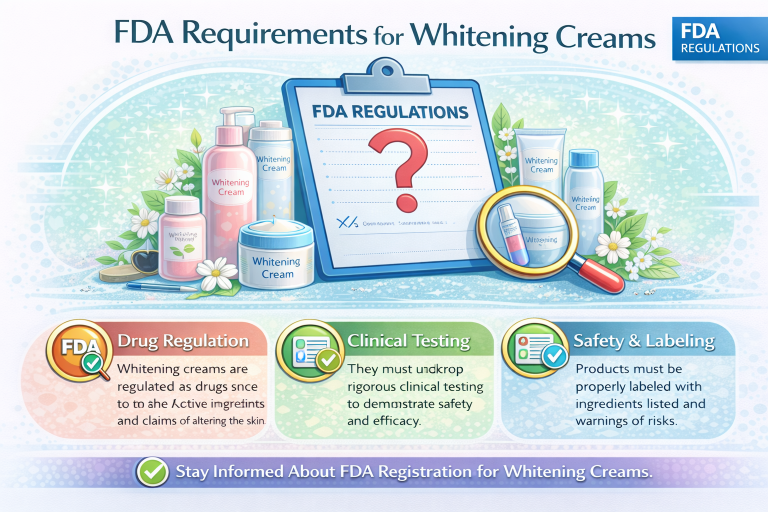
FDA Requirements for Whitening Creams
The brighten-appearance (cosmetic) vs lighten/treat (drug) line, why OTC hydroquinone is off the table, the mercury ban, and how to build a compliant brightening cosmetic.
Key Takeaways
- "Brighten the look" = cosmetic; "lighten/treat" = drug — the claim decides.
- OTC hydroquinone lighteners are unapproved new drugs — no legal OTC pathway (CARES Act 2020).
- Only Rx Tri-Luma is approved — and FDA sent warning letters to 12 companies in 2022.
- Mercury is illegal in cosmetics — limit 1 ppm; common in imported lighteners; enforced hard.
- Undeclared steroids — another recurring contamination problem.
- Registration doesn't legalize an illegal product — screen the formula and claims first.
Brighten (Cosmetic) vs Lighten/Treat (Drug)
| Cosmetic-safe (appearance) | Drug-triggering (lighten / treat) |
|---|---|
| Brightens the look of skin | Whitens / lightens skin |
| Evens the appearance of skin tone | Treats hyperpigmentation / melasma |
| Improves the look of dark spots | Fades / removes dark spots |
| Adds radiance / glow | Reduces / inhibits melanin production |
| Cosmetic-appropriate actives (niacinamide, vitamin C, kojic acid, arbutin, licorice) | Hydroquinone (a drug active with no legal OTC route) |
Hydroquinone: No Legal OTC Skin Lightener
Hydroquinone is the classic skin-lightening active — and it's the fastest way to an illegal product:
- OTC hydroquinone skin lighteners are unapproved new drugs — not generally recognized as safe and effective (not GRASE), and misbranded
- The CARES Act eliminated the OTC pathway — effective September 23, 2020; there are no legally marketed OTC skin-lightening drug products
- FDA warning letters to 12 companies — April 2022, over exactly these products
- Ochronosis risk — a bluish-black skin darkening that can be permanent, plus rashes and facial swelling
Mercury & Undeclared Steroids
Mercury. FDA does not allow mercury in cosmetics (or drugs) except under narrow preservative conditions that skin lighteners don't meet — the limit is no more than 1 part per million (ppm). Since 2019, FDA testing has repeatedly found imported skin-lightening creams with dangerously high mercury, leading to recalls and mercury-poisoning cases (kidney and neurological damage).
Undeclared steroids. Some imported lighteners have been found to contain undeclared corticosteroids (like clobetasol). A "cosmetic" containing an undeclared steroid is an unapproved, misbranded drug — and a serious safety hazard. Undeclared active drugs are a leading reason this category is scrutinized at import.
How to Build a Compliant Brightening Cosmetic
A whitening/brightening product can be a compliant cosmetic — if it stays a true cosmetic:
- No hydroquinone, no mercury, no steroids — screen the formula (and test, for imports)
- Cosmetic-appropriate actives — e.g., niacinamide, vitamin C, kojic acid, arbutin, licorice extract
- Appearance-only claims — "brightens the look," "improves the appearance of dark spots," "evens the look of tone" — never "lightens" or "treats"
- Then the MoCRA path — facility registration, product listing, Responsible Person, safety substantiation, adverse-event reporting, labeling; U.S. Agent if foreign
Common Whitening Cream Mistakes
- Hydroquinone in an OTC product — an unapproved drug; no legal OTC route
- Mercury contamination — illegal (>1 ppm), often undeclared, in imported creams
- Undeclared steroids — a misbranded, unapproved drug
- "Whitens / lightens / treats hyperpigmentation" on a "cosmetic" — makes it a drug
- Assuming home-country legality transfers — it doesn't
- Assuming registration legalizes the product — it doesn't
Get Your Whitening Cream Classified & Screened
FDA Registration Assistance starts with classification and an ingredient/claims screen — checking for hydroquinone, mercury, and steroids, and reviewing whether the claims are cosmetic (brighten the look) or drug (lighten/treat). For a compliant brightening cosmetic, we handle MoCRA facility registration and product listing, Responsible Person, U.S. Agent, safety substantiation, and labeling; where a product is actually a drug, we explain the (much heavier) drug pathway honestly.
Contact us at info@fdaregistrationassistance.com or call +1 (928) 275-8333 for a quote. An independent compliance firm serving 1,000+ companies across 135+ countries, with 15+ years of experience.
Frequently Asked Questions — Whitening Creams
1. Are whitening creams regulated by the FDA?
Yes, and heavily. Whitening/skin-lightening creams are one of FDA's most scrutinized product categories. A product that only claims to brighten the look of skin or even the appearance of tone can be a cosmetic (MoCRA). But a product that claims to lighten skin or treat hyperpigmentation, melasma, or dark spots is a drug - and the most common lightening active, hydroquinone, cannot be legally sold OTC at all. On top of that, mercury (found in some imported lighteners) is illegal in cosmetics. Classification and ingredient screening come first.
2. Is a whitening cream a cosmetic or a drug?
It depends on the claim. "Brightens the look of skin," "evens the appearance of skin tone," or "radiance" can be cosmetic claims. "Whitens" or "lightens" skin, "treats hyperpigmentation/melasma," "fades dark spots," or "reduces melanin" are drug claims - they claim to affect the skin's structure/function or treat a condition. So the same-looking cream can be a cosmetic or a drug depending entirely on how it's marketed and what's in it.
3. Can I sell an OTC hydroquinone skin lightener?
No. OTC skin lightening products containing hydroquinone are unapproved new drugs - not generally recognized as safe and effective (not GRASE) - and are misbranded. The CARES Act (effective September 23, 2020) eliminated the OTC pathway for them, so there are no legally marketed OTC skin-lightening drug products. FDA sent warning letters to 12 companies in April 2022 over exactly this. The only FDA-approved hydroquinone product is Tri-Luma, a prescription drug for short-term treatment of melasma-related dark spots.
4. Why is hydroquinone such a problem?
Because it's a drug active with no legal OTC route and real safety concerns. FDA has received reports of serious side effects from OTC hydroquinone lighteners, including skin rashes, facial swelling, and ochronosis - a bluish-black darkening of the skin that can be permanent. Since the CARES Act, OTC hydroquinone skin lighteners are deemed new drugs and misbranded. A legitimate hydroquinone product is a prescription drug (like Tri-Luma), used under a health professional's supervision.
5. Is mercury allowed in whitening creams?
No. FDA does not allow mercury in cosmetics (or drugs) except under narrow preservative conditions that skin lighteners don't meet - the limit for mercury in cosmetics is no more than 1 part per million (ppm). Since 2019, FDA testing has repeatedly found imported skin-lightening creams with dangerously high mercury, and there have been recalls and mercury-poisoning cases (kidney and neurological damage). Selling mercury-containing skin creams can lead to enforcement including seizure, injunction, and even criminal prosecution.
6. What about undeclared steroids in lightening creams?
Some imported skin-lightening products have been found to contain undeclared corticosteroids (such as clobetasol). Corticosteroids are drugs; while they can be legally used in some prescription products for inflammatory skin conditions under supervision, an OTC "cosmetic" lightener containing an undeclared steroid is an unapproved, misbranded drug and a serious safety hazard. Undeclared active drugs are a recurring problem in imported whitening creams and a major reason the category is scrutinized at import.
7. So can a whitening cream ever be a compliant cosmetic?
Yes - if it stays a true cosmetic: it uses cosmetic-appropriate ingredients (for example niacinamide, vitamin C, kojic acid, arbutin, licorice extract) and makes only appearance claims ("brightens the look," "improves the appearance of dark spots," "evens the look of tone"), with no hydroquinone, no mercury, and no drug (lighten/treat) claims. Then it follows the cosmetic path (MoCRA). The moment it claims to lighten or treat, or contains a drug active, it's a drug - and if that active is hydroquinone, an illegal one.
8. What is the cosmetic (MoCRA) path for a brightening cream?
For a compliant brightening cosmetic: register the manufacturing facility with FDA (via Cosmetics Direct, with an FEI, and a U.S. Agent if foreign), list each product, designate a Responsible Person, maintain safety substantiation, set up adverse-event reporting, and use compliant labeling with appearance-only claims. Facility registration renews every two years and listings update at least annually. The ingredient and claims review is the critical step here.
9. What if I want to sell a genuine skin-lightening treatment?
A genuine skin-lightening treatment - one that actually claims to lighten skin or treat a pigmentation condition - is a drug. Because there's no OTC monograph for skin lightening (the hydroquinone pathway was eliminated), that generally means a prescription drug with an approved application (NDA), like Tri-Luma. That's a substantial regulatory undertaking, very different from cosmetic registration. Most brands that want to be OTC keep to a compliant brightening cosmetic instead.
10. Are imported whitening creams treated differently?
They face heightened scrutiny. Because imported skin-lightening creams have so often been found to contain mercury, undeclared hydroquinone, or undeclared steroids, they're a focus of FDA import surveillance and enforcement. A foreign brand should assume its lightening cream will be examined closely, must ensure it contains none of these, and must classify and label it correctly for the U.S. before shipping. Home-country marketing as a "cosmetic" does not make it compliant here.
11. Does an ingredient being legal abroad make it legal here?
No. Skin lightening is regulated very differently around the world, and an ingredient or product routine in another market may be prohibited or drug-classified in the U.S. Hydroquinone OTC lighteners are the clearest example - legal OTC in some countries, illegal OTC here. So a U.S.-market whitening cream has to be assessed against U.S. rules specifically, not the home market's.
12. Does registering my whitening cream make it FDA-compliant?
Registration doesn't legalize an illegal product. If your "cosmetic" contains hydroquinone or mercury, or makes drug claims, cosmetic registration doesn't cure that - it's still a misbranded/unapproved drug or an adulterated cosmetic. And FDA doesn't "approve" cosmetics anyway. Registration and listing are compliance steps for a product that is lawful to begin with; the first job for a whitening cream is making sure it's a lawful cosmetic (or a properly approved drug).
13. What labeling do brightening cosmetics need?
Cosmetic labeling: a Principal Display Panel (statement of identity, net quantity) and an information panel (INCI ingredient declaration, responsible-party name/address, any required warnings, and the MoCRA adverse-event contact) - with appearance-only claims, no drug claims, and no "FDA Approved." Accurate ingredient disclosure matters especially here, given the history of undeclared hydroquinone, mercury, and steroids in the category. The label must match the formula and the classification.
14. Do foreign whitening cream brands need to register?
Yes - a compliant brightening cosmetic follows MoCRA (facility registration, listing, Responsible Person, U.S. Agent for foreign facilities, safety, labeling). But registration is only relevant once the product is lawful: no hydroquinone, no mercury, no undeclared steroids, appearance-only claims. Foreign brands should have the formula screened and the claims reviewed before pursuing registration or shipping to the U.S.
15. What are the most common whitening cream mistakes?
Using hydroquinone in an OTC product (an unapproved drug); mercury contamination (illegal, and often undeclared, in imported creams); undeclared steroids; making "whitens/lightens/treats hyperpigmentation" drug claims on a "cosmetic"; assuming home-country legality transfers; and assuming registration legalizes the product. The single most important step is an honest classification and ingredient screen before anything else.
16. How does FDA Registration Assistance help whitening cream brands?
We start with classification and an ingredient/claims screen - checking for hydroquinone, mercury, and steroids, and reviewing whether the claims are cosmetic (brighten the look) or drug (lighten/treat). For a compliant brightening cosmetic, we handle MoCRA facility registration, product listing, Responsible Person, U.S. Agent, safety substantiation, and labeling; where a product is actually a drug, we explain the (much heavier) drug pathway honestly. We're an independent compliance firm serving 1,000+ companies across 135+ countries with 15+ years of experience. Contact info@fdaregistrationassistance.com or +1 (928) 275-8333.