
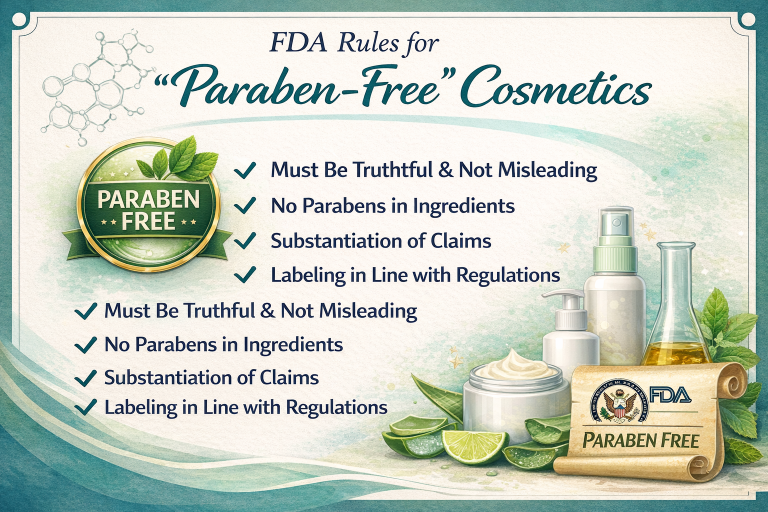
FDA Rules for Paraben-Free Cosmetics
Whether parabens are allowed, what the "paraben-free" claim actually requires, and why removing parabens makes preservation more important, not less.
Key Takeaways
- Parabens are legal in the US — no FDA ban, no concentration limit; FDA hasn't found them unsafe as used.
- "Paraben-free" is a marketing claim — no FDA definition; must be truthful & not misleading.
- It doesn't reduce compliance — a paraben-free cosmetic still follows all of MoCRA.
- You still need preservation — an alternative preservative or a preservative-free strategy, proven to work.
- Watch state law — California restricts certain parabens from 2025.
- Still a cosmetic — and registration ≠ approval.
Parabens Are Legal in U.S. Cosmetics
Parabens (methylparaben, ethylparaben, propylparaben, butylparaben, and others) are widely used cosmetic preservatives. In the U.S.:
- FDA permits them — cosmetic ingredients (other than color additives) don't need FDA pre-approval, and FDA has not found parabens unsafe as used
- No concentration limit — FDA sets none specifically for parabens; it considers them generally safe as currently used and keeps reviewing
- They're disclosed — parabens are declared on the label by INCI name (a "paraben-free" claim should be backed by an ingredient list showing none)
What "Paraben-Free" Actually Requires
"Paraben-free" is a marketing position, not an FDA-defined term. Two rules govern it, the same as any cosmetic claim:
- Truthful — the product genuinely contains no parabens, across all raw materials (some ingredients carry parabens as incidental preservatives, so check supplier documentation)
- Not misleading — it shouldn't falsely imply parabens are unsafe, or that "paraben-free" makes the product healthier; pairing it with a health claim ("paraben-free, won't disrupt hormones") drifts toward a misleading, drug-adjacent claim
Removing Parabens Makes Preservation More Important
Parabens do a job: they stop bacteria, mold, and yeast from growing in a water-containing product. Take them out and something else has to do that job — or the product can spoil and become unsafe.
- Use an alternative preservative — e.g., phenoxyethanol, organic acids, or another effective system
- Or a preservative-free strategy — anhydrous/low-water formulas, airless or single-use packaging, controlled pH
- Prove it works — preservative-efficacy (challenge) testing and microbial limits, as part of your safety substantiation
The MoCRA Path Doesn't Change
- Facility registration + product listing + Responsible Person — via Cosmetics Direct; biennial renewal; U.S. Agent if foreign
- Safety substantiation — including the preservative system and its efficacy testing
- Adverse-event reporting — serious events within 15 business days; records kept
- Compliant labeling & claims — INCI (showing no parabens if claimed), net quantity, adverse-event contact; truthful "free-of" language
Common Paraben-Free Mistakes
- Assuming "paraben-free" reduces compliance — it doesn't
- Inadequate preservation after removing parabens — a safety risk
- A "paraben-free" claim that isn't fully true — incidental parabens from raw materials
- Pairing it with health/hormone claims — misleading and drug-adjacent
- Overreaching "non-toxic" language; ignoring stricter state law (e.g., California)
- Missing the U.S. Agent (foreign); "FDA approved" claims
Get Your Paraben-Free Cosmetic Compliant
FDA Registration Assistance handles the MoCRA path (facility registration, product listing, Responsible Person, U.S. Agent, safety substantiation, labeling) and reviews your claims — including "paraben-free" and other "free-of" language — so they're truthful and not misleading. We also make sure the preservative system and its efficacy testing are reflected in the safety file, and flag stricter state requirements.
Contact us at info@fdaregistrationassistance.com or call +1 (928) 275-8333 for a quote. An independent compliance firm serving 1,000+ companies across 135+ countries, with 15+ years of experience.
Frequently Asked Questions — Paraben-Free Cosmetics
1. Are parabens banned in U.S. cosmetics?
No. Parabens are legal in U.S. cosmetics. Under the FD&C Act, FDA doesn't pre-approve or restrict cosmetic ingredients (except color additives), and FDA has not found evidence that parabens are unsafe as used in cosmetics - it considers them generally safe as currently used and continues to review the science. FDA sets no specific concentration limit for parabens. So "paraben-free" is a choice, not a legal requirement, in the U.S.
2. Is "paraben-free" an FDA-regulated term?
No - "paraben-free" is a marketing position, not a regulatory requirement, and FDA has no definition or standard for it. Like any claim, it must be truthful and not misleading: the product must actually contain no parabens, and the claim shouldn't falsely imply that parabens are unsafe or that the product is therefore "safer." A misleading "free-of" claim can be a labeling problem even though the term itself isn't FDA-defined.
3. Do paraben-free cosmetics still need to comply with FDA rules?
Yes - fully. Being paraben-free doesn't reduce your obligations. A paraben-free cosmetic is still a cosmetic under MoCRA: facility registration, product listing, a Responsible Person, safety substantiation, adverse-event reporting, and compliant labeling (U.S. Agent if foreign). "Free-of" is a marketing claim layered on top of the same compliance - not a shortcut around it.
4. If I remove parabens, what replaces them?
You still need effective preservation. Parabens are preservatives - they stop bacteria, mold, and yeast from growing in a water-containing product, which would otherwise spoil and become unsafe. Going paraben-free means using alternative preservatives (for example phenoxyethanol, organic acids, or other approved systems) or a preservative-free strategy (anhydrous/low-water formulas, airless/single-use packaging, controlled pH). Whatever you choose has to actually work - proven by preservative-efficacy testing.
5. What's the safety risk of an under-preserved paraben-free product?
A water-based cosmetic without adequate preservation can grow microorganisms and become contaminated - a genuine safety hazard and, potentially, an adulterated cosmetic. The irony is that removing an effective preservative (parabens) for marketing reasons, without a robust replacement, can make a product less safe. That's why preservative-efficacy (challenge) testing and microbial limits are core parts of the safety substantiation for any paraben-free formula.
6. How do I substantiate a "paraben-free" claim?
Confirm and document that no parabens are present - across all raw materials, not just the ones you added intentionally (some ingredients can carry parabens as incidental preservatives). Parabens are declared on the label by their INCI names (e.g., methylparaben, propylparaben; "parahydroxybenzoate" is a synonym), so your ingredient list should show none. Keep supplier documentation supporting the claim, and make sure the wording isn't misleading.
7. Are there U.S. state laws on parabens?
Yes - state law can be stricter than federal. California's Toxic-Free Cosmetics Act restricts certain parabens (isopropylparaben and isobutylparaben are among the ingredients it bans, effective 2025). So even though FDA imposes no paraben ban, a product sold in California (or other states with their own rules) may need to avoid specific parabens. The federal framework is a floor, not a ceiling - check the states you sell into.
8. How does the U.S. differ from the EU on parabens?
The EU is stricter. It banned five parabens (isopropyl-, isobutyl-, phenyl-, benzyl-, and pentylparaben) in 2014 and set concentration limits for propylparaben and butylparaben; methylparaben and ethylparaben remain permitted with limits. The U.S. imposes no paraben ban and no specific concentration limit. So a product formulated for the EU may already meet U.S. rules, but a U.S. product isn't automatically EU-compliant - and "paraben-free" means different things against different markets' baselines.
9. Does "paraben-free" make my product a drug?
No - "paraben-free" by itself is a cosmetic ingredient claim and doesn't change classification. But be careful not to pair it with health or treatment claims: "paraben-free, so it won't disrupt your hormones" or "paraben-free to prevent [condition]" drifts toward a drug/health claim and can be misleading. Keep the claim to what it is - the product doesn't contain parabens - without implying a health benefit.
10. Do foreign paraben-free brands need to register?
Yes. Any cosmetic marketed in the U.S. must comply regardless of where it's made, and foreign facilities need a U.S. Agent under MoCRA - paraben-free or not. Registration, listing, safety substantiation (including the preservative system), and labeling all apply. If you're marketing "paraben-free" into the U.S., make sure the claim is accurate for the U.S. formula and the preservation is adequately substantiated.
11. Does "clean" or "non-toxic" work the same as "paraben-free"?
Similar principle: "clean," "non-toxic," and other "free-of" terms have no FDA definition, so they must be truthful and not misleading. "Non-toxic" is especially risky because it implies a safety conclusion FDA hasn't made and can disparage permitted ingredients. These terms don't change your compliance obligations, and overreaching versions of them can create labeling problems - keep marketing claims accurate and substantiated.
12. What labeling do paraben-free cosmetics need?
Standard cosmetic labeling: a Principal Display Panel (statement of identity, net quantity) and an information panel (INCI ingredient declaration, responsible-party name/address, any required warnings, and the MoCRA adverse-event contact) - with truthful, non-misleading claims and no "FDA Approved." The ingredient list should show no parabens if you claim paraben-free, and the preservative you do use should be declared. The label must match the formula and the claims.
13. Does registering my paraben-free cosmetic mean FDA approved it?
No. FDA doesn't approve cosmetics. Registration and listing make you compliant and put your facility and products in FDA's system - they aren't approval or an endorsement, and being paraben-free doesn't add any FDA blessing. Calling a paraben-free cosmetic "FDA-approved" is misleading. Describe it accurately: a registered/listed cosmetic that (truthfully) contains no parabens.
14. What are common paraben-free mistakes?
Assuming "paraben-free" reduces compliance (it doesn't); inadequate preservation after removing parabens (a safety risk); a "paraben-free" claim that isn't fully true (incidental parabens from raw materials); pairing "paraben-free" with health/hormone claims (misleading, drug-adjacent); overreaching "non-toxic" language; ignoring stricter state law (e.g., California); missing the U.S. Agent (foreign); and "FDA approved." Most trace back to treating a marketing claim as if it changed the rules.
15. Is "paraben-free" worth doing?
That's a business/marketing decision, not a compliance one - many consumers and retailers prefer paraben-free, and many major U.S. retailers restrict parabens in their own-brand products. From a compliance standpoint it's neutral: it's allowed, it's a claim you must substantiate, and it shifts the preservation question rather than removing it. If you go paraben-free, do it with a proven preservative system and an accurate claim.
16. How does FDA Registration Assistance help paraben-free brands?
We handle the MoCRA path (facility registration, product listing, Responsible Person, U.S. Agent, safety substantiation, labeling) and review your claims - including "paraben-free" and other "free-of" language - so they're truthful and not misleading. We also make sure the preservative system and its efficacy testing are reflected in the safety file, and flag stricter state requirements. We're an independent compliance firm serving 1,000+ companies across 135+ countries with 15+ years of experience. Contact info@fdaregistrationassistance.com or +1 (928) 275-8333.
