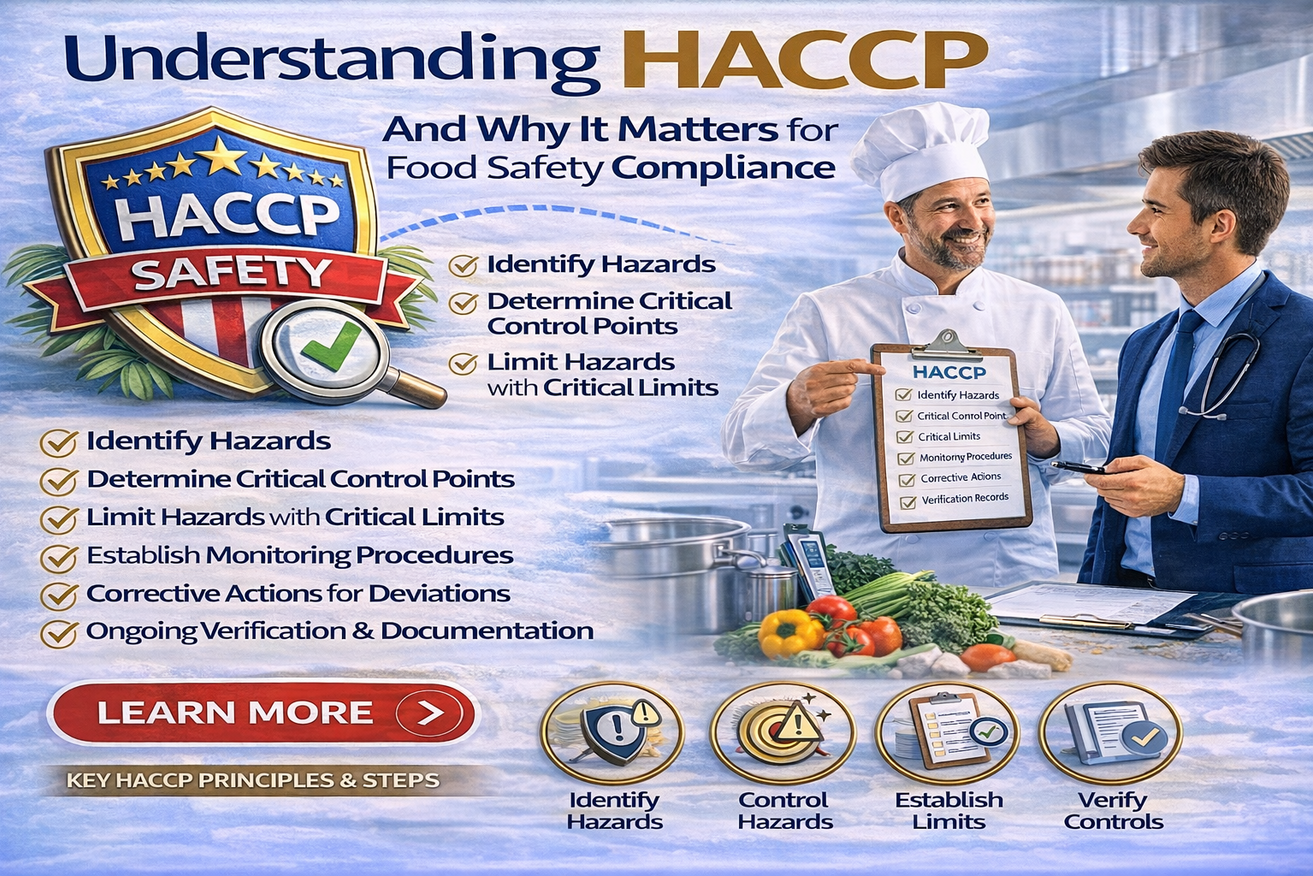
HACCP Meaning: What Is HACCP in Food Safety?

Understanding HACCP and Why It Matters for Food Safety Compliance
Food Safety Guide
Last updated:

HACCP Meaning: What Is HACCP in Food Safety?

HACCP — Hazard Analysis and Critical Control Points — is a systematic, science-based food safety management system that identifies and controls hazards in the food production process before they affect consumers. Under FDA regulations, HACCP is mandatory for two product categories: seafood processors under 21 CFR Part 123 (since 1997) and juice processors under 21 CFR Part 120 (since 2002). All other food manufacturers must comply with FSMA Preventive Controls under 21 CFR Part 117 — a related but distinct regulatory framework. A HACCP plan is not a substitute for a FSMA food safety plan, and vice versa.

This guide explains the 7 HACCP principles with regulatory-level detail, which FDA regulations mandate HACCP, how HACCP differs from FSMA Preventive Controls, the mandatory seafood and juice HACCP requirements, and how HACCP relates to FDA food facility registration.

HHazard
AAnalysis
and
CCritical
CControl
PPoints

Originally developed in the 1960s by Pillsbury, NASA, and the U.S. Army Natick Laboratories to ensure zero-defect food safety for space missions. Now the global standard for food safety — codified in CODEX Alimentarius CXC 1-1969 and mandatory in U.S. FDA regulations for seafood and juice processors.

The Core Framework

The 7 Principles of HACCP — Explained with Regulatory Precision

1
Hazard AnalysisIdentify all potential biological, chemical, and physical hazards that could reasonably occur at each step of the production process. For each hazard, determine: Is it likely to occur? Is it significant (i.e., would it cause illness or injury if not controlled)? Under 21 CFR 123.6(a) for seafood and 21 CFR 120.7 for juice, the hazard analysis must be specific to each product and the process used to produce it. Three hazard categories: biological (Salmonella, Listeria, E. coli O157:H7, C. botulinum, parasites); chemical (pesticides, heavy metals, allergens, histamine/scombrotoxin in fish, mycotoxins); physical (metal fragments, glass, bone, wood).
2
Identify Critical Control Points (CCPs)A CCP is a step where a control measure is essential to prevent, eliminate, or reduce a significant hazard to an acceptable level. Not every step is a CCP — over-identification of CCPs is a common HACCP error. The four-question CCP Decision Tree is the standard tool: (1) Do control measures exist for this hazard? (2) Is this step specifically designed to eliminate or reduce it? (3) Could contamination occur at or beyond this step at unacceptable levels? (4) Will a subsequent step eliminate it? If no subsequent step controls the hazard — this step is a CCP. Common CCPs: cooking (thermal kill); metal detection; pH adjustment; chilling (temperature control).
3
Establish Critical LimitsCritical limits are the maximum or minimum values for biological, chemical, or physical parameters at each CCP. Critical limits must be scientifically validated — proven to control the hazard to the required level. Examples: minimum pasteurization temperature for juice (5-log pathogen reduction under 21 CFR Part 120); maximum time-temperature for chilled scombroid fish (histamine prevention); minimum internal temperature for cooked seafood; maximum water activity for intermediate moisture foods. Critical limits must be measurable in real time during production.
4
Establish Monitoring ProceduresMonitoring procedures define how each CCP is measured, how frequently, who is responsible, and how measurements are recorded. Monitoring must be able to detect a loss of control at the CCP in time to take corrective action before the product is affected. Continuous monitoring (e.g., temperature recorders) is preferred over periodic sampling where feasible. Monitoring records must include the actual values measured — not just pass/fail designations.
5
Establish Corrective ActionsCorrective actions define what must be done when monitoring indicates a CCP deviation. Under 21 CFR 123.7 (seafood), corrective actions must: (1) ensure no injurious or adulterated product enters commerce; (2) correct the cause of the deviation; and (3) be documented in a corrective action record including the product disposition, the cause, the action taken, and the name of the responsible person. Corrective action records are among the most frequently reviewed by FDA inspectors during seafood HACCP inspections.
6
Establish Verification ProceduresValidation (done first) confirms that the HACCP plan — especially the critical limits — will actually control the hazards when implemented. Validation uses scientific data, published research, or challenge testing. Verification (ongoing) confirms the plan is functioning as intended — reviewing monitoring records, observing CCPs, calibrating equipment, testing finished product, and reassessing the HACCP plan at least annually or when there is a process change. Validation “will this work?” Verification “is it working?”
7
Establish Recordkeeping and DocumentationUnder 21 CFR 123.9 (seafood HACCP), required records include: monitoring records for each CCP; corrective action records; verification records; and the HACCP plan itself. Minimum retention: 1 year for refrigerated and frozen products; 2 years for shelf-stable and long shelf-life products. Records must be available to FDA inspectors within 24 hours of a request. Electronic records are acceptable with proper identity and signature controls. Records must be kept at the processing facility or be accessible from the processing facility.
Who Must Have HACCP Under U.S. Law

Mandatory HACCP Requirements in U.S. Regulations

Product CategoryRegulationAgencyEffective DateKey Requirements
Seafood (all seafood products)21 CFR Part 123FDADecember 1997Written HACCP plan for each product; covers all significant hazards; annual reassessment; 1–2 year records; applies to domestic AND foreign processors exporting to U.S.
Juice (all juice products)21 CFR Part 120FDAJanuary 2002 (large); Jan 2003–2004 (small)5-log reduction of the most resistant relevant pathogen required; pasteurization is the primary CCP; juice sold without 5-log treatment must carry a specific warning label.
Meat and poultry9 CFR Part 417USDA/FSIS (not FDA)1996–1998USDA/FSIS mandatory HACCP — separate from FDA regulatory framework. Applies to slaughter and processing plants inspected under the Federal Meat Inspection Act and Poultry Products Inspection Act.
All other human food manufacturers21 CFR Part 117FDA2016–2020 (phased)FSMA Preventive Controls — based on HACCP principles but a distinct regulatory framework. Requires PCQI; addresses process, allergen, sanitation, and supply chain controls. Not a HACCP plan but incorporates HACCP-style hazard analysis.
HACCP vs. FSMA Preventive Controls — The Key Distinction

HACCP vs. FSMA Preventive Controls — Not Interchangeable

HACCP and FSMA Preventive Controls are both hazard-based food safety systems but are distinct regulatory frameworks with specific differences that matter for compliance:

HACCP — 21 CFR Parts 123 and 120
Who it applies toMandatory for seafood processors (Part 123) and juice processors (Part 120)
Framework7 principles; focuses on CCPs in the production process
Personnel requirementHACCP team; no specific individual qualification requirement in the regulation
Supply chainNo explicit supply chain program in the 7-principle framework
Allergen controlsAllergens addressed as chemical hazards in the hazard analysis; no separate allergen control requirement
SanitationPrerequisite programs (PRPs) like SSOPs complement the HACCP plan but are typically separate documents
FSMA Preventive Controls — 21 CFR Part 117
Who it applies toMandatory for all other food manufacturers (with limited exemptions for very small businesses)
Framework4 types of preventive controls: process, allergen, sanitation, and supply chain-applied controls
Personnel requirementA Preventive Controls Qualified Individual (PCQI) must develop or oversee the food safety plan — a specific qualification requirement not in traditional HACCP
Supply chainExplicit supply chain program required for hazards controlled by the supplier — a separate component of the food safety plan
Allergen controlsAllergen controls are a required, explicitly named type of preventive control with specific written procedure requirements
SanitationSanitation controls are a required, explicitly named type of preventive control integrated into the food safety plan

A seafood or juice processor that implements a HACCP plan under 21 CFR Part 123 or 21 CFR Part 120 does not separately need to comply with 21 CFR Part 117 for those regulated activities — but must still comply with the cGMP requirements in Part 117 Subpart B. A manufacturer of conventional packaged foods does not satisfy 21 CFR Part 117 by having a HACCP plan — the FSMA Preventive Controls requirements are a distinct regulatory obligation.

Seafood HACCP — 21 CFR Part 123

FDA Mandatory Seafood HACCP — Key Requirements Under 21 CFR Part 123

Who Must Comply with Seafood HACCP

All domestic and foreign seafood processors that export seafood to the United States must have written HACCP plans under 21 CFR Part 123. A seafood processor is any person engaged in commercial, custom, or institutional processing of fish or fishery products. Foreign seafood processors must also register their facilities with FDA and designate a U.S. Agent. U.S. importers of seafood must verify foreign suppliers’ HACCP compliance as part of FSVP.

Key Seafood-Specific Hazards

Scombrotoxin (histamine) in scombroid species (tuna, mahi-mahi, mackerel) — cannot be destroyed by cooking; time-temperature control is the CCP. Clostridium botulinum in reduced oxygen packaged (vacuum-packed) fish — temperature abuse enables toxin production. Listeria monocytogenes in smoked fish (ready-to-eat seafood). Anisakis parasites in raw finfish intended for raw consumption — freezing is the CCP. These seafood-specific hazards are the most frequently reviewed by FDA during seafood HACCP inspections.

FDA Compliance Support

Need FDA Food Facility Registration or HACCP Compliance Support?

FDA Registration Assistance provides FDA Food Facility Registration, U.S. Agent services for foreign food processors, FSVP programs for food importers, food label compliance review, Prior Notice guidance, and regulatory consulting on HACCP and FSMA Preventive Controls obligations. 1,000+ clients. 135+ countries. 15+ years of FDA regulatory experience.

Contact us at info@fdaregistrationassistance.com or call +1 (928) 275-8333.

FAQ

Frequently Asked Questions — HACCP Meaning and FDA Food Safety

1. What does HACCP stand for?

HACCP stands for Hazard Analysis and Critical Control Points. It is a systematic, science-based food safety management system designed to identify, evaluate, and control hazards that could make food unsafe. HACCP focuses on preventing hazards during production rather than inspecting finished products.

2. What are the 7 principles of HACCP?

(1) Conduct a hazard analysis; (2) Identify Critical Control Points (CCPs); (3) Establish critical limits; (4) Establish monitoring procedures; (5) Establish corrective actions; (6) Establish verification procedures (including validation); (7) Establish recordkeeping and documentation. Each principle is detailed above with the relevant CFR citation for seafood HACCP under 21 CFR Part 123.

3. Is HACCP required by FDA?

Yes — for two specific product categories. Seafood processors must comply with 21 CFR Part 123 (mandatory since 1997). Juice processors must comply with 21 CFR Part 120 (mandatory since 2002). All other food manufacturers must comply with FSMA Preventive Controls under 21 CFR Part 117 — a related but distinct regulatory framework with specific differences including the PCQI requirement.

4. What is a Critical Control Point (CCP) in HACCP?

A CCP is a step in the production process where a control measure is essential to prevent, eliminate, or reduce a significant food safety hazard to an acceptable level. Not every step is a CCP — only steps where the hazard cannot be controlled later in the process. Common CCPs: cooking (thermal kill of pathogens), metal detection, pH adjustment, chilling (temperature control). The four-question CCP Decision Tree is the standard tool for identifying CCPs.

5. What is the difference between HACCP and FSMA Preventive Controls?

Both are hazard-based systems but are distinct. HACCP (21 CFR Parts 123 and 120): 7 principles; mandatory for seafood and juice; no explicit PCQI requirement; no explicit supply chain program. FSMA Preventive Controls (21 CFR Part 117): 4 control types; mandatory for all other food manufacturers; requires a PCQI; includes an explicit supply chain program; explicitly addresses allergen controls and sanitation controls as separate required types. A HACCP plan does not satisfy FSMA Preventive Controls; FSMA Preventive Controls does not satisfy mandatory HACCP for seafood and juice.

6. When was HACCP developed?

HACCP was developed in the early 1960s by Pillsbury Company, NASA, and the U.S. Army Natick Laboratories to ensure near-zero defect food safety for the U.S. space program. Presented publicly at the 1971 National Conference on Food Protection. FDA mandatory seafood HACCP took effect December 1997; juice HACCP effective beginning 2002.

7. What are critical limits in HACCP and how are they established?

Critical limits are the maximum or minimum values at each CCP that must be met to control the hazard. They must be scientifically validated. Examples: minimum pasteurization temperature for juice (5-log pathogen reduction); minimum internal temperature for cooked seafood; maximum time-temperature for chilled scombroid fish. Critical limits must be measurable in real time during production.

8. What is validation vs. verification in HACCP?

Validation (done before implementation): confirms the HACCP plan — especially critical limits — will actually control the hazards. Uses scientific data, research, or challenge testing. Verification (ongoing): confirms the HACCP system is functioning as intended — reviewing monitoring records, observing CCPs, calibrating equipment, testing finished product, and reassessing at least annually. Validation: “will this work?” Verification: “is it working?”

9. Who must have a HACCP plan under FDA regulations?

Under FDA: all domestic and foreign seafood processors exporting to the U.S. (21 CFR Part 123), and all juice processors (21 CFR Part 120). Under USDA: meat and poultry processors under 9 CFR Part 417. All other food manufacturers must have FSMA Preventive Controls under 21 CFR Part 117.

10. What is FDA seafood HACCP under 21 CFR Part 123?

21 CFR Part 123 mandates HACCP for all seafood processors. Each seafood product requires a written HACCP plan covering all significant hazards. Common hazards: C. botulinum in vacuum-packaged fish; Listeria in smoked fish; scombrotoxin (histamine) in scombroid species; Anisakis parasites in raw finfish. Records retained 1 year (refrigerated/frozen) or 2 years (shelf-stable). Plans must be reassessed at least annually. Applies to foreign seafood processors exporting to the U.S. as well as domestic processors.

11. What is FDA juice HACCP under 21 CFR Part 120?

21 CFR Part 120 requires juice processors to achieve a 5-log reduction of the most resistant relevant pathogen. Pasteurization is the primary CCP for most juice products. Juice sold without the required 5-log treatment must carry a specific warning statement. Effective beginning January 2002 for large businesses.

12. What is the CCP Decision Tree?

The four-question CCP Decision Tree: Q1 — Do control measures exist for this hazard? Q2 — Is this step designed to eliminate or reduce the hazard? Q3 — Could contamination occur at or beyond this step at unacceptable levels? Q4 — Will a subsequent step eliminate or reduce the hazard to acceptable levels? If no subsequent step controls it — this step is a CCP. Over-identifying CCPs makes the plan unmanageable and is a common HACCP error.

13. What are the HACCP recordkeeping requirements under 21 CFR Part 123?

Required records: monitoring records for each CCP; corrective action records; verification records; and the HACCP plan itself. Retained 1 year (refrigerated/frozen) or 2 years (shelf-stable). Must be available to FDA inspectors within 24 hours of request. Can be electronic with proper identity and signature controls.

14. Do foreign seafood processors exporting to the U.S. need HACCP?

Yes. 21 CFR Part 123 applies to both domestic and foreign seafood processors exporting to the United States. Foreign seafood processors must also register with FDA and designate a U.S. Agent. U.S. seafood importers must verify foreign suppliers’ HACCP compliance as part of their FSVP.

15. What is a HACCP team?

The HACCP team develops and maintains the HACCP plan. Typically includes: a HACCP coordinator/team leader; production personnel with detailed process knowledge; quality assurance personnel; and engineering/maintenance representatives. The team conducts the hazard analysis, identifies CCPs, establishes critical limits, develops monitoring and corrective action procedures, and conducts verification. At smaller facilities, one person may serve multiple HACCP team roles.

16. What are the three types of hazards addressed in HACCP?

Biological: pathogens (Salmonella, Listeria, E. coli O157:H7, C. botulinum, Campylobacter, norovirus, parasites). Chemical: pesticide residues, heavy metals, allergens, scombrotoxin/histamine, cleaning residues, mycotoxins, veterinary drug residues. Physical: metal fragments, glass, bone, wood, plastic, personal care items. The hazard analysis must evaluate all three categories at each step.

17. Is HACCP the same as ISO 22000 or FSSC 22000?

No. ISO 22000 and FSSC 22000 are food safety management system standards that incorporate HACCP as one component alongside prerequisite programs and management system elements. FSSC 22000 certification does not specifically satisfy FDA’s mandatory HACCP regulations (21 CFR Part 123 or Part 120). A facility may hold FSSC 22000 certification and still be required to maintain a separate HACCP plan under 21 CFR Part 123 for seafood.

18. How does HACCP relate to FDA food facility registration?

HACCP and FDA food facility registration are separate requirements. Registration under 21 U.S.C. § 350d is required of all food facilities. HACCP (Part 123 or Part 120) is required for seafood and juice processors. A seafood processor must register AND have a HACCP plan. Registration does not satisfy the HACCP obligation; HACCP compliance does not satisfy the registration obligation.

19. What is a HACCP plan vs. a food safety plan under FSMA?

A HACCP plan (21 CFR Part 123 or 120) covers the 7 HACCP principles for the facility’s specific products. A FSMA food safety plan (21 CFR Part 117) includes a hazard analysis, 4 types of preventive controls (process, allergen, sanitation, supply chain), monitoring, corrective actions, verification, and a supply chain program. They are not interchangeable documents. One does not substitute for the other.

20. What is the prerequisite program (PRP) relationship to HACCP?

Prerequisite programs (PRPs) are foundational hygiene practices applied throughout the facility — including GMPs, sanitation SOPs, pest control, equipment maintenance, and allergen management — that create the conditions necessary for HACCP to function. PRPs address the facility environment; HACCP addresses specific hazards at specific CCPs. Without adequate PRPs, a HACCP plan cannot function effectively.

21. Can a food manufacturer use its HACCP plan to satisfy FSVP?

No. A facility’s own HACCP plan applies to its own production process — not to its raw material suppliers. FSVP under 21 CFR Part 1 Subpart L is an importer obligation covering supplier verification for imported foods — a separate regulatory framework entirely.

22. Do exporters to the United States need HACCP programs?

Foreign seafood processors must have HACCP under 21 CFR Part 123. Foreign juice processors must have HACCP under 21 CFR Part 120. For other food categories, U.S. importers must verify foreign food supplier food safety compliance as part of FSVP supplier verification — in practice, foreign processors without documented food safety systems will not pass FSVP audits conducted by U.S. importers.

23. What is scombrotoxin (histamine) and why is it a key seafood HACCP hazard?

Scombrotoxin (histamine) forms in scombroid fish species (tuna, mahi-mahi, mackerel, bluefish) when bacteria break down the amino acid histidine after improper chilling. Histamine cannot be destroyed by cooking. Scombrotoxin poisoning mimics allergic reaction symptoms and develops rapidly. Under 21 CFR Part 123, time-temperature control is the CCP for scombroid species. Scombrotoxin is one of the most commonly cited seafood HACCP hazards during FDA inspections.

24. What corrective action requirements apply under seafood HACCP?

Under 21 CFR 123.7, corrective actions must: (1) ensure no injurious or adulterated product enters commerce; (2) correct the cause of the deviation; (3) be documented in a corrective action record including product disposition, cause, action taken, and name of responsible person. Corrective action records are frequently reviewed by FDA inspectors during seafood HACCP inspections.

25. How do I get FDA compliance support for my food facility or HACCP program?

Contact FDA Registration Assistance at info@fdaregistrationassistance.com or call +1 (928) 275-8333. For seafood HACCP (21 CFR Part 123) or juice HACCP (21 CFR Part 120), provide product types, process descriptions, and any existing HACCP documentation. For FSMA Preventive Controls, provide your food product categories and facility information.

HM
Reviewed By Hector Matos, Senior Regulatory Compliance Specialist  ·  15+ years FDA compliance experience  ·  Published March 2026
Food and Drug Administration Contact Us for Assistance