
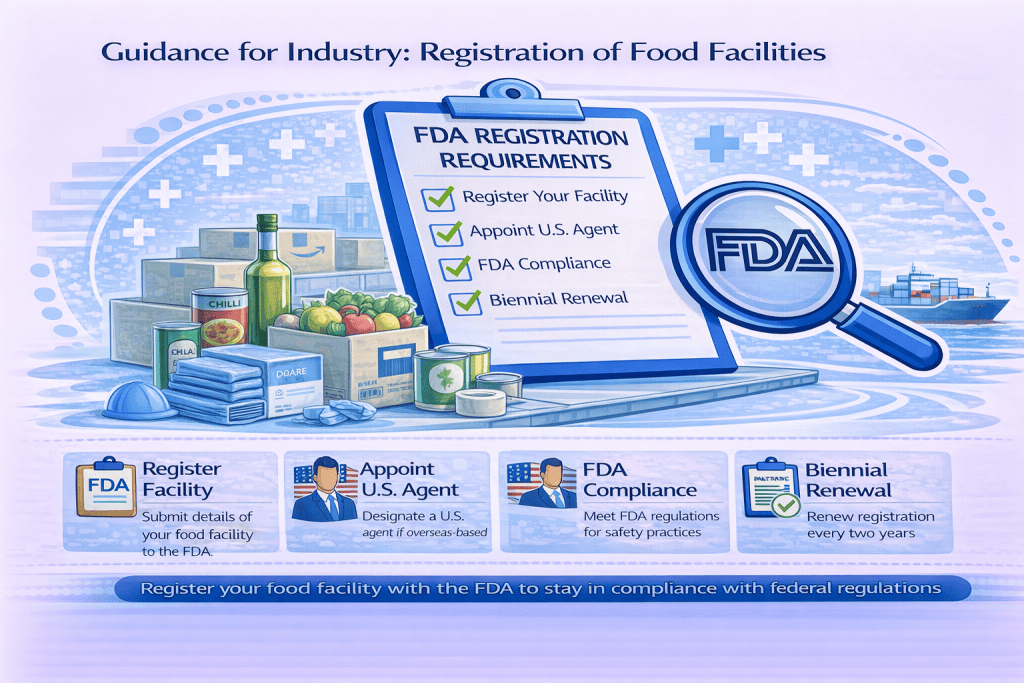
FDA Food Facility Registration Requirements
Who must register a food facility with FDA, which facilities are exempt, what the registration must contain, the U.S. Agent rule for foreign facilities, and the deadlines for updates, cancellation and biennial renewal under 21 CFR Part 1, Subpart H. Prepared by FDA Registration Assistance, with 15+ years of FDA regulatory experience.
Not sure whether your facility must register? Tell us where each location is and what happens there. We can confirm whether registration applies, prepare the filing and U.S. Agent designation, and keep updates and renewals on schedule.
Request My Facility Registration QuoteStart With the Physical Facility and Its Activities
The requirement is not determined by brand ownership, company nationality or having a website. It depends on the physical location and the activities conducted there (21 CFR 1.225). FDA's food-business overview confirms that covered facilities register before beginning those activities.
| Activity | What It Covers | Registration |
|---|---|---|
| Manufacturing/processing | Making food from ingredients, or changing food: cooking, mixing, freezing, packaging, labeling and similar steps | Required unless exempt |
| Packing | Placing food into a container other than packaging it as part of processing | Required unless exempt |
| Holding | Storing food, including warehouses, cold storage, grain elevators and distribution centers | Required unless exempt |
| Foreign facility | Any of the above for food exported to the United States | Required, plus a U.S. Agent, unless the food is further processed abroad |
Assess each location individually rather than assuming a supplier's registration covers your operation:
- List each location and what happens there.
- Identify whether food is for human or animal consumption in the United States.
- Check the definitions and exemptions.
- Decide whether this is a new filing or maintenance of an existing record.
Who Does Not Have to Register
The rule does not apply to the following facilities (21 CFR 1.226). These are definitional exemptions, not blanket exemptions for every business using those labels:
Exempt Facilities
- Farms
- Retail food establishments
- Restaurants
- Nonprofit food establishments that prepare or serve food directly to consumers
- Fishing vessels not engaged in processing
- Facilities regulated exclusively by USDA (meat, poultry, egg products)
- Foreign facilities whose food is further manufactured or packaged at another foreign facility, unless that step is only labeling or similar de minimis activity
Watch the Edge Cases
- A farm mixed-type facility may conduct activities outside the farm definition and must register.
- A private residence is not a facility, but a commercial kitchen in a home is assessed on its facts.
- Online sellers that do not manufacture, pack or hold food may not register, but their suppliers and warehouses usually must.
- A foreign facility that only labels food for another foreign processor is not exempt.
What the Registration Must Contain
A registration includes the following information (21 CFR 1.232); our document checklist turns it into a practical list:
| Item | Detail |
|---|---|
| Facility identity | Name, full address and phone number; preferred mailing address; trade names; parent company |
| Unique facility identifier (UFI) | Currently a DUNS number, with an address matching the registration (FDA registration Q&A guidance) |
| Owner, operator or agent in charge | Name, address, phone and email |
| Food categories and activities | Product categories from Form FDA 3537 and the activity type for each (processor, packer, warehouse and others) |
| Inspection assurance | A statement that FDA will be permitted to inspect the facility as the FD&C Act allows |
| Certification | That the information is true and accurate, and, if filed by someone else, that they are authorized |
| Foreign facilities only | U.S. Agent name, address, phone and email, plus an emergency contact |
Register, Update, Cancel and Renew
If a registration is not renewed, FDA considers it expired and treats the facility as unregistered (21 CFR 1.241). Need a renewal? See food facility registration renewal.
What Registration Does Not Establish
Not FDA Approval
A registration number does not convey FDA approval or endorsement of the facility or its products (21 CFR 1.242).
No Fee, No Certificate
FDA charges no registration fee and issues no certificate (FDA). A consultant's fee pays for private services.
Not Other Requirements
Registration does not satisfy FSVP, Prior Notice or food labeling obligations.
Register With the Right Support
Foreign Food Facility Registration
Registration, DUNS and U.S. Agent for facilities outside the United States.
How to Register Step by Step
The filing process in FDA's Food Facility Registration Module.
Biennial Renewal
Renew an existing registration in the October to December window.
U.S. Agent for Food Facilities
Required for every foreign food facility.
Food Importers
What importers need beyond facility registration.
Common Registration Mistakes
The errors that cause rejected or cancelled registrations.
Get Your Food Facility Registered Correctly
FDA Registration Assistance confirms whether each location must register, prepares the registration with the correct food categories and activity types, obtains or verifies the DUNS number, provides U.S. Agent service for foreign facilities, and handles updates, ownership changes and biennial renewal.
- Confirm registration applicability for each facility.
- File the registration and U.S. Agent designation correctly the first time.
- Agree the scope, documents and pricing before any paid work begins.
Contact our specialists, email info@fdaregistrationassistance.com, or call +1 (928) 275-8333. Registration pricing · FDA food services.
Request My Facility Registration QuoteFDA Registration Assistance is a private consulting firm, not FDA or any government agency. FDA registration is not FDA approval, clearance or certification.
Frequently Asked Questions — Food Facility Registration
Who generally must register a food facility?
Owners, operators, or agents in charge of domestic or foreign facilities that manufacture, process, pack, or hold food for U.S. consumption must register unless an exemption applies (21 CFR 1.225). A domestic facility registers whether or not its food enters interstate commerce. FDA guidance
Is every farm or online seller treated the same way?
No. The regulatory definitions and actual activities matter. A farm mixed-type facility may conduct activities outside the farm exemption; a seller is not automatically a registered processing or holding facility. FDA guidance
When does renewal occur?
Covered facilities renew from October 1 through December 31 of every even-numbered year. Updating a registration is a different action. FDA guidance
What happens when ownership changes?
The former owner cancels the facility's registration within 60 calendar days of the change, and the new owner submits a new registration (21 CFR 1.234). FDA's guidance describes this cancellation-and-new-registration process rather than a routine ownership-field edit. FDA guidance
Is guidance the same as a binding regulation?
No. Guidance explains FDA's current thinking. The registration requirements are established by applicable law and regulation, including 21 CFR Part 1, Subpart H. FDA guidance
Does registration satisfy FSVP or labeling requirements?
No. Facility registration, importer verification, labeling, and other food requirements must be assessed separately. FDA guidance
Does FDA charge a fee for food facility registration?
No. FDA does not charge a fee to register or renew a food facility, and it does not issue registration certificates (FDA). Any fee you pay a private company is for its services, not to FDA.
What information does a food facility registration require?
The facility name, full address and phone number; an FDA-accepted unique facility identifier (UFI); parent company and trade names; owner, operator or agent in charge contact details; the food product categories and activity types at the facility; an assurance that FDA will be permitted to inspect; and a certification that the information is true and accurate (21 CFR 1.232). Foreign facilities also provide U.S. Agent and emergency contact details.
What is a UFI, and is a DUNS number required?
The registration must include a unique facility identifier recognized by FDA (21 CFR 1.232). FDA currently recognizes the DUNS number as an acceptable UFI, and it verifies that the address associated with the UFI matches the facility address in the registration (FDA registration Q&A guidance). See DUNS request assistance if you do not have one.
Do foreign food facilities need a U.S. Agent?
Yes. A foreign facility must designate a U.S. Agent who lives or maintains a place of business in the United States and is physically present there; a mailbox or answering service does not qualify (21 CFR 1.227). The agent is FDA's communications link with the facility. See U.S. Agent services for food facilities.
When must a new facility register?
Before it begins to manufacture, process, pack or hold food for consumption in the United States (21 CFR 1.230). For a foreign facility, that means before the first shipment is made.
How long do I have to update a registration?
Within 60 calendar days of any change to the required information, such as a new operator, agent in charge or U.S. Agent (21 CFR 1.234). A change of owner is handled through cancellation and a new registration instead.
When must a registration be cancelled?
Within 60 calendar days of the reason for cancellation, for example when the facility stops operating, stops supplying food for U.S. consumption, or is sold (21 CFR 1.235).
What happens if a registration is not renewed?
FDA considers the registration expired, treats the facility as having failed to register, and may cancel the registration (21 CFR 1.241). Failing to register, renew, update or cancel as required is a prohibited act under section 301(dd) of the FD&C Act, and food from an unregistered foreign facility offered for import is subject to being held at the port.
Does a registration number mean FDA approved my facility?
No. Assignment of a registration number means the facility is registered; it does not convey FDA approval or endorsement of the facility or its products (21 CFR 1.242).
Is my food facility registration information public?
The list of registered facilities and registration documents are not subject to disclosure under the Freedom of Information Act, nor is information derived from them that would identify a specific registered facility (21 CFR 1.243). That is why there is no public database to look up a food facility registration number.
Do warehouses and cold storage facilities have to register?
Generally, yes. Holding food, including ambient, refrigerated and frozen storage, is a covered activity, and warehouse activity types are listed on the registration form (21 CFR 1.232). See FDA registration for food warehouses.
Is a private kitchen or home-based business a facility?
The private residence of an individual is not a facility under the rule (21 CFR 1.227), but a commercial operation does not become a private residence just because someone lives there. Borderline operations deserve a factual assessment.
Does each location need its own registration?
Yes. Registration is per facility. A facility may consist of one or more contiguous structures, and a single building may house more than one facility if they are under separate ownership (21 CFR 1.227). A supplier's registration does not cover your own locations.
How do I actually submit the registration?
Registrations, renewals, updates and cancellations are submitted electronically through FDA's Food Facility Registration Module unless FDA grants a waiver. For the step-by-step process, see how to register an FDA food facility, and for documents, see documents needed for FDA food registration.
Request Facility Registration Support
Tell us what your company makes, sells, or distributes, where each product is manufactured or packed, your U.S. importer or buyer arrangement, label readiness, and target shipment date.
Submitting this inquiry does not purchase a service or authorize paid work. Our team can discuss the scope and required materials before you commission assistance. Fields marked with an asterisk are required.