
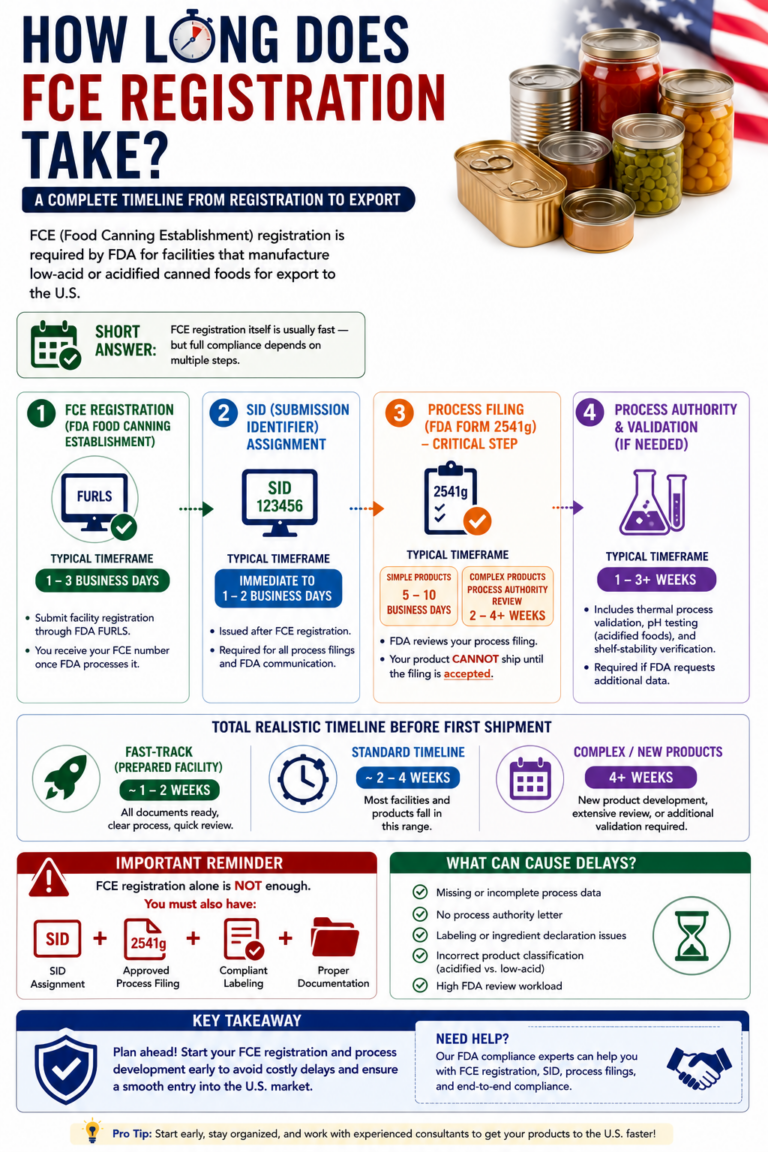
How Long Does FCE Registration Take?
Why there's no fixed number, what actually drives your timeline, and how to compress it.
Key Takeaways
- No single fixed number — timing depends on your product and readiness.
- FCE registration itself is quick — it's a submission, not an approval.
- Validation is the long pole — the process authority sets your real timeline.
- Two different questions — "FCE done" vs. "ready to ship" aren't the same.
- More products = longer — each may need its own scheduled process.
- Start the slow step first — engaging a process authority early compresses everything.
"FCE Done" vs. "Ready to Ship"
Most of the confusion comes from treating these as the same thing. They're not:
FCE registration itself
Registering the establishment to get your FCE number. A submission of facility information — typically one of the quicker steps once your details are accurate and consistent.
Ready to ship (full filing)
FCE plus a validated scheduled process for each product. Governed by the process-authority validation and SID filings — the part that actually takes time.
What's Quick — and What's the Long Pole
Rather than a made-up day count, here's each piece by relative speed, so you can see where the time actually goes and what to start first:
Facility Registration + U.S. Agent
The base FDA registration and your U.S. contact. Arranged relatively quickly.
Usually quickerFCE registration
Submitting facility information to get your FCE number. A registration, not a review — typically among the fastest steps.
Usually quickerProcess-authority validation
Technical evaluation of your formulation, pH, and process for each product. Scheduling and completing this is the single biggest driver — the long pole. Start it first.
The long pole — start hereScheduled process (SID) filings
Filed per product and container once validation is done — more products means more filings.
Takes longerLabel, documentation & prior notice
Can largely progress alongside the filings rather than after them.
Runs in parallelWhat Makes Your Timeline Shorter or Longer
Information readiness
Accurate, consistent facility and product details move things fast; missing or mismatched info triggers the correction loops where most time is lost.
Number of products
FCE registers the facility once, but each product, formulation, or container size may need its own scheduled process and validation.
Process authority availability
Validation has to be scheduled and completed — the most common bottleneck, and the reason to engage one early.
Confirmed classification
Knowing up front whether you're low-acid or acidified avoids reworking the whole plan on the wrong requirements.
How to Compress Your Timeline
You can't shortcut FDA's requirements, but you can remove almost all the waiting:
- Start the long pole first — engage a process authority before anything else, so validation isn't what everyone waits on
- Get your information consistent — facility details aligned across DUNS and FDA registration before you submit
- Confirm classification up front — low-acid vs. acidified, so you build on the right requirements
- Do the submission right the first time — accuracy avoids the back-and-forth corrections that cause most delays
- Run parallel tracks — let labeling and documentation progress while validation is underway
Get the Timeline Right From the Start
FDA Registration Assistance maps your timeline around the steps that take longest, then executes the FDA side: Food Facility Registration and U.S. Agent, FCE and scheduled process (SID) filings, and process-authority coordination — starting the validation early so it isn't the thing holding up your ship date.
Contact us at info@fdaregistrationassistance.com or call +1 (928) 275-8333. Food Facility Registration is available starting at $858. Trusted by companies across 135+ countries, with 15+ years of experience.
Frequently Asked Questions
1. How long does FCE registration take?
There's no single fixed number, and any guide that gives you an exact day count is guessing. FCE registration itself — the facility submission that gets you an FCE number — is usually one of the fastest steps, because it's a registration rather than a review-gated approval. What actually sets your timeline is the process-authority validation and scheduled process (SID) filings behind it, which vary by product and readiness.
2. Why can't you just tell me the exact number of days?
Because an honest answer depends on your specifics: how ready and consistent your facility information is, how many products and containers you have, whether your process documentation exists, and whether a process authority is already engaged. A precise day count quoted without knowing those things sets a false expectation — the safer approach is to plan around the steps that take longest.
3. Isn't FCE registration the slow part?
Usually not. Registering the establishment to get your FCE number is typically quick once your information is accurate. The slower part is the scheduled process filings and, above all, the process-authority validation — the technical evaluation that confirms your product is safely processed. That's the long pole, so it's the piece to start first.
4. So how long until I can actually ship?
That's the more useful question, and the answer is: as long as your longest step takes — which is normally the validation and SID filings, not the FCE registration. Rather than aim for a fixed date, plan your ship date around getting the process authority engaged and the filings done, and treat the FCE registration itself as a quick piece near the start.
5. What's the biggest bottleneck?
Process-authority validation. It's a technical review of your formulation, pH, and process for each product and container, and scheduling and completing it takes the most time of any single step. Engaging a process authority early is the most effective way to shorten your overall timeline.
6. What makes it take longer?
Incomplete or inconsistent facility information, a larger number of products or container sizes (each may need its own scheduled process), process documentation that doesn't exist yet, no process authority lined up, and unconfirmed classification. Each of these adds back-and-forth, and the corrections loop is where most exporters lose time.
7. Can I speed FCE registration up?
You can compress the overall timeline, mostly by removing waiting. Have accurate, consistent facility and product information ready, confirm your classification up front, and engage a process authority early so validation isn't the thing everyone waits on. Doing the submission right the first time avoids the correction cycles that cause most delays.
8. Does the number of products affect the timeline?
Yes. FCE registration identifies the facility once, but each product — and often each container size or formulation — may need its own scheduled process and validation. More SKUs generally means more filings and more validation work, which extends the timeline even though the FCE registration itself doesn't change.
9. Do I need SID filings after FCE?
For regulated products, yes. FCE registration comes first and identifies the establishment; then a scheduled process (SID) is filed for each product, validated by a process authority. The FCE is the quick front end; the scheduled process and validation are where the time goes.
10. Can I ship before FCE and the filings are done?
No. For products that require it, FCE and the scheduled process must be complete before the shipment arrives, and a missing filing can't be resolved at the border. This is exactly why starting early — especially the validation — matters more than any specific day count.
11. What happens if I start too late?
If the filings aren't complete when your shipment reaches the port, it can be held, delayed, or refused, with added storage costs and lost time. Starting late — particularly leaving process-authority validation until the end — is one of the most common and avoidable causes of delay.
12. Does an experienced partner make it faster?
It can, mainly by removing avoidable waiting: getting your information right the first time, confirming classification, sequencing the steps so validation starts early, and keeping the FCE and SID filings aligned. The gains come from avoiding correction loops and bottlenecks, not from any shortcut through FDA's requirements.
13. Is FCE registration required for all foods?
No — only certain categories, mainly low-acid canned foods and acidified foods, need FCE and a scheduled process. If your product doesn't fall into those categories, this timeline may not apply, though Food Facility Registration still does. Confirming your classification first tells you whether the FCE timeline is even relevant.
14. How does FDA Registration Assistance help with timing?
We map your timeline around the steps that take longest, then execute the FDA side: Food Facility Registration and U.S. Agent, FCE and scheduled process (SID) filings, and process-authority coordination — starting the validation early so it isn't the thing holding up your ship date. Starting at $858 for registration, for companies across 135+ countries. Contact info@fdaregistrationassistance.com or +1 (928) 275-8333.
