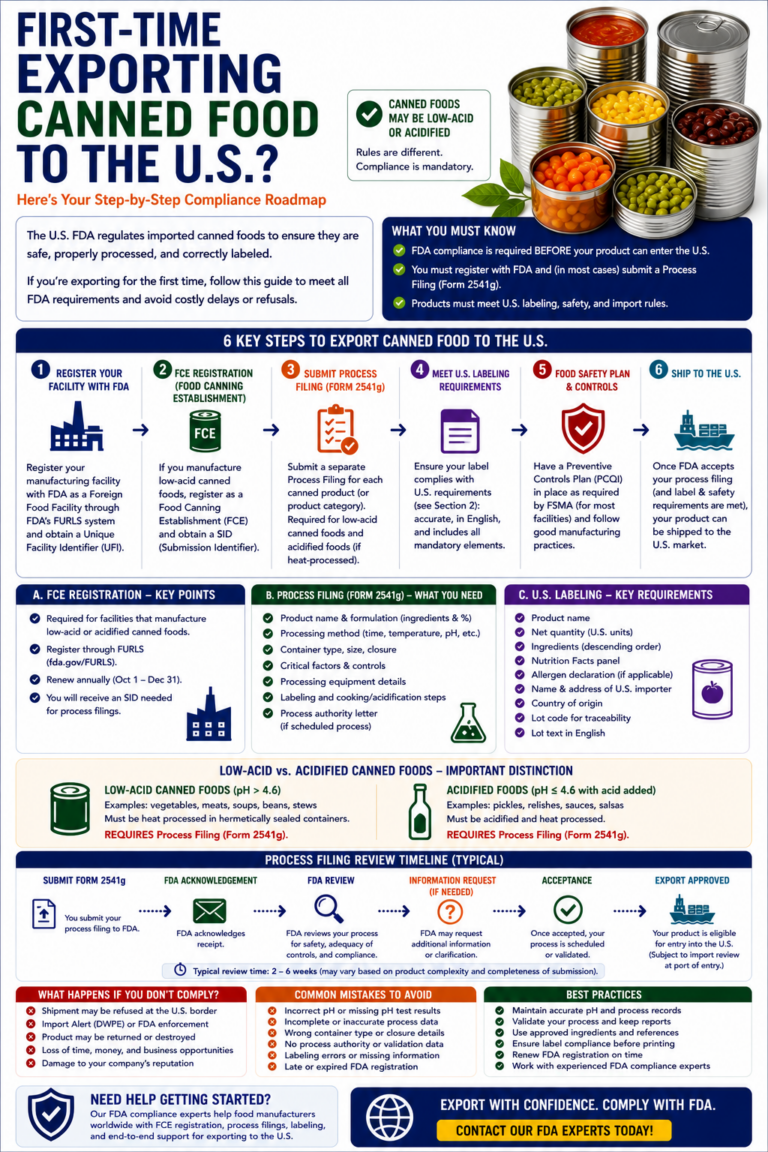
First-Time Exporting Canned Food to the U.S.?
Why the first shipment trips people up, how long it really takes, and what's at stake if it's not ready.
Key Takeaways
- The first shipment carries the most risk — no history, and the tightest timeline.
- Validation & filings are the long pole — start with them, not last.
- Start earlier than feels necessary — plan around the slow steps.
- Classification comes first — it sets your whole requirement list.
- A hold isn't just a delay — storage costs, re-export risk, strained customers.
- Nothing can be fixed at the border — it all goes in beforehand.
What Makes a First Shipment Vulnerable
First-time canned exports fail for a predictable set of reasons — none about product quality:
No compliance history
Nothing on file yet — every requirement is being met for the very first time, so any gap shows up now.
First-time classification
Getting low-acid vs. acidified wrong sends the whole requirement list off course before you start.
Over-relying on a broker
Brokers file entry and prior notice — not registration, FCE, filings, labeling, or FSVP.
What's Quick — and What Takes Time
The biggest first-timer misconception is that this is a few-days task. Some of it is quick; the parts that make canned food safe are not. Plan around the slow steps:
Facility registration + U.S. Agent
The base registration and your FDA contact. Can be arranged relatively quickly.
Usually quickerFCE registration
Registering the canning establishment to get your FCE number, once you're classified.
Usually quickerProcess-authority validation
An expert establishes and validates the safe process for each product and container. Technical, product-specific, and the usual long pole — line it up first.
Takes longer — start hereScheduled process (SID) filings
Filed per product and container once validation is done — and they must match production.
Takes longerLabel + documentation + prior notice
Compliant label matching the filing, consistent docs, and prior notice before arrival.
Parallel-friendlyWhat Happens If It's Not Ready
A first shipment that isn't compliant doesn't just wait — it costs, in ways that compound:
Held at entry
FDA can hold the shipment while you try to resolve the issue — time you didn't budget for.
Added storage & logistics costs
Product sitting at the port accrues charges, on top of the shipping you've already paid.
Refusal or re-export
If it can't be brought into compliance, it may be refused and have to be re-exported or destroyed.
Strained first impression
A failed first shipment can damage a new customer relationship before it's even established.
Line Up the Pieces
Once you know the timeline, these walk through the specifics:
What the terms mean
FCE, SID, process authority — decoded, with whether they apply to you.
Beginner canning guide →The full canned roadmap
The complete ordered path for a canned food entering the U.S.
Canned food market entry →The filing itself
What FCE and the scheduled process filing contain, and the forms.
Process filing explained →Readiness checklist
A quick check that your FCE/SID filings are actually in order.
FCE/SID checklist →Make Your First Shipment Count
FDA Registration Assistance maps your timeline around the pieces that take longest, then handles the FDA side end to end: classification guidance, Food Facility Registration and U.S. Agent, FCE and scheduled process filings with process-authority coordination, and label and documentation review — so your first shipment is complete before it ships.
Contact us at info@fdaregistrationassistance.com or call +1 (928) 275-8333. Food Facility Registration is available starting at $858. Trusted by companies across 135+ countries, with 15+ years of experience.
Frequently Asked Questions
1. Why is my first canned-food shipment the riskiest?
Because you have no compliance history, first-time classification is easy to get wrong, filings and validation may be incomplete, and there's often over-reliance on a broker for steps a broker doesn't handle. A single missing piece can hold the shipment — and the first one is where those gaps usually surface.
2. How far ahead should I start?
Earlier than most first-timers expect. Facility registration and FCE can be arranged relatively quickly, but process-authority validation and the scheduled process filings take longer because each product and container is reviewed technically. Plan around those longer items rather than your ideal ship date — starting well ahead is the safest approach.
3. How long does compliance actually take?
It varies by product and how ready your process documentation is. Registration and FCE can be quick; the process-authority validation and scheduled process filings are the longer part and shouldn't be assumed to be a matter of days. The honest answer is to build in time and start early rather than rely on a fast turnaround.
4. What's the first thing I should do?
Confirm your product classification — low-acid canned, acidified, or neither — because it determines whether you need FCE and a scheduled process. Getting classification right first prevents building your whole timeline on the wrong set of requirements.
5. Do all canned foods need FCE and SID?
No. Low-acid canned and acidified foods do; a naturally acidic product in a can may not. The classification decides it, not the can. This is why the first step is confirming which category your product falls into.
6. What happens if my first shipment isn't compliant?
It can be held, and while it sits you may face added storage and logistics costs; if it can't be brought into compliance it may be refused and have to be re-exported or destroyed. Beyond the direct cost, a failed first shipment can strain a new customer relationship before it's established.
7. Can I fix problems once the shipment reaches the port?
Generally no. FDA reviews the shipment at entry, and a missing FCE, scheduled process, or compliant label can't be resolved at the border. For canned foods, everything has to be complete before the product leaves — which is exactly why the timeline matters.
8. Do I need a process authority for my first shipment?
If your product is low-acid canned or acidified, yes. A process authority establishes and validates the scheduled process your filing depends on. Because this is often the longest step, it's the one to line up first — not last.
9. Who is responsible for FSVP and prior notice?
The U.S. importer holds FSVP responsibility, and prior notice is usually filed by the customs broker or importer before the shipment arrives. As the exporter you don't own these directly, but you need a compliant importer in place and consistent information for the prior notice.
10. Does labeling really matter on the first shipment?
Yes — labeling errors are among the most common causes of holds. For canned and acidified foods, the label must be compliant and match the formulation and process on file. A first shipment with a mismatched label can be stopped even if everything else is in order.
11. Can my broker handle all of it?
No. Your broker typically files the customs entry and prior notice, but facility registration, FCE, scheduled process filings, labeling, and FSVP are separate and outside a broker's usual scope. Assuming the broker covers everything is a classic first-timer mistake.
12. What are the most common first-time mistakes?
Assuming facility registration alone is enough, skipping FCE or the scheduled process, misclassifying the product, a label that doesn't match the filing, no process-authority validation, and prior notice errors. Nearly all are preventable with enough lead time.
13. Is this the same as the beginner canning guide?
They're related. The beginner guide decodes what the terms mean — FCE, SID, process authority — and whether they apply to you. This page focuses on getting a first shipment out: why it's risky, the realistic timeline, and what a hold costs. Reading both gives you the terms and the plan.
14. How does FDA Registration Assistance help first-time exporters?
We map your timeline around the pieces that take longest, then handle the FDA side end to end: classification guidance, Food Facility Registration and U.S. Agent, FCE and scheduled process filings, and process-authority coordination, plus label and documentation review — all so your first shipment is complete before it ships. Starting at $858 for registration, for companies across 135+ countries. Contact info@fdaregistrationassistance.com or +1 (928) 275-8333.