
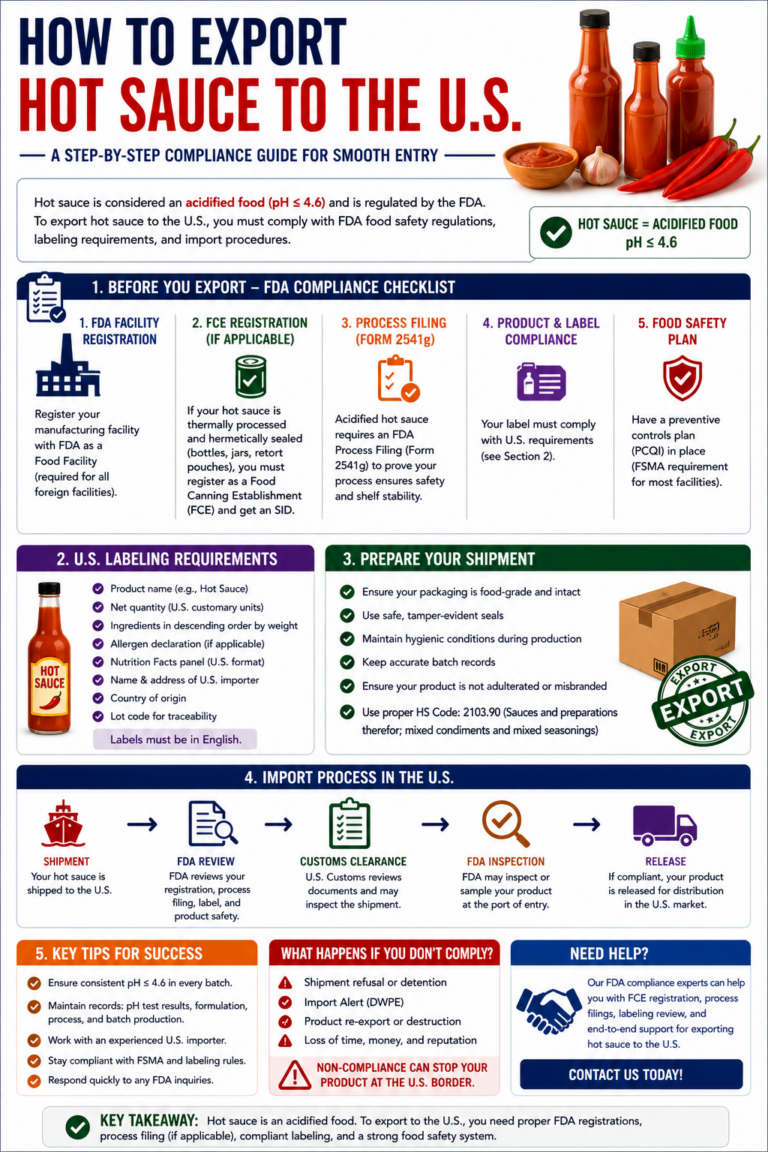
How to Export Hot Sauce to the U.S.
Trusted by 1,000+ companies across 135+ countries, with 15+ years of FDA regulatory experience. Below: why hot sauce is acidified, how to classify yours, the full export checklist, and how to label it.
Most Hot Sauce Is an Acidified Food
Hot sauce usually starts from low-acid ingredients — peppers, sometimes fruit or vegetables — and reaches a safe, shelf-stable pH only because acid or vinegar is added. That is the textbook definition of an acidified food under 21 CFR Part 114, and it pulls hot sauce into the same process-filing world as canned foods.
Is Your Hot Sauce Acidified, Acid, or Fermented?
Not every pepper sauce files the same way. The finished pH and how you got there decide it — and a process authority makes the call.
| Type | What it means | Filing |
|---|---|---|
| Acidified | Acid or vinegar added to low-acid ingredients to reach pH 4.6 or below (most sauces) | FCE + SID on Form 2541e |
| Naturally acid | Predominantly vinegar, pH 4.6 or below with little low-acid content | May fall outside Part 114 — confirm with a process authority |
| Fermented | pH lowered by fermentation; vinegar or acid often added on bottling | Usually acidified once acid is added → FCE + SID |
Because hot sauce often sits right at the 4.6 line, the finished equilibrium pH must be measured properly before you decide.
Everything You Need to Export Hot Sauce
Labeling Your Hot Sauce
The label has to match what you filed — a mismatch is a common cause of holds even when the process filing is correct. Every bottle needs:
Nutrition & Ingredients
A compliant Nutrition Facts panel and an ingredient list in descending order by weight.
Allergens
Declare any of the nine major allergens present — fish (anchovy), soy, sesame, and tree nuts appear in some recipes.
Identity & Net Quantity
Accurate product identity, net quantity in U.S. units, and the name and place of business.
Match the Filing
The label, formulation, and SID filing must align, all in English.
Export Your Hot Sauce Without Delays
Send us your sauce formulation, finished pH if you have it, bottle sizes, and facility details. We'll confirm classification, complete food facility registration and U.S. Agent service, handle FCE and SID filings, coordinate a process authority, support FSVP, and review your label — so your hot sauce clears the FDA the first time. Email info@fdaregistrationassistance.com or call +1 (928) 275-8333.
Frequently Asked Questions — Exporting Hot Sauce to the U.S.
Do I need FDA registration to export hot sauce to the U.S.?
Yes. The facility must complete FDA food facility registration, and because most hot sauces are acidified foods, you also need FCE registration and a SID process filing. Foreign facilities additionally need a U.S. Agent.
Is hot sauce an acidified food?
Usually yes. Most commercial hot sauces add vinegar or acid to peppers to reach a finished pH of 4.6 or below, which makes them acidified foods under 21 CFR Part 114 — requiring FCE registration and a scheduled-process filing.
Why does hot sauce need FCE and SID?
Because as an acidified food it must be processed to control Clostridium botulinum. The FDA requires the establishment (FCE) and validated process (SID) on file before you ship — see what foods require FCE/SID filing.
What form does hot sauce file on?
Acidified foods file the scheduled process on Form FDA 2541e, after FCE registration on Form FDA 2541. Each product and container size generally needs its own filing and Submission Identifier.
How much does it cost to export hot sauce?
Our service fee is $858, which covers food facility registration and U.S. Agent service. The FDA itself charges $0. FCE registration, the SID filing, and process-authority validation are handled as added scope for acidified products.
Does the FDA charge a fee?
No. The FDA charges $0 for food facility registration and for FCE and SID filings. Our fee covers completing and managing the process correctly and on time before you ship.
Is a DUNS Number required?
Yes. The DUNS Number is the required Unique Facility Identifier for food facility registration. We help you obtain one if you don't already have it, so it doesn't delay your filing.
Does FDA registration mean my hot sauce is approved?
No. The FDA does not approve foods. Registration and process filing are mandatory requirements, but they are separate from any notion of FDA “approval.”
What if my hot sauce is just vinegar and peppers?
A sauce that is naturally acidic — predominantly vinegar, with a finished pH at or below 4.6 and little low-acid content — may be an acid food, which can fall outside the acidified-foods rule. A process authority confirms this from your formulation and pH.
Are fermented hot sauces acidified foods?
It depends. If the low pH comes only from fermentation, the sauce may fall outside the acidified rule; if vinegar or acid is added — as in most fermented-then-bottled sauces — it becomes an acidified food requiring FCE and SID.
Do I need a process authority?
Yes, for acidified hot sauce. A process authority establishes and validates the acidification process — pH, acid, and time — behind your SID filing, and the FDA expects one to be involved.
What pH matters for hot sauce?
The finished equilibrium pH. At or below 4.6 with added acid, it's an acidified food. The measurement must be done properly, since hot sauce often sits close to the 4.6 line where classification can change.
Do I need Better Process Control School?
Supervisors of acidified processing generally must be trained, typically through Better Process Control School, as part of meeting the 21 CFR Part 114 requirements for acidified foods.
Is FSVP required to export hot sauce?
Yes, for imports. The U.S. importer must run a Foreign Supplier Verification Program to verify your facility. We can support FSVP or act as the FSVP Agent.
Is Prior Notice required?
Yes. Every shipment of hot sauce to the U.S. requires FDA Prior Notice before arrival. Errors in Prior Notice can cause immediate refusal at the port of entry.
Do foreign hot sauce makers need a U.S. Agent?
Yes. Every foreign facility that registers with the FDA must designate a U.S. Agent under 21 CFR 1.227 as its U.S. point of contact. We provide this service.
What labeling does hot sauce need?
A Nutrition Facts panel, ingredient list, allergen declarations, net quantity, name and place of business, and English text — matching the filed formulation. See fixing a food label before import.
What allergens appear in hot sauces?
Some hot sauces contain fish (anchovy), soy, sesame, or tree nuts, depending on the recipe. Any of the nine major allergens that are present must be declared accurately on the label.
Does each sauce or bottle size need its own SID?
Generally yes. Because the scheduled process depends on formulation and container, each product and size usually needs its own process filing and Submission Identifier on file.
How long does it take to get export-ready?
Facility registration is often completed within a few business days, but FCE/SID and process-authority validation take longer, so plan ahead of your first shipment to avoid a rushed timeline.
What happens if I skip FCE or SID?
Acidified products without proper FCE and SID filings are commonly detained or refused at the port. The filings must be in place before shipping.
Do I need to renew anything?
Food facility registration renews biennially — every two years, in even-numbered years — and process filings are updated whenever a product, formulation, or container changes.
What's the difference between hot sauce and salsa for the FDA?
Both are typically acidified foods needing FCE and SID. Salsa often contains chunky low-acid vegetables, while hot sauce is pepper-and-acid based, but both rely on acidification, and a process authority sets the right process for each.
Can you handle the whole hot sauce export setup?
Yes. We complete food facility registration and U.S. Agent service, handle FCE and SID filings, coordinate a process authority, support FSVP, and review labeling so your sauce clears the FDA.
How do I get started?
Send us your sauce formulation, finished pH if known, bottle sizes, and facility details. Contact our team and we'll confirm classification, complete the filings, and handle the import pieces. Email info@fdaregistrationassistance.com or call +1 (928) 275-8333.