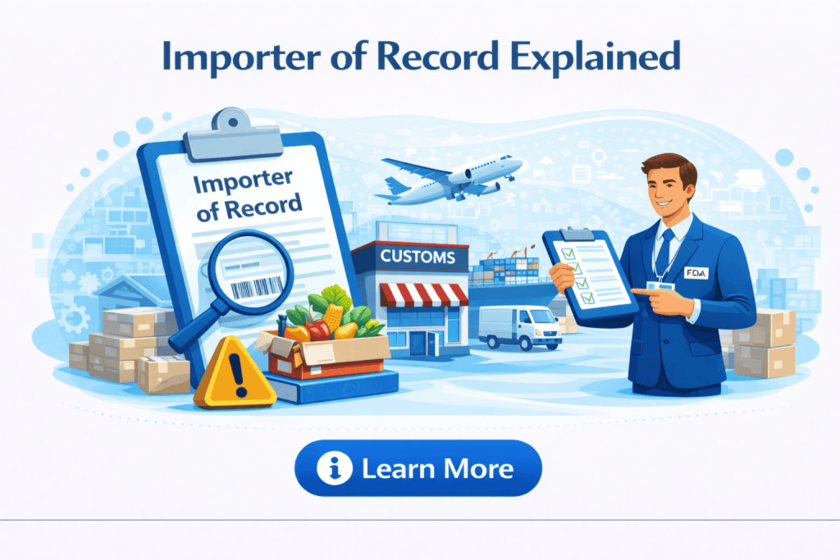
Importer of Record (IOR), Explained
The party CBP holds responsible for your import — what it does, who can be it, and how it differs from the roles people confuse it with.
Key Takeaways
- IOR = the CBP-responsible party for a customs entry — even if a broker files it.
- It pays duties, ensures compliance, and keeps records (generally five years).
- It's the principal on the customs bond — no bond, no entry.
- Owner, purchaser, or authorized broker can be the IOR; foreign IORs are possible with a bond.
- Incoterms decide it — DDP makes the seller the IOR; otherwise usually the U.S. buyer.
- Not the same as the FDA importer roles (FSVP importer, initial importer).
What the Importer of Record Does
- Files the customs entry — declaring value and classification (HS code)
- Pays duties, taxes, and fees — the party CBP sends the bill (and any penalty) to
- Posts the customs bond — the IOR is the principal (19 CFR Part 113)
- Ensures compliance — with all applicable U.S. laws, including other agencies' rules (like FDA's) for regulated goods
- Keeps records — generally five years (19 CFR Part 163), produced on demand
Who Can Be the IOR (Including Foreign IORs)
- The owner or purchaser of the goods — the most common IOR
- A licensed customs broker the owner/purchaser authorizes to act as IOR
- A foreign company — as a "foreign importer of record," if it qualifies and meets CBP requirements (a U.S. customs bond, often a resident agent for service of process)
IOR vs Consignee vs Broker — and Incoterms
| Party | What it is |
|---|---|
| Importer of Record | Named on the customs entry as legally responsible to CBP for the importation |
| Consignee | The party the goods are shipped to on the transport document (often, but not always, the IOR) |
| Customs broker | Files the entry on the IOR's behalf; not the IOR unless authorized to act as one |
The IOR and FDA-Regulated Products
For FDA-regulated goods, the IOR must ensure the shipment can lawfully enter — a compliant product, Prior Notice and a registered foreign facility for food, and no blocking import alert. But the IOR is distinct from FDA's own importer roles:
- FSVP importer (food) — the U.S.-based party responsible for foreign-supplier verification; FDA holds this party accountable, not the customs IOR
- Initial importer (device) — the first U.S. receiver, which registers and lists with FDA
- U.S. Agent — the FDA contact for the foreign facility
Structure Your Import & FDA Roles
FDA Registration Assistance helps you get the roles right for FDA-regulated imports — clarifying who should be the Importer of Record, ensuring the FDA-side roles are correctly assigned (FSVP importer for food, initial importer for devices, U.S. Agent for the foreign facility), and making sure the product and entry are FDA-compliant so shipments clear. We coordinate with your customs broker on the entry side.
Contact us at info@fdaregistrationassistance.com or call +1 (928) 275-8333. An independent compliance firm serving 1,000+ companies across 135+ countries, with 15+ years of experience.
Frequently Asked Questions — Importer of Record
1. What is an Importer of Record (IOR)?
The Importer of Record is the party U.S. Customs and Border Protection (CBP) holds legally responsible for a customs entry: filing the entry, declaring the value and classification, paying duties, taxes, and fees, ensuring the goods comply with U.S. law, and keeping entry records (generally five years). The IOR is the principal on the customs bond. It's fundamentally a customs role - the party CBP sends the bill and any penalty notice to.
2. What does the IOR actually do?
Files the customs entry and declares the goods' value and classification (HS code); pays the duties, taxes, and fees; posts and maintains the customs bond; ensures the shipment complies with all applicable U.S. laws (including other agencies' rules, like FDA's, for regulated goods); and keeps the entry records available for CBP. In short, the IOR is legally accountable to CBP for that importation - even if a broker does the filing.
3. Who can be the Importer of Record?
Generally the owner or purchaser of the goods, or a licensed customs broker the owner/purchaser authorizes to act as IOR. The IOR must have an importer number (often the IRS/EIN, or a CBP-assigned number) and a customs bond. So it's not just whoever handles the shipping - it's the party formally named on the entry as responsible to CBP. Choosing the right IOR is a decision, not an afterthought.
4. Can a foreign company be the Importer of Record?
Sometimes - a foreign company can act as a "foreign importer of record" if it qualifies and meets CBP requirements, notably posting a U.S. customs bond and satisfying CBP's rules (often involving a resident agent for service of process). But note a key limit: for imported food under FDA's FSVP rule, the FSVP importer must be a U.S.-based party. So even a foreign IOR often still needs a U.S. party for the FDA side. See our importer of record for FDA-regulated products page.
5. Is the IOR the same as the consignee?
Not by definition. The consignee is the party the goods are shipped to on the transport document; the IOR is the party named on the customs entry as legally responsible for the importation. They're often the same, but not always - and a consignee who can't make entry (no bond/importer number) can't serve as IOR. It's worth confirming which party is playing which role rather than assuming they're identical.
6. How do Incoterms affect who the IOR is?
Heavily. Under Delivered Duty Paid (DDP), the seller generally becomes the IOR, because they take on customs clearance, duties, and compliance. Under most other terms, the U.S. buyer/consignee is typically the IOR. So your commercial terms directly determine who's the IOR (and, for food, who owns the goods at entry, which drives the FSVP importer determination). Align your Incoterms with who you intend to be the responsible party.
7. What is a customs bond and does the IOR need one?
A customs bond is a financial guarantee that the importer will comply with customs laws and pay duties, taxes, and fees; the IOR is the principal on the bond. Most commercial imports require one - either a single-entry bond (for one shipment) or a continuous bond (covering a year of entries). Without a valid bond in the right party's name, entry generally can't be made, whatever the sales contract says.
8. What records does the IOR have to keep?
Under U.S. customs recordkeeping rules, the IOR must retain entry records - generally for five years from the date of entry - and produce them on demand, covering the entry declaration, valuation, classification, and supporting documents. For FDA-regulated goods there are separate FDA records too (for example FSVP records for food). So a regulated import carries both customs recordkeeping (IOR) and FDA recordkeeping.
9. Does a customs broker become the IOR?
Not automatically. A licensed customs broker usually files the entry on the IOR's behalf - but the IOR (the owner/purchaser) remains the party responsible to CBP. A broker can act as the IOR only if the owner/purchaser authorizes it to. So "my broker handles it" doesn't remove your responsibility as IOR unless the broker has formally taken on that role. Confirm in writing who the IOR actually is.
10. What's the IOR's role for FDA-regulated goods?
Beyond the customs basics, the IOR must ensure an FDA-regulated shipment can lawfully enter: that the product is compliant (labeling, claims, any required clearance/approval), that food has Prior Notice and a registered foreign facility, and that the shipment isn't blocked by an import alert. But the IOR is distinct from FDA's own importer roles - the FSVP importer (food) and the initial importer (device) - and FDA holds those parties accountable. See our importer of record for FDA-regulated products page for that interplay.
11. Is the IOR the same as the FSVP importer or the FDA initial importer?
No - these are different roles that often get conflated. The IOR is the CBP-responsible party for the customs entry. The FSVP importer is the FDA-defined U.S. party responsible for verifying a food's foreign supplier. The initial importer is the FDA-defined first U.S. receiver of a device, which registers/lists with FDA. One firm may hold more than one, but they're distinct - and FDA holds the FDA roles (not the customs IOR) accountable for FDA compliance.
12. Does being the IOR make a product FDA-approved?
No. Being the IOR is about customs responsibility for the entry; it has nothing to do with FDA approval. FDA doesn't approve most products, and the customs role confers no FDA authorization. The product still needs whatever FDA pathway applies (registration, and any premarket clearance/approval). So "we're the importer of record" is not a statement about FDA status.
13. What goes wrong when the IOR isn't set correctly?
Common problems: no bond in the right party's name (entry can't be made); a party named as IOR that didn't intend to take that responsibility; Incoterms that put IOR duties on the wrong party; and - for FDA goods - a broker or third party unknowingly listed as the FSVP importer with no records. Each causes delays, cost, or compliance exposure. Assigning the IOR (and the FDA roles) deliberately, in writing, prevents these.
14. Do I need a customs broker if I'm the IOR?
You don't have to use one, but most importers do, because customs entry is technical (classification, valuation, entry filing). The broker acts on your behalf; you remain the IOR. For FDA-regulated goods, the broker/entry side is separate from the FDA compliance side (registration, U.S. Agent, FSVP, labeling), which is where a compliance firm like ours fits in - we handle the FDA side while your broker handles the customs entry.
15. Is a foreign IOR a good idea for selling into the U.S.?
It can work, but weigh it carefully. A foreign IOR needs a U.S. customs bond and to meet CBP's requirements, and it doesn't remove the need for U.S.-side FDA roles (for food, the FSVP importer must be U.S.-based). Many foreign sellers find it cleaner to arrange a U.S.-based importer or the right U.S. roles rather than carry every responsibility as a foreign IOR. We can help you compare the setups for your product.
16. How does FDA Registration Assistance help with the IOR?
We help you get the roles right for FDA-regulated imports: clarifying who should be the Importer of Record, ensuring the FDA-side roles are correctly assigned (FSVP importer for food, initial importer for devices, U.S. Agent for the foreign facility), and making sure the product and entry are FDA-compliant so shipments clear. For foreign sellers, we help structure a compliant U.S.-side setup. We coordinate with your customs broker on the entry side. We're an independent compliance firm serving 1,000+ companies across 135+ countries with 15+ years of experience. Contact info@fdaregistrationassistance.com or +1 (928) 275-8333.