Understanding TTB Registration Requirements in the United States
TTB Registration for Alcohol Importers, Wholesalers, and Beverage Companies
TTB registration is a critical federal compliance step for companies that import, distribute, produce, bottle, warehouse, or sell regulated alcohol products in the United States. FDA Registration Assistance helps alcohol and beverage companies understand how TTB requirements connect with FDA registration, U.S. Agent service, Prior Notice, labeling review, and import compliance.
Compliance Support Built for U.S. Market Entry
Alcohol businesses often need more than one filing. A correct compliance strategy may involve TTB permits, FDA food facility registration, label review, Prior Notice, importer setup, and coordination with customs brokers.
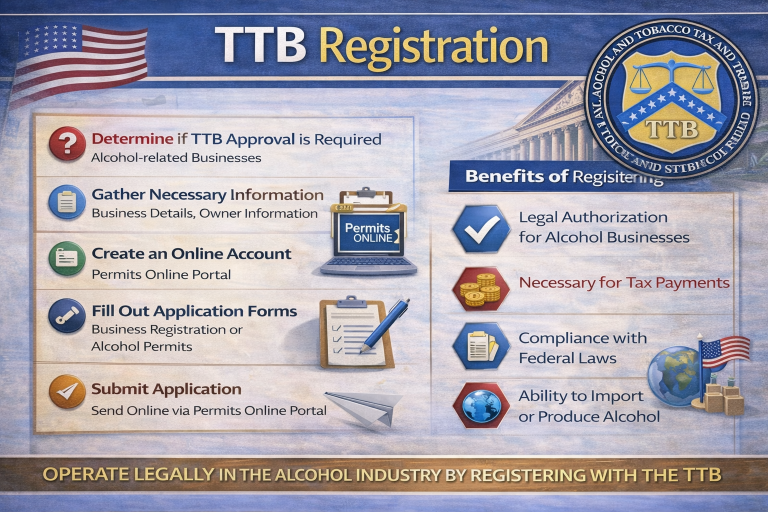
Quick Facts About TTB Registration
Why TTB Registration Matters
TTB registration is not just an administrative filing. It helps determine whether a business is legally positioned to import, distribute, produce, bottle, warehouse, or sell regulated alcohol products in the United States. When the setup is incomplete or inconsistent, the business may face delayed permit review, shipment problems, label approval issues, customs complications, or regulatory questions after products are already in commerce.
Companies entering the U.S. alcohol market often focus on sales, distribution, branding, and logistics first. Compliance should come earlier. A product that is ready commercially may still be blocked by missing permits, incorrect label assumptions, incomplete importer setup, FDA registration gaps, Prior Notice issues, or misunderstandings about whether TTB, FDA, or both agencies apply.
FDA Registration Assistance helps companies review the full compliance picture before they move forward. Our team supports alcohol importers, beverage brands, and foreign manufacturers with FDA-related obligations while helping them understand where TTB registration fits into the overall U.S. market entry process.
Core TTB Registration Concepts
Importer Permit
An alcohol importer generally needs the correct federal authority before bringing alcohol beverages into the United States for commercial sale. The importer is usually a U.S.-based business and must maintain accurate business, ownership, address, and operational information.
Wholesaler Operations
Businesses that distribute alcohol products may need to evaluate federal and state requirements before selling to retailers, restaurants, distributors, or other commercial buyers. TTB registration is only one part of the total compliance framework.
FDA Coordination
Alcohol products may also involve FDA requirements when facilities manufacture, pack, process, or hold products for the U.S. market. FDA Food Facility Registration, U.S. Agent service, and Prior Notice can be important parts of import readiness.
TTB Registration vs FDA Compliance
TTB and FDA regulate different parts of the alcohol and beverage compliance process. TTB focuses heavily on alcohol tax, permits, labeling approval, alcohol beverage classification, and regulated alcohol industry operations. FDA focuses on food safety, facility registration, Prior Notice, ingredient and labeling compliance for certain products, and import-related food requirements.
| Compliance Area | Compliant Approach | Non-Compliant Approach |
|---|---|---|
| Business setup | Confirm the correct U.S. business structure, responsible parties, address, permit category, and importer role before submitting filings. | Apply with incomplete ownership details, unclear business activity, or an address that does not match the real import or distribution operation. |
| TTB registration | Identify whether the company needs importer, wholesaler, producer, bottler, or other alcohol-related authorization. | Assume one permit covers every activity without reviewing the actual product, business model, and distribution chain. |
| FDA registration | Confirm whether foreign or domestic facilities involved with the product need FDA Food Facility Registration and U.S. Agent service. | Assume alcohol products are always outside FDA requirements and ship without reviewing facility registration obligations. |
| Labeling | Review alcohol content, identity, claims, warnings, ingredients, net contents, responsible party details, and any required label approvals before printing. | Print labels before confirming whether TTB, FDA, or both agencies have requirements that affect the product label. |
| Imports | Coordinate permit status, FDA registration, Prior Notice, customs documentation, and broker instructions before the shipment leaves origin. | Wait until the shipment is already in transit before discovering missing registration, label, or importer documentation. |
Key Compliance Requirements to Review
Every alcohol business is different, but most companies should review the same core compliance areas before launching, importing, or distributing alcohol products in the United States.
Legal Authority and Official Rules
Alcohol compliance can involve several federal authorities depending on the product and business activity. The Federal Alcohol Administration Act provides core authority for alcohol industry permits and labeling controls. TTB regulations are found in Title 27 of the Code of Federal Regulations, including permit and basic permit requirements. FDA requirements may also apply under the Federal Food, Drug, and Cosmetic Act when alcohol or beverage products fall within food safety, facility registration, Prior Notice, or misbranding rules.
Companies should not treat registration as proof that a product is approved. Registration and permits are compliance steps, but they do not automatically make a product label, formulation, claim, shipment, or distribution model lawful. A product can still face problems if it is misbranded, adulterated, improperly labeled, incorrectly imported, or sold under an incomplete permit structure.
Real-World Risks of Getting TTB Registration Wrong
Compliance mistakes can create business problems that are far more expensive than handling the registration correctly at the beginning. The risk is not only regulatory. It can affect launch dates, cash flow, distributor confidence, importer relationships, marketplace listings, and customer trust.
Why Companies Commonly Fail TTB Registration
Most companies do not fail because they are trying to avoid compliance. They fail because the alcohol regulatory process is more layered than expected. A company may understand its product and market but still misunderstand the difference between TTB registration, FDA registration, state alcohol licensing, customs entry, label approval, Prior Notice, and importer responsibility.
Another common issue is applying too late. If labels are already printed, shipments are already booked, or buyers are already waiting, the company has less flexibility to correct problems. A rushed application may contain errors, missing documentation, inconsistent ownership details, or incorrect product assumptions.
The safest approach is to confirm the compliance pathway before commercial commitments are made. This allows the business to align the importer structure, facility registration, label review, broker instructions, and shipment timing before product enters the U.S. supply chain.
When Should You Start TTB Registration?
Companies should start reviewing TTB registration before they import, sell, advertise, distribute, warehouse, or contract with buyers in the United States. If the product is coming from a foreign manufacturer, FDA obligations should also be reviewed before the first shipment is scheduled.
Start Before You Print Labels
Label review should happen before printing because alcohol labels may involve TTB considerations, FDA considerations, claim restrictions, mandatory statements, alcohol content issues, and responsible party details. Correcting a digital label is easier than correcting printed inventory.
Start Before You Ship
Imports should be coordinated before goods leave the foreign facility. FDA registration, Prior Notice, importer information, broker instructions, and shipment records should be aligned to reduce the risk of port delays or entry complications.
Get Professional TTB and FDA Compliance Support
FDA Registration Assistance is based in Miami, Florida, USA and supports alcohol importers, beverage companies, foreign manufacturers, distributors, and brand owners preparing to enter the U.S. market. We help businesses understand the connection between TTB registration, FDA Food Facility Registration, U.S. Agent service, Prior Notice, labeling review, and import readiness.
Our team has assisted over 1,000 companies across 135+ countries with more than 15 years of combined regulatory experience.
Related FDA Registration Assistance Services
Alcohol and beverage companies may need several compliance services before importing or selling products in the United States. These internal resources can help you understand related requirements.
Frequently Asked Questions About TTB Registration
These answers are written for alcohol importers, foreign manufacturers, beverage brands, distributors, and business owners preparing to enter the U.S. market.
1. What is TTB registration?
TTB registration refers to federal registration, permit, or application requirements administered by the Alcohol and Tobacco Tax and Trade Bureau for certain alcohol-related business activities. Depending on the business model, a company may need authority to import, wholesale, produce, bottle, store, or distribute alcohol beverages. The correct requirement depends on what the company does, where it is located, and how the product enters the U.S. market.
2. Who needs TTB registration?
Companies may need TTB registration if they import alcohol into the United States, operate as an alcohol wholesaler, produce alcohol beverages, bottle or package alcohol, operate certain alcohol premises, or conduct other regulated alcohol business activities. A foreign manufacturer may not always hold the U.S. importer permit directly, but its U.S. importer, distributor, or business partner may need the proper federal authorization.
3. Is TTB registration the same as FDA registration?
No. TTB registration and FDA registration are separate compliance areas. TTB focuses on alcohol industry permits, tax administration, alcohol beverage labeling, and regulated alcohol operations. FDA focuses on food safety, food facility registration, Prior Notice, misbranding, adulteration, and certain labeling requirements. Many alcohol businesses need to review both agencies before importing or selling products.
4. Do alcohol products need FDA registration?
Many alcohol products can involve FDA registration when a facility manufactures, processes, packs, or holds products for consumption in the United States. A foreign facility may need FDA Food Facility Registration and a U.S. Agent if it manufactures or stores alcohol products for the U.S. market. The exact requirement depends on the facility role, product type, and supply chain.
5. Can a foreign company apply for a TTB importer permit?
A TTB importer permit is generally connected to a U.S. importer that is legally positioned to import alcohol into the United States. Foreign suppliers usually work with a U.S.-based importer, distributor, or business entity that holds the needed federal and state authority. Foreign companies should also review FDA registration and U.S. Agent obligations for their manufacturing or storage facilities.
6. Do I need a U.S. company for alcohol imports?
In many cases, a U.S. business entity or U.S. importer is needed to hold the importer role and manage the regulated import activity. This does not eliminate the foreign manufacturer’s compliance responsibilities. The foreign facility may still need FDA registration, a U.S. Agent, compliant labeling, and documentation that supports lawful importation.
7. What information is usually needed for TTB registration?
The information can vary by permit type, but businesses commonly need legal company details, ownership information, responsible party information, business address, EIN, operational description, product type, signing authority, and supporting business documentation. Inaccurate or inconsistent information can delay review and create follow-up questions.
8. How long does TTB registration take?
Processing time can vary based on application type, completeness, agency workload, ownership complexity, and whether the agency requests additional information. Companies should not wait until a shipment is ready to leave origin. The safest approach is to begin early, confirm the correct permit path, and avoid submitting incomplete information.
9. What happens if I import alcohol without the proper registration?
Importing alcohol without the proper authority can create serious business and regulatory consequences. The shipment may be delayed, refused, detained, or held while the importer tries to correct missing documentation. The business may also face problems with customs brokers, distributors, retailers, and future regulatory filings.
10. Does TTB registration mean my label is approved?
No. Registration or permitting does not automatically approve a product label. Alcohol labels may require separate review depending on product category, alcohol content, claims, origin statements, health-related wording, and other mandatory label elements. Companies should review label compliance before printing bottles, cans, cartons, or promotional packaging.
11. Do I need COLA approval for alcohol products?
Certain alcohol products may require a Certificate of Label Approval before being sold in interstate commerce. Whether COLA applies depends on the product category and regulatory pathway. Even when a product does not require COLA, the label still needs to be truthful, accurate, and compliant with applicable federal requirements.
12. Can FDA Registration Assistance help with alcohol labels?
Yes. FDA Registration Assistance can help review alcohol and beverage labels from an FDA compliance perspective and help identify issues that may affect market entry. We also help companies understand how FDA labeling concerns may connect with the broader TTB process, especially for imported products and beverage categories that create classification questions.
13. Is Prior Notice required for alcohol imports?
Prior Notice may be required for imported food and beverage products before arrival in the United States. Alcohol products can still be subject to FDA import requirements, depending on the product and supply chain. Prior Notice should be coordinated with the customs broker and importer before the shipment arrives.
14. Does a bonded warehouse need TTB registration?
Warehousing and storage arrangements can create additional compliance questions, especially when alcohol products are stored, transferred, or distributed under regulated conditions. Whether a specific warehouse needs TTB-related authorization depends on the type of operation, product, ownership, and movement of goods.
15. Do non-alcoholic beverages need TTB approval?
Many non-alcoholic beverages do not require the same TTB pathway as regulated alcohol beverages, but they may still require FDA compliance. Products such as flavored waters, alcohol-free beer, mixers, functional beverages, and non-alcoholic drinks should be reviewed for FDA registration, labeling, claims, ingredient safety, and import requirements.
16. What is the difference between alcohol-free and non-alcoholic products?
The terms alcohol-free and non-alcoholic can carry different regulatory and labeling implications depending on the product type, residual alcohol content, and how the product is marketed. Businesses should not rely only on marketing language. They should verify classification, label wording, alcohol content statements, and the applicable agency pathway before selling in the United States.
17. Can TTB registration be rejected?
An application can be delayed, questioned, or rejected if it is incomplete, inaccurate, inconsistent, or submitted under the wrong business activity. Common problems include ownership errors, unclear premises details, missing supporting documents, incorrect responsible party information, and misunderstanding the permit type needed for the operation.
18. Do state alcohol licenses replace TTB registration?
No. State alcohol licensing and federal TTB registration are different requirements. A company may need federal authority, state licensing, local approvals, FDA compliance, customs documentation, and broker coordination depending on the product and activity. Businesses should review all levels before operating.
19. Do I need TTB registration before speaking with distributors?
You can speak with distributors early, but serious commercial discussions should be supported by a clear compliance plan. Distributors may ask whether the importer, label, facility registration, and regulatory pathway are ready. Having the correct registration strategy helps avoid delays after a buyer shows interest.
20. Can I ship samples before TTB registration is complete?
Sample shipments can still trigger import, labeling, customs, FDA, and alcohol regulatory questions. Companies should not assume that samples are exempt simply because they are not intended for retail sale. The correct approach depends on the product, alcohol content, quantity, importer, intended use, and documentation.
21. What documents should foreign alcohol manufacturers prepare?
Foreign manufacturers should prepare legal company information, facility address details, product specifications, ingredient information, alcohol content details, label artwork, manufacturing and storage information, importer details, and shipping documents. They should also confirm whether FDA Food Facility Registration and U.S. Agent designation are required before shipping.
22. Why should I review FDA requirements if TTB controls alcohol?
TTB controls many alcohol-specific requirements, but FDA can still apply to food safety, facility registration, imports, Prior Notice, adulteration, misbranding, and certain product categories. A company that only reviews TTB may miss FDA obligations that affect shipments, labels, facility status, and customs entry.
23. Can one company help coordinate TTB and FDA compliance?
Yes. FDA Registration Assistance helps companies coordinate FDA-related requirements while supporting the broader TTB registration process. This helps the business avoid disconnected filings, inconsistent information, and last-minute issues between permits, registration, labels, Prior Notice, and import documents.
24. What is the best time to contact FDA Registration Assistance?
The best time to contact us is before labels are printed, before a shipment is booked, before a distributor requires documentation, and before a permit application is submitted. Early review gives the company more time to correct issues and build a clean compliance pathway for the U.S. market.
25. How can FDA Registration Assistance help with TTB registration?
FDA Registration Assistance helps alcohol and beverage companies understand the compliance steps connected to U.S. market entry. We support FDA Food Facility Registration, U.S. Agent service, Prior Notice, label review, import readiness, and coordination of related alcohol compliance questions so businesses can move forward with fewer delays and fewer avoidable mistakes.