
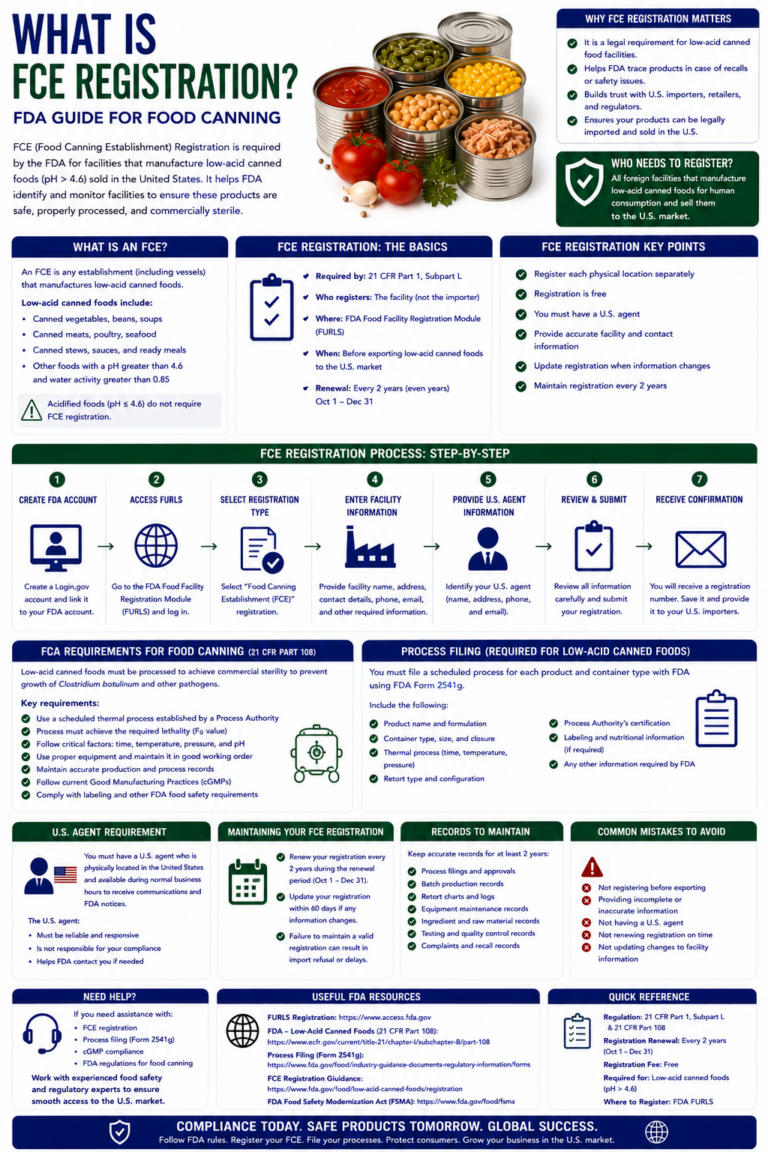
What Is FCE Registration? An FDA Guide for Food Canning
What FCE registration is, the food-canning rules it sits within, and who it applies to.
Key Takeaways
- FCE registration = Form 2541 — under Part 108, the Emergency Permit Control rules.
- Register within 10 days — of first making low-acid canned or acidified foods.
- It's the entry point to process filing — the FCE comes before any SID.
- Three Parts frame it — 108 requires it, 113 governs LACF, 114 governs acidified.
- Separate from Food Facility Registration — you need both, plus SIDs.
- A registration, not an approval — FDA doesn't pre-approve the product.
What FCE Registration Is
"FCE" stands for Food Canning Establishment. FCE registration puts a plant that makes low-acid canned or acidified foods on record with FDA, using Form 2541, and assigns it an FCE number. That registration is the first step in the process-filing system — the number is what every scheduled process (SID) is filed against.
It's required by the Emergency Permit Control regulations in 21 CFR Part 108, which exist because the safety of a sealed, shelf-stable canned food can't be judged after it's already in commerce — so FDA requires the process to be registered and validated up front. A commercial processor must register and file process information within 10 days of first producing these foods.
The Food-Canning Rules Behind FCE Registration
FCE registration doesn't stand alone — it sits inside a small framework of FDA regulations that govern canned foods. Three Parts do the work:
| CFR Part | What it is | Its role |
|---|---|---|
| Part 108 | Emergency Permit Control | Requires FCE registration (Form 2541) and process filing — 108.35 for LACF, 108.25 for acidified; register within 10 days |
| Part 113 | Thermally Processed Low-Acid Foods in Hermetically Sealed Containers | How low-acid canned foods must be thermally processed (the LACF good-manufacturing rules) |
| Part 114 | Acidified Foods | How acidified foods must be made — the acidification and pH-control requirements |
Where FCE Registration Sits in the Process
Food Facility Registration
The baseline registration nearly every food facility needs (Form 3537) — separate from, and in addition to, the FCE.
FCE registration
Register the canning establishment on Form 2541 under Part 108, and receive your FCE number — the entry point to process filing.
Scheduled process (SID) per product
File each product's process against the FCE, validated by a process authority under Part 113 or 114.
Does FCE Registration Apply to You?
FCE registration is required for commercial processors — domestic or foreign — that make:
- Low-acid canned foods (finished pH above 4.6) in hermetically sealed containers — canned vegetables, meats, seafood, soups, meals
- Acidified foods (a low-acid base brought to pH 4.6 or below with added acid) — pickles, hot sauces, salsas, relishes
Get Your FCE Registration Right
FDA Registration Assistance handles FCE registration under Part 108 alongside the filings around it: Food Facility Registration and U.S. Agent, the scheduled process (SID) for each product, and process-authority coordination — so your establishment and its processes are properly on record before you export.
Contact us at info@fdaregistrationassistance.com or call +1 (928) 275-8333. Food Facility Registration is available starting at $858. Trusted by companies across 135+ countries, with 15+ years of experience.
Frequently Asked Questions
1. What is FCE registration?
FCE registration is how a facility that makes low-acid canned or acidified foods registers with FDA as a Food Canning Establishment, on Form 2541. It's required under 21 CFR Part 108 (the Emergency Permit Control regulations), which govern these foods, and it assigns the plant an FCE number. That number is the entry point to the process-filing system — once registered, you file a scheduled process (SID) for each product.
2. Which regulations require FCE registration?
21 CFR Part 108, the Emergency Permit Control regulations. Section 108.35 covers thermally processed low-acid canned foods and 108.25 covers acidified foods; both require the processor to register on Form 2541 and file process information. The companion processing rules are Part 113 (how low-acid canned foods must be thermally processed) and Part 114 (how acidified foods must be made).
3. When does a processor have to register?
Under Part 108, a commercial processor must register — and file process information — not later than 10 days after first engaging in the manufacture, processing, or packing of low-acid canned or acidified foods. In practice, for exporters, this means the FCE has to be in place before product is made for and shipped to the U.S., not treated as an afterthought.
4. What form is used for FCE registration?
Form FDA 2541 — the food canning establishment registration form. It captures the establishment name, principal place of business, the location of each plant where processing is carried on, and the processing method. It's distinct from the scheduled process forms (2541d, 2541e, 2541f, 2541g) used to file each product's process.
5. How does FCE registration fit with SID and process filing?
FCE registration comes first and identifies the plant; the scheduled process (SID) comes next and describes how each product is safely made, validated by a process authority. The FCE is the establishment record; the SIDs are the product process records filed against it. Part 108 requires both for low-acid canned and acidified foods.
6. Is FCE registration the same as Food Facility Registration?
No. Food Facility Registration (Form 3537) applies to nearly all food facilities. FCE registration (Form 2541) is an additional requirement specifically for low-acid canned and acidified food plants under Part 108. For these foods you need both, plus a scheduled process per product — three separate things, not one.
7. Who needs FCE registration?
Commercial processors — domestic or foreign — that manufacture, process, or pack low-acid canned foods (finished pH above 4.6) or acidified foods (a low-acid base brought to pH 4.6 or below with added acid) in hermetically sealed containers. Foreign processors exporting these to the U.S. need it too. Naturally acidic foods generally don't fall under these rules.
8. What are Parts 113 and 114?
They're the processing rules behind the two categories. Part 113 governs thermally processed low-acid foods in hermetically sealed containers — the heat-processing requirements for LACF. Part 114 governs acidified foods — the acidification and pH-control requirements. Part 108 requires you to register and file; Parts 113 and 114 govern how the food must actually be made.
9. Do foreign canning establishments need to register?
Yes. A foreign plant producing low-acid canned or acidified foods for the U.S. registers as an FCE and files scheduled processes, just like a domestic one, and also needs a U.S. Agent. For foreign processors, the rules provide that FDA can request refusal of admission of non-compliant foods at the border rather than issue a permit — so the filings really do have to be right before shipping.
10. Does FCE registration require a process authority?
The FCE registration itself doesn't — it's the establishment registration. A process authority is required for the scheduled processes (SIDs) that follow, validating how each product is processed. So you'll engage a process authority for the product filings, not to register the establishment.
11. What happens without FCE registration?
If your product requires it and it's not in place, the shipment can be detained, delayed, or refused — and it can't be fixed after goods ship. Assuming Food Facility Registration alone is enough, when the product actually needs an FCE and scheduled process, is one of the most common causes of avoidable holds for canned foods.
12. Does FCE registration mean FDA approved my product?
No. FCE registration is a registration under the Emergency Permit Control regulations, not an FDA approval or endorsement. FDA doesn't pre-approve foods; registering puts your establishment on record so process filings can be made and tracked. The product still has to meet all applicable requirements at import.
13. How long does FCE registration take?
There's no single fixed number — the FCE registration submission itself is relatively quick once your facility information is ready. What usually takes longest is the process-authority validation behind the scheduled processes that follow. Separately, the rule requires registering within 10 days of first producing these foods, so it's best started early.
14. How does FDA Registration Assistance help with FCE registration?
We handle FCE registration under Part 108 alongside the filings around it: Food Facility Registration and U.S. Agent, the scheduled process (SID) for each product, and process-authority coordination for validation — so your establishment and its processes are properly on record before you export. Starting at $858 for registration, for companies across 135+ countries. Contact info@fdaregistrationassistance.com or +1 (928) 275-8333.