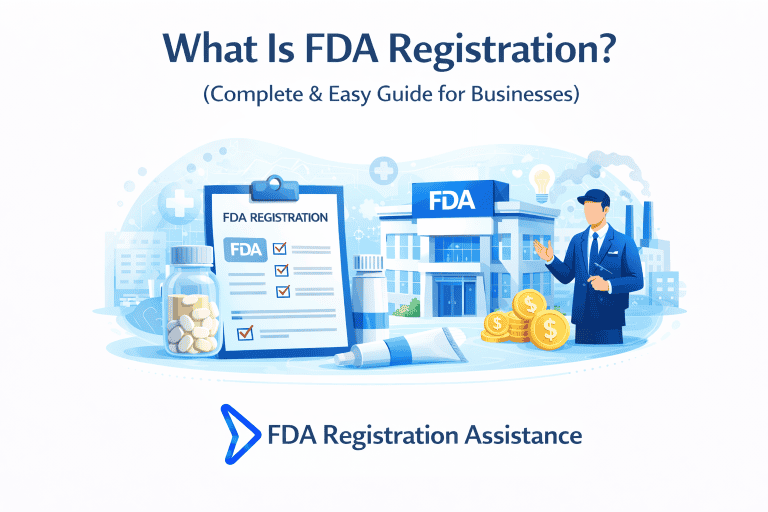
What Is FDA Registration?
The concept, defined — what FDA registration is, what it isn't, who needs it, and how it works.
Key Takeaways
- Registration = listing your facility in FDA's system — an administrative step, legally required for covered establishments.
- Not FDA approval — FDA doesn't approve most products; registered ≠ approved.
- FDA issues a number, not a certificate — beware fake "FDA registration certificates."
- Registration ≠ listing — registration is your facility; listing is your products.
- Food/drug/device/cosmetic — domestic & foreign (foreign needs a U.S. Agent).
- Renewed periodically; free for food/cosmetic, government fees for device/OTC drug.
What FDA Registration Actually Is
At its core, FDA registration puts your establishment on FDA's radar: it records that a specific facility, at a specific place, makes/processes/packs/holds an FDA-regulated product. It gives FDA a way to know who's in the supply chain, contact you, and schedule inspections. It's a baseline legal requirement for covered establishments — a foundation, not the finish line.
What FDA Registration Is NOT
- Not "approval." FDA approves only certain products (new drugs, Class III devices, biologics) and clears others (most Class II devices, 510(k)). Most products aren't approved at all. Registered ≠ approved — and for devices, implying approval via registration is prohibited (21 CFR 807.39)
- Not a "certificate." FDA issues a registration number; there's no official "FDA registration certificate." A third-party certificate isn't proof — the number in FDA's system is
- Not the same as listing. Registration identifies your facility; listing identifies your products (e.g., device listing, drug NDC listing). Often paired, but distinct steps
Who Needs It and How It Works
- Who: establishments that manufacture, process, pack, or hold FDA-regulated products — food (incl. supplements), drugs, devices, cosmetics; domestic and foreign
- Foreign firms: register plus designate a U.S. Agent
- How: electronically via FURLS (food/drug/device) or Cosmetics Direct (cosmetic); food needs a DUNS number
- Fees: $0 for food and cosmetic; device establishment registration has an annual MDUFA fee ($13,785 FY2026–27 range), OTC monograph drug facilities pay OMUFA
- Renewal: food biennial, drug/device annual, cosmetic biennial — it's ongoing, not one-time (see renewal)
Registration Differs by Product Type
| Program | Cadence | Government fee |
|---|---|---|
| Food (& supplements) | Biennial | $0 |
| Drug establishment | Annual | $0 (OTC monograph facilities pay OMUFA) |
| Medical device | Annual | MDUFA establishment fee |
| Cosmetic (MoCRA) | Biennial | $0 |
Common Misconceptions
- "FDA registered = FDA approved." No — registration is administrative, not approval
- "I have an FDA certificate." FDA issues a number, not a certificate
- "Registration is one-and-done." No — it renews (biennially or annually)
- "Registration covers my products too." Not necessarily — listing your products is a separate step
- "There's always a government fee." No — food and cosmetic registration are free
- "I can advertise 'FDA registered.'" Only accurately — not in a way implying approval/endorsement
Understand the Full Picture
Register Your Establishment With FDA
FDA Registration Assistance confirms whether and how registration applies to your product, then completes the registration and listing in the right system, obtains/verifies your DUNS, serves as your U.S. Agent for foreign facilities, coordinates any government fee, and manages renewals — so your establishment is correctly registered and stays current. We're clear that registration is not approval, and that FDA issues a number, not a certificate.
Contact us at info@fdaregistrationassistance.com or call +1 (928) 275-8333 for a quote. An independent compliance firm serving 1,000+ companies across 135+ countries, with 15+ years of experience.
Frequently Asked Questions — FDA Registration
1. What is FDA registration?
FDA registration is the administrative process of entering your establishment (facility) into FDA's system - telling FDA who you are, where you are, and that you manufacture, process, pack, or hold an FDA-regulated product. It's a legal requirement for covered establishments across food, drugs, devices, and cosmetics. Importantly, it's not FDA "approval," FDA issues a registration number (not a certificate), and it's different from product listing. It puts you in FDA's system - nothing more, nothing less.
2. Is FDA registration the same as FDA approval?
No - this is the most important distinction. Registration is administrative; it places your establishment in FDA's system. FDA "approval" means FDA reviewed and authorized a specific product before marketing, which applies only to certain categories (new drugs, Class III devices, biologics). Most products FDA regulates are not "approved" at all. So being registered means registered - not approved or cleared. Marketing a registered product as "FDA approved" is inaccurate, and for devices, using registration to imply approval is specifically prohibited (21 CFR 807.39).
3. Does FDA give me a registration certificate?
No - FDA issues a registration number, not a certificate. There is no official "FDA registration certificate," and FDA doesn't recognize certificates issued by third parties. So the genuine proof of registration is your number in FDA's system, not a document someone sells you. Be wary of any "FDA registration certificate" offered as proof of compliance - treat it with suspicion and verify the underlying number instead.
4. What's the difference between registration and listing?
Registration is about your facility - it identifies the establishment to FDA. Listing is about your products - it tells FDA what products the establishment makes (for example, device listing, or the drug product NDC listing). They're often done together and both are administrative, but they're distinct steps: you register the facility and list the products. For food, facilities register; for devices and drugs, you both register the establishment and list the products.
5. Who needs to register with FDA?
Generally, establishments that manufacture, process, pack, or hold FDA-regulated products - food (including dietary supplements), drugs, medical devices, and cosmetics. Both domestic and foreign establishments register, and foreign establishments must also designate a U.S. Agent. Whether you specifically need to register (and what else applies) depends on your product and role; there are some exemptions by program. See our establishment registration overview for the by-program detail.
6. How do I register with FDA?
Registration is done electronically through FDA's systems - FDA Industry Systems (FURLS) for food, drug, and device, and Cosmetics Direct for cosmetics. You create an account, provide your establishment details, and (for food) a DUNS number as your unique facility identifier; foreign facilities designate a U.S. Agent. Some programs also require a government fee at registration (see below). A firm can complete the registration for you, but the registration itself lives in FDA's system.
7. Does FDA registration cost money?
It depends on the program. Food and cosmetic facility registration have no FDA fee ($0). Medical device establishment registration carries an annual MDUFA fee (a government fee - $13,785 for FY2027), and OTC monograph drug facilities pay an OMUFA fee. So there's no universal "registration fee" - it's free for some programs and a government fee for others. Any consulting fee for having it handled is separate from these government fees.
8. Do I have to renew my FDA registration?
Yes - registration isn't permanent. Food facility registration renews every two years (biennially, October-December of even years); drug and device establishment registrations renew annually (October-December). Cosmetic registration renews every two years based on your registration anniversary. If you miss the renewal window, your registration expires. So registration is an ongoing obligation, not a one-time step. See our renewal guide.
9. Does registration apply the same way to every product?
No - the core idea is the same (get your establishment into FDA's system), but the specifics differ by program: food (Part 1, biennial, free, DUNS), drug (Part 207, annual), device (Part 807, annual, with the MDUFA fee), and cosmetic (MoCRA, biennial, via Cosmetics Direct). Each has its own rule, system, cadence, and fee. That's why identifying your product's category first is essential - it determines which registration framework applies.
10. Is registration required before I can sell or import?
Generally yes for covered establishments - operating or importing an FDA-regulated product from an unregistered establishment violates FDA requirements, and (for food) product from an unregistered foreign facility can be refused at the border. But registration alone isn't the whole picture: your product may also need a premarket pathway (like a device 510(k)), compliant labeling, and other requirements. Registration is a necessary foundation, not the only step.
11. Does a foreign company register with FDA?
Yes - foreign establishments that make/process/pack/hold FDA-regulated products for the U.S. market register just like domestic ones, and they must additionally designate a U.S. Agent (a U.S.-based contact for FDA). The registration is completed electronically; there's no need to travel to the U.S. So a foreign facility's setup typically includes the registration plus a U.S. Agent. See our U.S. Agents page.
12. Can I verify that a facility is registered?
It depends on the program. Device and drug establishment registrations are publicly searchable in FDA's databases. Food and cosmetic registrations are confidential - there's no public lookup - so only the account holder can confirm their own (via their FDA account). Either way, the proof of registration is a number in FDA's system, not a certificate. See our registration verification page for how to check properly.
13. What happens if I don't register?
Operating or importing an FDA-regulated product from an unregistered establishment is a violation. Consequences can include import refusal (for food from an unregistered foreign facility), enforcement action, and being unable to lawfully market the product. Registration is a baseline legal requirement for covered establishments - not optional. If you're unsure whether you need to register, that's worth confirming before you operate or ship.
14. Is "FDA registered" something I can advertise?
Be careful. Stating a fact ("our facility is registered with FDA") can be accurate, but using "FDA registered" as a marketing badge that implies FDA endorsement or approval is misleading - and for devices, implying approval through registration is prohibited. Consumers often read "FDA registered" as "FDA approved," which it isn't. Keep any reference accurate and avoid suggesting a level of FDA review that registration doesn't represent.
15. How is registration related to FURLS and the FDA?
Three related ideas: the FDA is the agency that regulates the products; FURLS (the FDA Unified Registration and Listing System) is the online portal where most registration and listing happens; and registration is the administrative act of entering your establishment into that system. So "what is the FDA," "what is FURLS," and "what is FDA registration" are three layers of the same picture - the regulator, the system, and the step. See our what-is-the-FDA and FURLS pages.
16. How does FDA Registration Assistance help with registration?
We confirm whether and how FDA registration applies to your product, then complete the registration and listing in the right system (FURLS or Cosmetics Direct), obtain/verify your DUNS, serve as your U.S. Agent for foreign facilities, coordinate any government fee, and manage renewals - so your establishment is correctly registered and stays current. We're clear that registration is not approval and that FDA issues a number, not a certificate. We're an independent compliance firm serving 1,000+ companies across 135+ countries with 15+ years of experience. Contact info@fdaregistrationassistance.com or +1 (928) 275-8333.