
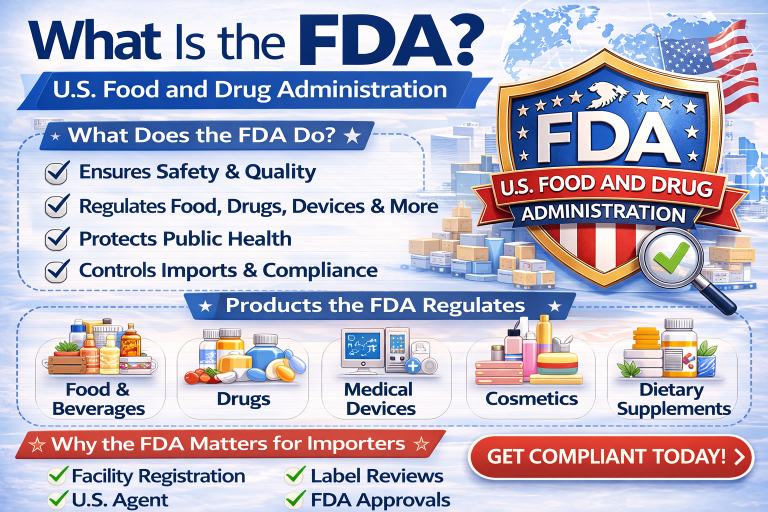
What Is the FDA?
What the FDA is, what it regulates (and what it doesn't), how it's organized, and the approval-vs-registration distinction that trips everyone up.
Key Takeaways
- FDA = a federal agency within HHS — acting under the FD&C Act (since 1938).
- Broad remit — food & supplements, drugs, biologics, devices, cosmetics, tobacco, veterinary.
- Organized into centers — CDER, CBER, CDRH, CVM, CTP, and the Human Foods Program.
- Doesn't cover everything — meat/poultry/egg = USDA; most ads = FTC; etc.
- Approval ≠ clearance ≠ registration — many products have no premarket approval at all.
- FDA doesn't approve cosmetics, most foods, or supplements — those are registered/listed, not approved.
What the FDA Regulates
- Food & dietary supplements — about 80% of the U.S. food supply
- Human drugs — prescription and over-the-counter (OTC)
- Biologics — vaccines, blood products, and other biological products
- Medical devices — and radiation-emitting electronic products
- Cosmetics — now under MoCRA
- Tobacco & nicotine products — including e-cigarettes/ENDS
- Veterinary products — animal drugs and animal food
What the FDA Does NOT Regulate
| Product / area | Regulated by |
|---|---|
| Meat, poultry & processed egg products (~20% of the food supply) | USDA / FSIS |
| Most advertising (except prescription-drug ads) | FTC |
| Alcoholic beverages (largely) | TTB |
| Consumer products — appliances, toys, etc. | CPSC |
| Pesticides & drinking water | EPA |
| Illegal-drug enforcement | DEA |
FDA's Centers
| Center | Covers |
|---|---|
| CDER | Human drugs — prescription, OTC, generic |
| CBER | Biologics — vaccines, blood, cell/gene products |
| CDRH | Medical devices & radiation-emitting products |
| CVM | Veterinary medicine — animal drugs & food |
| CTP | Tobacco & nicotine products |
| Human Foods Program | Food safety & nutrition (replaced most of CFSAN, Oct 2024) |
Approval vs Clearance vs Registration
FDA doesn't "approve" everything it regulates — and mixing up these terms is the most common (and consequential) error:
| Term | What it means | Applies to |
|---|---|---|
| Approval | FDA reviewed & authorized before marketing | New drugs (NDA/ANDA), Class III devices (PMA), biologics (BLA) |
| Clearance | 510(k): substantially equivalent to a marketed device | Most Class II devices ("cleared," not "approved") |
| Registration / listing | Administrative — identifies your facility/products; not review | Food, cosmetics, supplements, exempt Class I devices, and all establishments |
Where Does Your Product Fit?
FDA's requirements differ by category. Start with the one that matches your product:
FDA registration
Registration & listing across all programs.
Registration →Medical devices
Class I, II & III and pathways.
Devices →Cosmetics (MoCRA)
What falls under MoCRA.
Cosmetics →Cosmetic or OTC drug?
The classification that decides everything.
Classify →Food & imports
Food regulation and importing.
Food →U.S. Agent
Required for foreign establishments.
U.S. Agent →Oversight & Enforcement
- FDA doesn't test most products before sale — the system relies on manufacturers meeting requirements, with FDA overseeing
- Registration & listing — identifies who and what is in the system
- Premarket review — where it applies (drug approval, device 510(k)/PMA, biologics)
- Inspections — of domestic and foreign facilities
- Import oversight — detentions, refusals, and import alerts (DWPE) at the border
- Enforcement — warning letters, recalls, seizures; "adulterated"/"misbranded" make goods unlawful
Get FDA Compliance Help
FDA Registration Assistance helps you determine how FDA applies to your product and then meet the requirements — classifying the product (food, drug, device, or cosmetic), completing registration and listing, reviewing labeling and claims, providing U.S. Agent service for foreign firms, and supporting import compliance. We're clear about what's registration versus approval, and about what FDA does and doesn't require.
Contact us at info@fdaregistrationassistance.com or call +1 (928) 275-8333 for a quote. An independent compliance firm serving 1,000+ companies across 135+ countries, with 15+ years of experience.
Frequently Asked Questions — About the FDA
1. What is the FDA?
The FDA - the U.S. Food and Drug Administration - is a federal agency within the Department of Health and Human Services (HHS) that protects and promotes public health. Acting mainly under the Federal Food, Drug, and Cosmetic (FD&C) Act, it regulates the safety of foods (including dietary supplements), cosmetics, and radiation-emitting products; the safety and effectiveness of drugs, biologics (like vaccines), and medical devices; and the public-health aspects of tobacco - plus veterinary products. FDA has been part of HHS since 1940, and traces its authority to the 1906 Pure Food and Drugs Act.
2. What does the FDA regulate?
Broadly: food (including dietary supplements) - about 80% of the U.S. food supply; human drugs (prescription and over-the-counter); biologics (vaccines, blood products); medical devices; radiation-emitting electronic products; cosmetics; tobacco and nicotine products; and veterinary/animal drugs and food. For each category FDA sets requirements for safety (and, for drugs/devices/biologics, effectiveness), quality, labeling, and post-market oversight. It's a very broad remit - most consumer health-related products fall under FDA in some way.
3. What does the FDA NOT regulate?
Several things people assume are FDA but aren't: meat, poultry, and processed egg products (USDA/FSIS - about 20% of the food supply); most advertising (the FTC, though FDA oversees prescription-drug ads); alcoholic beverages (largely TTB); everyday consumer products like appliances and toys (CPSC); pesticides and drinking water (EPA); and enforcement against illegal drugs (DEA). Knowing where FDA's authority ends - and another agency's begins - matters when you're figuring out who regulates your product.
4. How is the FDA organized?
Under the Office of the Commissioner, FDA is organized into product-focused centers: CDER (Center for Drug Evaluation and Research - human drugs), CBER (biologics/vaccines/blood), CDRH (medical devices and radiation-emitting products), CVM (veterinary medicine), CTP (tobacco products), and the Human Foods Program (food safety and nutrition). There's also a field inspection/import arm and a research center (NCTR). Each center has jurisdiction over its category, which is why the requirements differ so much by product type.
5. What is the Human Foods Program (and what happened to CFSAN)?
The Human Foods Program (HFP) is FDA's unified food-safety-and-nutrition organization, launched October 1, 2024. It consolidated most of the former Center for Food Safety and Applied Nutrition (CFSAN), the Office of Food Policy and Response, and the food-related field operations from the Office of Regulatory Affairs into one program under a Deputy Commissioner for Human Foods who reports directly to the Commissioner. So if you see older references to "CFSAN" for food, the current home for most of that work is the Human Foods Program.
6. Does the FDA approve everything it regulates?
No - and this is the single most common misconception. FDA gives premarket approval to some products (new drugs, Class III devices, biologics) and clears others (most Class II medical devices, via a 510(k)). But many products it regulates - most foods, cosmetics, dietary supplements, and 510(k)-exempt Class I devices - are not subject to any premarket FDA approval at all. For those, being "in FDA's system" means registration and listing, which is administrative and is not the same as FDA approval.
7. What's the difference between FDA approval, clearance, and registration?
Approval: FDA reviewed and authorized the product before marketing (new drugs via NDA/ANDA, Class III devices via PMA, biologics via BLA). Clearance: a 510(k) determination that a device is substantially equivalent to a legally marketed one (most Class II devices) - the correct word is "cleared," not "approved." Registration/listing: an administrative step that identifies your facility (registration) and products (listing) to FDA - it is not review or approval. Using these interchangeably (e.g., calling a registered product "FDA approved") is inaccurate and, for devices, prohibited.
8. Does the FDA approve cosmetics or dietary supplements?
No. FDA does not approve cosmetics (aside from color additives) or dietary supplements before they're marketed. Cosmetics are now subject to MoCRA (facility registration, product listing, safety substantiation, adverse-event reporting) - but that's not approval. Dietary supplements are regulated as a category of food, with their own labeling and GMP rules - also not approval. So "FDA approved" is almost never accurate for a cosmetic or supplement; the honest terms are registered/listed and compliant.
9. Does the FDA test products itself?
Mostly no - FDA doesn't test the majority of products before they're sold. The system relies heavily on manufacturers meeting requirements, with FDA overseeing through registration/listing, premarket review where it applies, facility inspections, import screening, sampling, adverse-event monitoring, and enforcement (warning letters, recalls, import alerts). FDA does test some products (for example, imported goods under scrutiny, or during investigations), but "FDA tested and approved" is not how most of the system works.
10. What law gives the FDA its authority?
Primarily the Federal Food, Drug, and Cosmetic (FD&C) Act of 1938, plus many amendments over the decades (for example, FSMA for food safety, MoCRA for cosmetics, MDUFA for device user fees), and the Public Health Service Act for biologics. FDA's enforcement lineage goes back to the 1906 Pure Food and Drugs Act. These statutes define what FDA regulates and the requirements - registration, labeling, premarket pathways, and the prohibitions on adulteration and misbranding.
11. Who has to register with the FDA?
Generally, establishments (facilities) that manufacture, process, pack, or hold FDA-regulated products - food, drug, device, or cosmetic - typically must register, and foreign establishments also designate a U.S. Agent. What's required depends on the program and your role. Registration is separate from any premarket pathway your product needs. See our FDA establishment registration overview for how registration works across the different programs.
12. Does the FDA regulate imports?
Yes. FDA oversees imported FDA-regulated products at the border (with CBP), can detain or refuse non-compliant shipments, and maintains import alerts that subject certain products/firms to Detention Without Physical Examination (DWPE). Foreign firms selling into the U.S. must meet the same requirements as domestic ones - registration, a U.S. Agent, compliant labeling, and any premarket authorization - plus import-specific duties (like FSVP and Prior Notice for food).
13. Is the FDA the same as the USDA?
No - they're different agencies. FDA (in HHS) regulates most of the food supply plus drugs, devices, cosmetics, biologics, and tobacco. USDA (a separate department) regulates meat, poultry, and processed egg products through its Food Safety and Inspection Service (FSIS), plus agriculture more broadly. A single company can deal with both - for example, a product with a meat component may fall under USDA while a similar non-meat product falls under FDA. Confirm which agency your specific product answers to.
14. What are FDA's main enforcement tools?
FDA uses inspections (of domestic and foreign facilities), warning letters, recalls (voluntary and, in some cases, mandatory), import detentions and refusals, import alerts/DWPE, seizures and injunctions, and - for the most serious cases - referrals for civil or criminal action. It also relies on the legal concepts of "adulterated" and "misbranded" products, which make non-compliant goods unlawful to sell or import. Most companies encounter FDA through registration, inspections, and (if something goes wrong) a warning letter or import action.
15. Does "FDA registered" mean the same as "FDA approved"?
No. "FDA registered" means your establishment (and, where applicable, products) are recorded in FDA's system - an administrative step. "FDA approved" means FDA reviewed and authorized a specific product before marketing, which applies only to certain categories (drugs, Class III devices, biologics). Using "FDA registered" to imply approval or endorsement is misleading, and for devices, using registration to suggest approval is specifically prohibited. Describe your status accurately.
16. How does FDA Registration Assistance help with FDA compliance?
We help companies figure out how FDA applies to their product and then meet the requirements: classifying the product (food, drug, device, or cosmetic - and which sub-category), completing FDA establishment registration and listing, reviewing labeling and claims, providing U.S. Agent service for foreign firms, and supporting import compliance. We're clear about what's registration versus approval, and about what FDA does and doesn't require. We're an independent compliance firm serving 1,000+ companies across 135+ countries with 15+ years of experience. Contact info@fdaregistrationassistance.com or +1 (928) 275-8333.
