
What Products Fall Under MoCRA?
Which product categories are cosmetics under MoCRA, the precise soap exclusion, the drug and combination carve-outs, and how claims decide the category.
Key Takeaways
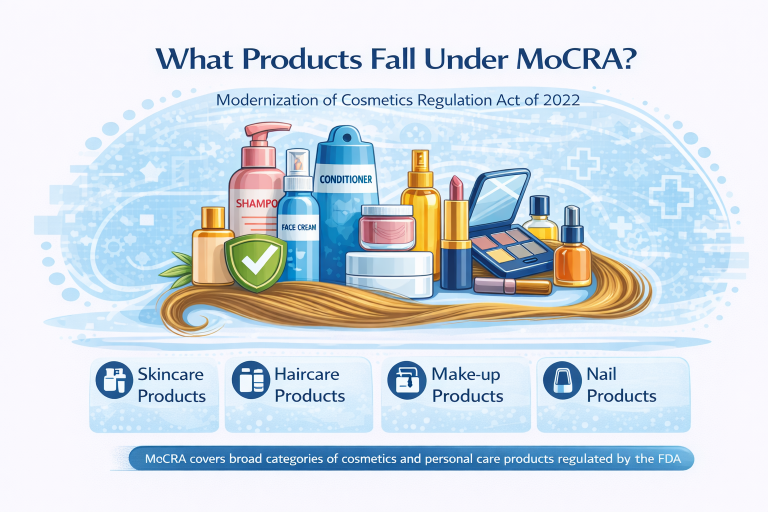
- MoCRA covers cosmetics — skincare, makeup, haircare, fragrance, nail, cosmetic deodorants.
- True soap is excluded — alkali salts + only cleansing claims → CPSC, not FDA.
- Drugs are out — sunscreen, acne, hand sanitizer follow the OTC drug rules.
- Combos follow the drug rules — antiperspirant, SPF moisturizer, dandruff shampoo.
- Devices & food are out — different frameworks entirely.
- Claims decide the category — the same product can be cosmetic, drug, or both.
What Counts as a Cosmetic
Under FD&C §201(i), a cosmetic is an article intended to be applied to the body for cleansing, beautifying, promoting attractiveness, or altering the appearance — a physical effect on appearance, not a physiological effect on the body's structure or function (that would be a drug). MoCRA also defines a "cosmetic product" as a finished preparation of cosmetic ingredients. Cosmetics regulations sit at 21 CFR Parts 700–740.
In Scope vs Out of Scope
| Product | Under MoCRA? | Where it's regulated |
|---|---|---|
| Skincare, makeup, haircare, fragrance, nail, cosmetic deodorant, body wash, lotion | Yes — cosmetic | MoCRA (cosmetics) |
| Anti-aging with appearance claims | Yes — cosmetic | MoCRA (cosmetics) |
| "Soap" with cosmetic claims / synthetic-detergent bars | Yes — cosmetic | MoCRA (cosmetics) |
| True soap (alkali salts; only cleansing claims) | No | CPSC (not FDA) |
| Sunscreen, acne treatment, hand sanitizer, medicated products | No — drug | OTC drug rules |
| Antiperspirant, SPF moisturizer, anti-dandruff shampoo, fluoride toothpaste | Both | Drug rules apply (plus cosmetic aspects) |
| Beauty devices/tools; food, beverages, supplements | No | Device or food/supplement rules |
The Soap Exclusion — Precisely
"Soap" is the most misunderstood category, because FDA's legal definition is narrower than everyday usage. There are really three buckets:
| If the product… | It's… | Regulated by |
|---|---|---|
| Is mainly alkali salts of fatty acids AND labeled/sold only as soap (cleansing claims only) | True soap — excluded from the cosmetic definition | CPSC (not FDA) |
| Makes cosmetic claims (moisturizing, deodorizing, softening) or is a synthetic-detergent bar | A cosmetic | MoCRA (FDA) |
| Makes drug claims (treats eczema, kills germs) | A drug | Drug rules (FDA) |
Drugs & Drug/Cosmetic Combinations
MoCRA governs cosmetics — so a product that's a drug follows the drug rules, not MoCRA. And many products are both: they clean or beautify (cosmetic) and treat or affect the body (drug).
- Pure drugs — sunscreen, acne treatments, hand sanitizer, medicated skincare → OTC drug pathway (registration, NDC, Drug Facts, monograph)
- Drug/cosmetic combinations — antiperspirant-deodorant, SPF moisturizer, anti-dandruff shampoo, fluoride toothpaste → the drug rules apply to the drug portion, and the product must satisfy those obligations
- The classification decides the pathway — confirm whether you're a cosmetic, a drug, or both before you register
What MoCRA Then Requires
If your product is a cosmetic, MoCRA brings a defined set of obligations:
- Facility registration — foreign facilities also need a U.S. Agent
- Cosmetic product listing — each marketed product
- Responsible Person, safety substantiation & adverse-event reporting
- Compliant labeling — with GMP coming through FDA rulemaking
Find Out If MoCRA Applies to Your Product
FDA Registration Assistance assesses your product against the cosmetic, drug, combination, and soap definitions — reviewing the claims, ingredients, and positioning — so you know whether MoCRA applies, whether the drug rules apply, or both, before you build compliance on the wrong pathway. Then we handle the resulting cosmetic registration and listing.
Contact us at info@fdaregistrationassistance.com or call +1 (928) 275-8333 for a quote. An independent compliance firm serving 1,000+ companies across 135+ countries, with 15+ years of experience.
Frequently Asked Questions — What Falls Under MoCRA
1. What products fall under MoCRA?
Products that meet the FD&C Act's definition of a cosmetic — articles applied to the body to cleanse, beautify, promote attractiveness, or alter appearance. That covers skincare (moisturizers, cleansers, serums), makeup and color cosmetics, haircare (shampoo, conditioner, styling, hair color), fragrances, nail products, cosmetic deodorants, body washes, lotions, and similar products, including professional-use cosmetics. What's excluded: true soap, products that are drugs, medical devices, and food/supplements.
2. How is a cosmetic defined?
Under FD&C Act section 201(i), a cosmetic is an article intended to be rubbed, poured, sprinkled, sprayed on, or otherwise applied to the human body for cleansing, beautifying, promoting attractiveness, or altering the appearance. The key is a physical effect on appearance — not a physiological effect on the body's structure or function (that would be a drug). MoCRA also defines a "cosmetic product" as a finished preparation of cosmetic ingredients.
3. Is soap covered by MoCRA?
It depends on what the "soap" actually is. True soap — where the cleansing action comes mainly from alkali salts of fatty acids and the product is labeled, sold, and represented only as soap (cleansing claims only) — is excluded from the cosmetic definition (FD&C 201(i)(2)) and is regulated by the Consumer Product Safety Commission, not FDA. But if a "soap" makes cosmetic claims (moisturizing, deodorizing) it's a cosmetic under MoCRA, and if it makes drug claims (treats eczema, kills germs) it's a drug. Most modern bars are synthetic-detergent bars, which are cosmetics, not true soap.
4. Does sunscreen fall under MoCRA?
No. Sunscreen is regulated as an OTC drug in the U.S., because sun protection is a drug claim — so it follows the drug pathway (establishment registration, NDC listing, Drug Facts, monograph), not MoCRA cosmetic registration. Sunscreen is the classic example of a product regulated as a cosmetic in some countries but as a drug here. The same is true of other drug products marketed alongside cosmetics.
5. What about products that are both a cosmetic and a drug?
Some products are both — an antiperspirant-deodorant, an SPF moisturizer, an anti-dandruff shampoo, a fluoride toothpaste. The drug portion is regulated under the drug rules (OTC monograph or an approved application), and the product must satisfy those drug obligations. Because the drug requirements govern these combinations, confirming the product's classification first is essential — it determines which pathway (and which registration) applies. Our cosmetic-vs-OTC-drug guide walks the test.
6. Are drugs excluded from MoCRA?
Yes. Products that are drugs — sunscreen, acne treatments, medicated skincare, hand sanitizer, and other products that treat or prevent a condition or affect the body's structure/function — are regulated under the drug rules, not MoCRA's cosmetic requirements. MoCRA governs cosmetics; a product that's a drug (or the drug portion of a combination) is handled through the drug pathway.
7. How do I know whether my product is a cosmetic or a drug?
By its intended use, which is established mainly by your claims. Appearance and cleansing claims keep a product a cosmetic; claims to treat a condition or affect the body's structure or function make it a drug. The same base product can be either depending on how it's marketed. This is the single most important scope question, and it's worth settling before you register — see our cosmetic-vs-OTC-drug guide.
8. Are hair care products covered?
Cosmetic hair products are — shampoos, conditioners, styling products, hair color, and permanent waves are cosmetics under MoCRA. But an anti-dandruff shampoo is a drug/cosmetic combination (it cleans as a cosmetic and treats dandruff as a drug), so it carries drug obligations too. Whether a hair product is purely cosmetic or also a drug depends on its claims and actives.
9. Are professional-use (salon) cosmetics covered?
Yes — professional-use cosmetics are covered by MoCRA, and products intended for professional use must be labeled accordingly. A salon that only applies or resells cosmetics generally isn't a "facility" that must register, but a salon or professional brand that manufactures or processes cosmetic products, or is the Responsible Person on the label, has MoCRA obligations.
10. Are medical devices or food covered?
No. Products regulated as medical devices (certain beauty tools/instruments) follow the device rules, and ingestible products — food, beverages, and dietary supplements — follow the food/supplement rules. MoCRA applies to cosmetics specifically. A product's regulatory category (cosmetic, drug, device, food) determines which framework applies, and only cosmetics fall under MoCRA.
11. If my product is a cosmetic, what does MoCRA require?
Facility registration (foreign facilities also need a U.S. Agent), cosmetic product listing for each product, a Responsible Person, safety substantiation, serious adverse-event reporting, and compliant labeling — with cosmetic GMP coming through FDA rulemaking. Registration renews biennially and listings update annually. See our cosmetics registrar guide for the full requirements.
12. Is there an exemption for small cosmetic businesses?
Yes, a limited one: businesses with average annual U.S. cosmetic sales under $1 million over the prior three years are exempt from facility registration, product listing, and GMP — but not if the product contacts the eye's mucous membrane, is injected, is for internal use, or alters appearance for more than 24 hours. Even exempt small businesses must still meet safety substantiation, adverse-event reporting, and labeling requirements.
13. Does "anti-aging" or "anti-wrinkle" keep a product a cosmetic?
Only if the claims stay about appearance. "Reduces the appearance of wrinkles" is a cosmetic claim; "stimulates collagen" or "rebuilds skin" affects the skin's structure/function and is a drug claim — and there's no OTC monograph for anti-aging, so a genuine anti-aging drug claim would need an approved application. Anti-aging products are cosmetics under MoCRA when they're kept to appearance claims.
14. Does being a cosmetic under MoCRA mean FDA approval?
No. Cosmetics don't get FDA pre-market approval (color additives aside). Falling under MoCRA means you have registration, listing, and safety/labeling obligations — not that FDA has approved or endorsed your product. Claiming a cosmetic is "FDA-approved" because it's registered is misleading.
15. Most modern "soap" — cosmetic or exempt?
Usually a cosmetic. The true-soap exclusion is narrow: the product has to be mainly alkali salts of fatty acids and labeled/sold only as soap with cleansing-only claims. Most bars and liquid "soaps" are synthetic-detergent products, or they carry moisturizing/deodorizing claims — either of which makes them cosmetics under MoCRA. Don't assume "soap" equals "exempt"; check the composition and the claims.
16. How does FDA Registration Assistance help determine MoCRA scope?
We assess your product against the cosmetic, drug, combination, and soap definitions — reviewing the claims, ingredients, and positioning — so you know whether MoCRA applies, whether the drug rules apply, or both, before you build compliance on the wrong pathway. Then we handle the resulting cosmetic registration and listing (or point you to the drug pathway). We're an independent compliance firm serving 1,000+ companies across 135+ countries with 15+ years of experience. Contact info@fdaregistrationassistance.com or +1 (928) 275-8333.
