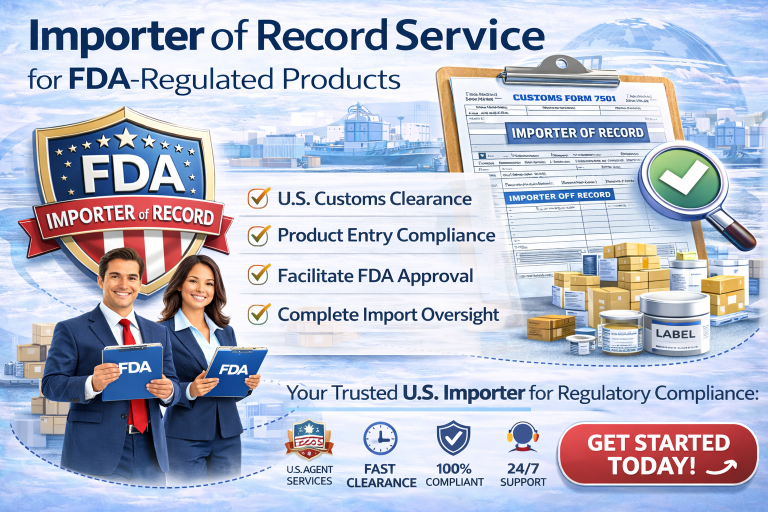
Importer of Record for FDA-Regulated Products
What the IOR is, how it differs from the FDA importer roles, and — the part that bites — who FDA actually holds liable.
Key Takeaways
- IOR = the CBP-responsible party — entry, duties, bond, and records (5 years).
- It's a customs role, not an FDA one — but it must ensure FDA requirements are met at entry.
- IOR ≠ FSVP importer — they frequently diverge, and FDA holds the FSVP importer accountable.
- The trap — a broker/third party listed as FSVP importer with no records = non-compliance.
- Devices — the "initial importer" (FDA) isn't necessarily the IOR (customs).
- Foreign IOR possible (with a bond) — but the FSVP importer must be U.S.-based.
What the Importer of Record Does
- Files the customs entry — declares value and classification (HS code)
- Pays duties, taxes, and fees — the party CBP sends the bill (and any penalty) to
- Posts the customs bond — the IOR is the principal (19 CFR Part 113)
- Ensures compliance — including FDA/PGA requirements for regulated goods at entry
- Keeps records — generally five years (19 CFR Part 163), produced on demand
IOR vs the FDA Importer Roles
| Role | Set by | Responsible for | Must be U.S.-based? |
|---|---|---|---|
| Importer of Record | CBP | Customs entry, duties, bond, compliance at entry, records | Foreign possible (with bond/CBP rules) |
| FSVP importer (food) | FDA (FSMA) | Verifying the foreign supplier's food safety; FDA holds it accountable | Yes — must be U.S.-based |
| Initial importer (device) | FDA | First U.S. receiver; registers/lists; labeling, complaints, reporting | Yes (U.S. party) |
| U.S. Agent | FDA | FDA's contact for the foreign facility (not the importer) | Yes — U.S.-based |
FDA Holds the FSVP Importer — Not the IOR
For food, FDA has made clear that the IOR and the FSVP importer frequently diverge — and FDA holds the FSVP importer accountable at inspection. The FSVP importer is the U.S. party that owns (or has agreed to purchase) the food at the time of entry.
Can a Foreign Company Be the IOR?
- Sometimes, as the IOR — a foreign company can act as a "foreign importer of record" if it qualifies and meets CBP requirements (a U.S. customs bond, and often a U.S. presence/resident agent for service of process)
- But not as the FSVP importer — that role must be a U.S.-based entity and cannot be a foreign company
- So a U.S. party is still needed for the food FDA role — a U.S. owner/consignee, or a U.S. agent acting as the FSVP importer
- Plus the foreign facility still registers with FDA and needs a U.S. Agent
Common IOR / Role-Alignment Mistakes
- A broker listed as IOR unaware they're also the FSVP importer — no records, non-compliance
- Assuming the foreign supplier's food-safety plan satisfies FSVP — it doesn't
- A foreign company as IOR with no U.S. party for the FSVP importer role
- Confusing the device "initial importer" (FDA) with the IOR (customs)
- No customs bond in the right party's name — entry can't be made
- Mismatches that surface only during an FDA inspection or a detention
Structure Your Importer of Record & FDA Roles
FDA Registration Assistance maps your import chain and aligns the roles — confirming who should be the Importer of Record, ensuring the FDA-side roles are correctly assigned (FSVP importer for food, initial importer for devices, U.S. Agent for the foreign facility), and making sure the product and entry are FDA-compliant so shipments clear. For foreign sellers, we help structure a compliant U.S.-side setup, since the FSVP importer must be U.S.-based.
Contact us at info@fdaregistrationassistance.com or call +1 (928) 275-8333 for a quote. An independent compliance firm serving 1,000+ companies across 135+ countries, with 15+ years of experience.
Frequently Asked Questions — Importer of Record
1. What is an Importer of Record (IOR)?
The Importer of Record is the party U.S. Customs and Border Protection (CBP) holds legally responsible for a customs entry: filing the entry, declaring the value and classification, paying duties, taxes, and fees, ensuring the goods comply with U.S. law, and keeping entry records (generally five years under 19 CFR Part 163). The IOR is the principal on the customs bond. It's fundamentally a customs role - the party CBP sends the bill and any penalty notice to.
2. Is the Importer of Record an FDA role?
No - it's a CBP/customs role, not an FDA one, though the two intersect. For FDA-regulated goods, the IOR must ensure the shipment meets FDA requirements at entry (for food, that includes Prior Notice and the foreign facility being registered, plus any import alerts). But FDA has its own defined importer roles - the FSVP importer for food, the initial importer for devices - which are distinct from the IOR and not automatically the same entity. Confusing the customs IOR with the FDA importer roles is where problems start.
3. What's the difference between the IOR and the FSVP importer?
They're different roles and frequently different entities. The IOR is the CBP-responsible party for the customs entry (duties, clearance, legal importation). The FSVP importer is the FDA-defined U.S. party that owns or has agreed to purchase the food at the time of entry and is responsible for verifying the foreign supplier's food safety. FDA has made clear these identities often diverge - and FDA holds the FSVP importer, not the IOR, accountable at inspection. So who's on the customs entry isn't necessarily who FDA will hold responsible for FSVP.
4. Who does FDA actually hold liable for imported food?
For FSVP, FDA holds the FSVP importer accountable - the entity identified as the FSVP importer at entry. If that party can't produce the required verification records during an FDA inspection, the shipment and program are treated as non-compliant. This is the costly trap: a customs broker or third party can end up listed as the FSVP importer without realizing it (and with no records), triggering immediate scrutiny. The IOR handling customs doesn't absorb the FSVP importer's FDA liability.
5. Can my customs broker be my FSVP importer?
A broker can be the IOR or file on your behalf, but the FSVP importer should be the U.S. owner/consignee with the financial interest and verification responsibility - not, by default, your broker. A common breakdown is a broker listed as the FSVP importer at entry who is unaware of it and has no verification program. Assign the FSVP importer role deliberately (based on ownership at entry), document each party's responsibilities, and make sure the entity named as FSVP importer actually maintains the records.
6. What about medical devices — is the IOR the initial importer?
Not necessarily. For devices, FDA's "initial importer" is the first U.S. party that receives the imported device, and it must register and list with FDA and handle device obligations (labeling, complaints, reporting). The IOR is the customs-responsible party for duties and entry. They can be the same entity, but they don't have to be - the initial importer is defined by FDA for device compliance, while the IOR is defined by CBP for the customs entry. Confirm both are covered and correctly assigned.
7. Can a foreign company be the Importer of Record?
Sometimes - a foreign company can act as a "foreign importer of record" if it qualifies and meets CBP requirements, notably posting a U.S. customs bond and satisfying CBP's rules (often involving a U.S. presence or resident agent for service of process). But there's a hard limit on the FDA side: the FSVP importer must be a U.S.-based entity and cannot be a foreign company. So even if a foreign entity is the IOR, a U.S. party (or a U.S. agent acting as FSVP importer) is still needed for the food FDA role.
8. What does the IOR have to do for FDA-regulated goods specifically?
Beyond the customs basics (entry, duties, bond, records), the IOR must ensure the FDA-regulated shipment can lawfully enter: that the product itself is compliant (labeling, claims, any required clearance/approval), that food has Prior Notice and a registered foreign facility, and that the shipment isn't blocked by an import alert or detention. The IOR doesn't replace the FDA importer roles - it has to make sure they're in place. In practice, coordinating the IOR with the FDA roles is the whole game.
9. What is a customs bond and does the IOR need one?
A customs bond (under 19 CFR Part 113) is a financial guarantee that the importer will comply with customs laws and pay duties, taxes, and fees; the IOR is the principal on the bond. Most commercial imports require one - either a single-entry bond or a continuous bond. Without a valid bond in the right party's name, entry generally can't be made, whatever the sales contract says. For FDA-regulated goods, the bond is part of the customs side; it doesn't satisfy the FDA importer roles.
10. Who is the IOR under different Incoterms (like DDP)?
It depends on the commercial terms. Under Delivered Duty Paid (DDP), the seller generally becomes the IOR, because they take on customs clearance, duties, and compliance. Under other terms, the U.S. buyer/consignee is typically the IOR. Ownership at the time of entry (which drives the FSVP importer determination for food) is set by the sales terms too. So your Incoterms directly affect who is the IOR and who is the FSVP importer - align them intentionally rather than by accident.
11. Is the IOR the same as the consignee?
Not by definition. The consignee is the party the goods are shipped to on the transport document; the IOR is the party named on the customs entry as legally responsible for importation. They're often the same, but not always - and a consignee without the ability to make entry (e.g., no bond/registration) can't serve as IOR. For FDA food, note the FSVP importer is the owner/consignee at entry, which adds yet another lens - which is why mapping all the roles matters.
12. What records does the IOR have to keep?
Under 19 CFR Part 163, entry records generally must be produced on demand for five years from the date of entry - covering the entry declaration, valuation, classification, and supporting documents. Separately, the FDA importer roles carry their own records (FSVP verification records for food; device records for the initial importer). So an FDA-regulated import has customs recordkeeping (IOR) and FDA recordkeeping (FSVP importer/initial importer) - both need to exist and be retrievable.
13. What goes wrong when the roles aren't aligned?
The classic failures: a broker listed as IOR unaware they're also the FSVP importer (no records → FDA non-compliance); a buyer assuming the foreign supplier's food-safety plan satisfies FSVP; a foreign company acting as IOR with no U.S. party for the FSVP importer role; and mismatches that surface only during an FDA inspection or a detention. Clearly assigning the IOR, FSVP importer, initial importer, and U.S. Agent - and documenting each - prevents these predictable breakdowns.
14. How is this different from your other importer pages?
This page focuses on the Importer of Record - the customs role - and how it interacts with (and differs from) the FDA importer roles, with an emphasis on who's actually liable. For a broader look at importer FDA duties, see our registration support for importers page; for the food-specific FSVP detail, see FSVP for importers; and for the general import framework, see U.S. food import regulations. Use this page to get the IOR-vs-FDA-roles alignment right.
15. Does the IOR make my product FDA-approved or compliant on its own?
No. Being the IOR is about customs responsibility; it doesn't make a product FDA-approved, and it doesn't by itself satisfy the FDA importer roles or product requirements. The product still needs compliant labeling/claims and any required clearance/approval, food still needs FSVP and Prior Notice, and the foreign facility still needs to be registered. The IOR's job is to ensure all of that is in place at entry - not to substitute for it.
16. How does FDA Registration Assistance help with the IOR?
We map your import chain and align the roles: confirming who should be the Importer of Record, ensuring the FDA-side roles are correctly assigned (FSVP importer for food, initial importer for devices, U.S. Agent for the foreign facility), and making sure the product and entry are FDA-compliant so shipments clear. For foreign sellers, we help structure a compliant U.S.-side setup (since the FSVP importer must be U.S.-based). We're an independent compliance firm serving 1,000+ companies across 135+ countries with 15+ years of experience. Contact info@fdaregistrationassistance.com or +1 (928) 275-8333.