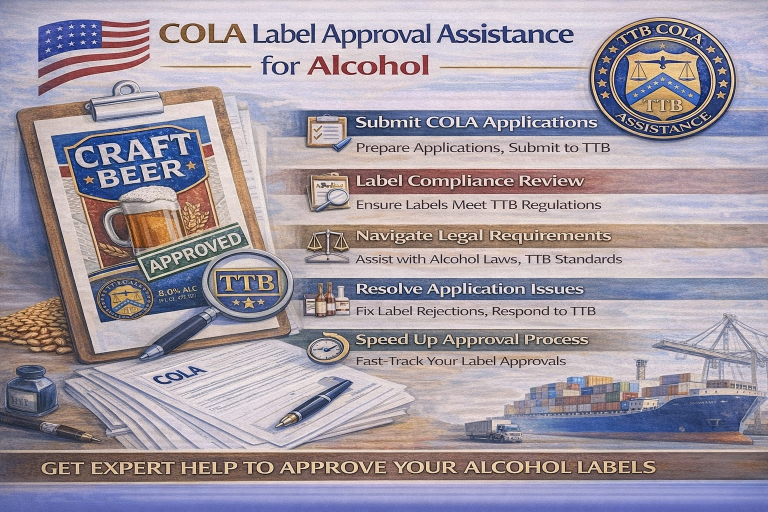
COLA Label Approval Assistance for Alcohol
Most COLA delays come from the label itself — a missing element or the wrong classification. Getting it right before submission is the whole game.
Key Takeaways
- COLA is a TTB label approval (Form 5100.31), not an FDA one.
- Required for distilled spirits, wine ≥7% ABV, and malt beverages in interstate commerce.
- Timing: before bottling (domestic) or before release from customs (imports).
- Formula approval can come first for flavored or non-standard products.
- Intrastate-only products may use a Certificate of Exemption instead.
- Label errors are the top delay — a pre-submission review is the fix.
Which Products Need a COLA
| Product | COLA needed? |
|---|---|
| Distilled spirits | Yes — regardless of alcohol strength |
| Wine at 7% ABV or more | Yes |
| Malt beverages (barley + hops) | Yes — for interstate commerce |
| Wine 0.5%–7% ABV | No — generally FDA labeling instead |
| Non-alcoholic beverages (<0.5% ABV) | No — FDA-regulated (malt-based NA beer is a TTB exception) |
| Product sold only within its bottling state | Certificate of Exemption, not a full COLA |
Mandatory Label Elements
- Brand name
- Class / type designation (e.g. "Vodka," "Cabernet Sauvignon," "Malt Beverage")
- Alcohol content (as required for the commodity)
- Net contents
- Name and address of the bottler or importer
- Government health warning statement (27 CFR Part 16)
- Appellation of origin (wine, when a vintage, varietal, or estate claim appears)
- Country of origin (imports) and declarations such as sulfites in wine
Formula Approval & the Intrastate Exemption
Formula approval (sometimes first)
Products with added flavors or non-standard ingredients — flavored spirits, aperitifs, sakés — need TTB formula approval before the COLA. It's filed through Formulas Online, and the approval number goes on the COLA application. Standard, unflavored products usually skip this.
Intrastate exemption
A product sold only within the state where it's bottled may qualify for a Certificate of Exemption from Label Approval instead of a full COLA — with the label stating "For sale in [State] only." Cross a state line and a full COLA is required.
How to Get a COLA
Confirm a COLA is required
Check whether your product is a spirit, wine ≥7% ABV, or malt beverage sold interstate.
Get formula approval if needed
For flavored or non-standard products, obtain TTB formula approval first — its number goes on the COLA.
Build a compliant label
Include every mandatory element with correct formatting, especially the health warning.
Submit via COLAs Online
File Form 5100.31 through COLAs Online with your artwork and any formula number.
Respond to TTB review
Correct any issues and resubmit — errors are the most common cause of delay.
Manage changes & FDA steps
Use TTB's allowable-revisions list for minor changes, and align FDA registration and prior notice for imports.
FDA Requirements Run Alongside the COLA
A COLA clears your label with TTB — but it doesn't touch your FDA obligations. Because alcohol is also "food" to FDA, the two run in parallel:
Facility registration
A foreign facility may need FDA food facility registration and a U.S. Agent.
Prior notice
Imported alcohol generally needs FDA prior notice before arrival — separate from the COLA.
Aligned handling
We handle the FDA side directly and support the COLA, so the two don't collide at the border.
Get Your Label Reviewed Before You Submit
FDA Registration Assistance reviews your alcohol label against the mandatory elements, flags where formula approval is needed, and supports your COLA application — while handling your FDA obligations so both agencies line up.
Contact us at info@fdaregistrationassistance.com or call +1 (928) 275-8333. Trusted by beverage companies across 135+ countries, with 15+ years of experience.
Frequently Asked Questions — COLA
1. What is a COLA?
A Certificate of Label Approval — TTB's approval of your alcohol label, on Form 5100.31, required under the FAA Act before certain products are bottled or imported. Obtained through COLAs Online.
2. Which products need a COLA?
Distilled spirits, wine at 7% ABV or more, and malt beverages in interstate commerce or imported. Wine between 0.5% and 7% ABV generally follows FDA labeling; distilled spirits need one at any strength.
3. Is a COLA the same as the 0.5% ABV rule?
No. The 0.5% line separates FDA non-alcoholic beverages from TTB alcohol in general, but the COLA requirement applies to spirits, malt beverages, and wine ≥7% ABV. A low-ABV wine can be alcohol yet not need a COLA.
4. When must a COLA be obtained?
Domestic: before bottling — no bottler may bottle or remove the product without one. Imports: before removal from customs custody. The container must bear the labels on the approved COLA.
5. What must the label include?
Brand name, class/type designation, alcohol content, net contents, bottler/importer name and address, and the government health warning — plus appellation (wine), country of origin (imports), and declarations like sulfites where applicable.
6. What is the government health warning?
A mandatory statement under 27 CFR Part 16 about drinking during pregnancy and impairment of driving/operating machinery and possible health problems, with specific wording and formatting. Omitting or altering it is a frequent rejection cause.
7. Do I need formula approval first?
For flavored spirits, added-ingredient products, aperitifs, and sakés — yes, before the COLA, filed through Formulas Online, with the approval number on the COLA application. Standard unflavored products usually don't.
8. How do I submit?
Through COLAs Online using Form 5100.31, with your label artwork and any formula number. Only a qualified permit holder — the bottler or importer of record — can hold the COLA.
9. How long does it take?
Processing times vary by commodity and TTB publishes current averages. Errors, missing elements, or wrong classification are the biggest delays, and a returned application restarts the clock.
10. Can I sell only within my state without a COLA?
Possibly — products sold only within the bottling state may use a Certificate of Exemption instead, with a "For sale in [State] only" statement. Crossing state lines requires a full COLA.
11. Can I change an approved label without reapplying?
Sometimes — TTB publishes an allowable-revisions list for changes that don't need a new COLA, plus rules for personalized labels. Changes outside that list require a new COLA.
12. Does FDA issue COLAs?
No — COLA is TTB. But FDA rules still apply to alcohol as food: facility registration, a U.S. Agent, and prior notice for imports. The COLA and FDA steps run in parallel.
13. Why do COLAs get rejected?
Wrong class/type, missing elements, an incorrect health warning, bad formatting, prohibited claims, or missing formula approval — most caught by a careful pre-submission review.
14. How does FDA Registration Assistance help?
It reviews your label against the mandatory elements, flags formula-approval needs, and supports the COLA — while handling your FDA obligations, so TTB and FDA align. For companies across 135+ countries.
15. How do I get started?
Contact FDA Registration Assistance at info@fdaregistrationassistance.com or call +1 (928) 275-8333 with your product and label artwork.