Alcohol Beverage Compliance Consultant (USA)
The mistake isn't usually one big error — it's missing one of the four agencies until a shipment is already at the port.
Key Takeaways
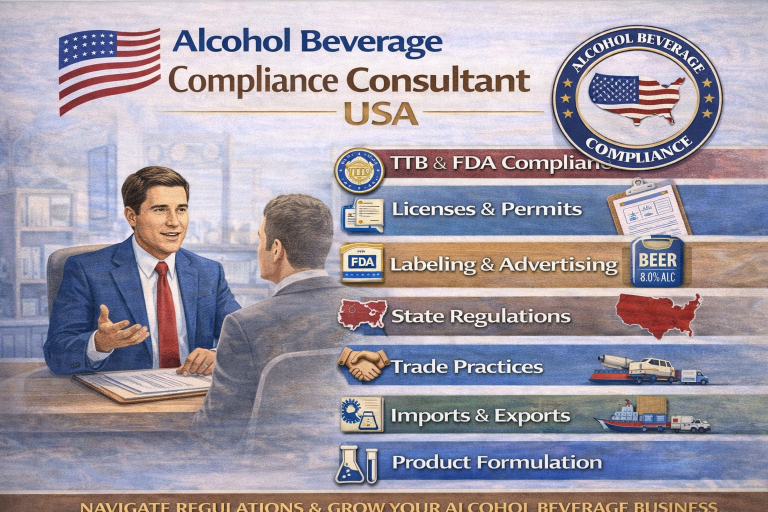
- Up to four regulators — TTB, FDA, CBP, and state/local — can apply to one beverage.
- TTB handles alcohol permits, COLA label approval, and excise tax.
- FDA applies because alcohol is also food — registration, prior notice, labeling.
- We execute the FDA side and advise/coordinate TTB, import, and state steps.
- Sequencing matters — label before print, registration before ship.
- A permit isn't approval, and federal steps don't replace state licensing.
The Four-Agency Map
| Authority | What it covers | Typical filings |
|---|---|---|
| TTB (Treasury) | Federal alcohol permits, label approval, formulas, excise tax | Basic Permit / Brewer's Notice / dealer registration; COLA |
| FDA | Alcohol as food: facility registration, imports, misbranding | Food facility registration; U.S. Agent; prior notice |
| CBP | Import entry and duties | Entry filing; importer of record |
| State & local | Three-tier licensing and distribution | Manufacturer/wholesaler/retailer licenses; brand/label registration |
What We Handle vs. Coordinate
We handle directly (FDA)
- FDA food facility registration
- U.S. Agent representation for foreign facilities
- Prior notice for imported shipments
- Label review from the FDA/misbranding angle
We advise & coordinate
- Which TTB authorization your activity needs
- COLA label approval process and timing
- Importer setup and sequencing with your broker
- Flagging the state/local licensing you'll still need
Businesses We Support
The Pitfalls a Consultant Catches
Jurisdiction confusion
Assuming TTB or FDA covers everything — when both, or the wrong one, applies. The 0.5% ABV threshold trips up NA and low-alcohol products.
Out-of-order steps
Printing labels or booking shipments before the pathway is confirmed — turning digital fixes into costly reprints and port delays.
Long-lead gaps
Missing lead-time items like a DUNS number or a permit application, so the launch date slips waiting on paperwork.
Explore the Specifics
- TTB registration — which alcohol permit your activity needs.
- Beverage manufacturers — the FDA rules by beverage type.
- Do NA beverages need TTB approval — the FDA-vs-TTB line.
- COLA label approval — approving your alcohol label.
- Importing beer, wine & spirits — the full import path.
- FDA prior notice — the per-shipment import filing.
How a Compliance Review Works
Classify the product
Alcoholic or not, and how it's made — this decides whether TTB, FDA, or both apply.
Map the agencies
Identify which of TTB, FDA, CBP, and state/local apply to your product and model.
Complete the FDA obligations
Facility registration, U.S. Agent, prior notice, and FDA-angle label review.
Coordinate the TTB pathway
Advise on the right authorization and COLA, sequenced with the FDA steps and import timeline.
Review labels before printing
Check both TTB and FDA considerations before print to avoid reprints.
Prepare import & state steps
Align importer setup, prior notice, and customs — and flag the state licensing you'll still need.
Get Every Agency Lined Up Before You Ship
FDA Registration Assistance handles your FDA obligations — facility registration, U.S. Agent, prior notice, and label review — and coordinates where TTB, import, and state requirements fit, so the whole picture aligns.
Contact us at info@fdaregistrationassistance.com or call +1 (928) 275-8333. Trusted by beverage companies across 135+ countries, with 15+ years of experience.
Frequently Asked Questions
1. What does an alcohol beverage compliance consultant do?
Helps a beverage company meet every requirement to legally produce, import, or sell in the U.S. — across up to four authorities (TTB, FDA, CBP, state/local). They map which apply, execute what they can, and coordinate the rest so the pieces line up.
2. Which agencies regulate alcohol beverages?
Primarily TTB (Treasury) for permits, COLA, formulas, and tax. FDA also applies because alcohol is food — registration, prior notice, misbranding. CBP handles imports, and each state adds three-tier licensing. Many businesses answer to all four.
3. Does FDA regulate alcohol?
Yes — alcohol is food to FDA, so facilities handling it for the U.S. may need food facility registration and a U.S. Agent, and imports may need prior notice, separate from the TTB permit. FDA also regulates non-alcoholic beverages directly.
4. What do you handle vs. advise on?
We directly handle the FDA side — facility registration, U.S. Agent, prior notice, FDA-angle label review. For TTB, import, and state pieces we advise and coordinate: the right authorization, COLA, sequencing, and import prep, so FDA and TTB don't collide.
5. Do I need a consultant, or can I DIY?
You can DIY. Many use a consultant because the process is layered — the FDA-vs-TTB line, COLA, importer setup, prior notice, DUNS lead times, and state licensing all need sequencing. The value is catching gaps before they become detained shipments.
6. Who benefits most?
Alcohol importers, foreign producers, and new brands entering the U.S., plus distilleries, breweries, and wineries — and NA, hard seltzer, RTD, and kombucha brands confirming whether they're on the FDA or TTB pathway.
7. TTB registration vs. FDA registration?
Separate. TTB registration is the alcohol permit plus label approval and tax; FDA registration is food facility registration. Meeting one doesn't satisfy the other, and alcohol businesses commonly need both. See our TTB registration page.
8. What is COLA approval?
A Certificate of Label Approval from TTB, required for many alcohol labels before interstate sale — separate from FDA labeling and from a permit. Review the label before printing to avoid reprints. See our COLA assistance.
9. Do NA beverages need TTB approval?
Usually not — under 0.5% ABV they're generally FDA-regulated, not TTB. The exception is malt-based NA beer, which stays under TTB at any ABV. Classification is one of the first things we check.
10. Do I still need state licenses?
Yes — state and local licensing is separate from and additional to federal TTB and FDA, usually by tier (manufacturer, wholesaler, retailer). Federal steps don't replace them.
11. When should I start?
Before you print labels, book a shipment, or commit to distributors. Confirming the pathway and starting long-lead items (DUNS, permits) early prevents rejected applications, reprints, and detained product.
12. What if my product is non-compliant?
Rejected permit/label applications, shipment detention, refused entry, warning letters, marketplace removals. Because several agencies can be involved, a gap with any one can stop an otherwise-ready product.
13. Can foreign companies sell beverages in the U.S.?
Yes, meeting U.S. requirements. Foreign producers usually work through a U.S. importer holding the TTB permit, while the foreign facility handles its FDA obligations, with prior notice and CBP entry for shipments.
14. How does FDA Registration Assistance help?
It handles your FDA obligations — registration, U.S. Agent, prior notice, label review — and coordinates the TTB, import, and state picture, so everything aligns before you ship. For companies across 135+ countries.
15. How do I get started?
Contact FDA Registration Assistance at info@fdaregistrationassistance.com or call +1 (928) 275-8333 with your product, alcohol content, and supply chain.