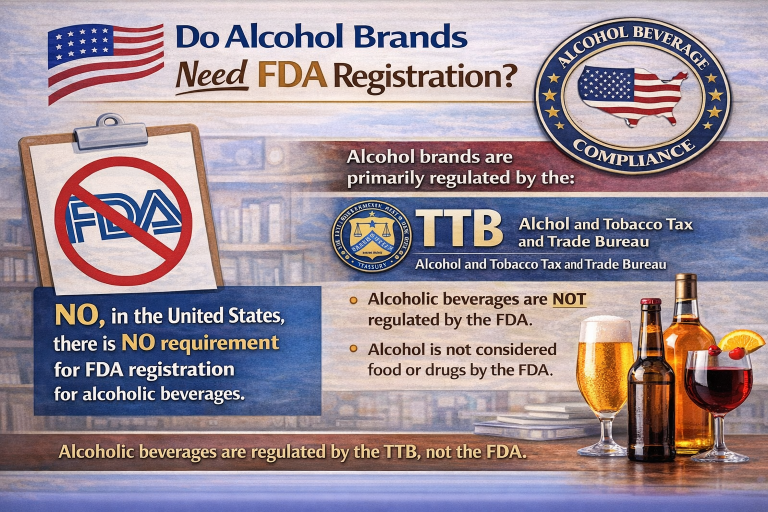
Do Alcohol Brands Need FDA Registration?
The surprise for most alcohol brands isn't that FDA applies — it's who actually registers, and how much less FDA asks of them than of other food.
Key Takeaways
- Alcohol is "food" to FDA — so producing/holding facilities must register (Bioterrorism Act).
- A brand isn't a facility — the maker or holder registers, not a marketing-only brand.
- FSMA §116: alcohol facilities register but are exempt from preventive controls (HARPC).
- Foreign facilities also need a U.S. Agent; imports need prior notice.
- Biennial renewal — even years, Oct–Dec, no FDA fee.
- Registration ≠ approval, and it doesn't replace your TTB permit or COLA.
A Brand Isn't a Facility
"Do alcohol brands need FDA registration?" turns on one distinction: FDA registration attaches to a facility, not to a brand. So the answer depends on your model:
You operate the facility
Own or run the winery, brewery, or distillery? That facility registers — clearly yes.
You use a co-packer
Marketing-only brand using a contract producer? The co-packer's facility registers — but confirm it's registered, since the product must come from a registered facility.
You import a finished brand
Pure importer? You may not be the registrant, but the foreign facility must register and have a U.S. Agent, and prior notice applies.
Which Alcohol Facilities Register
| Facility | Register with FDA? |
|---|---|
| Winery (bonded wine premises) | Yes |
| Brewery / microbrewery | Yes |
| Distillery (distilled spirits plant) | Yes |
| Cidery / meadery | Yes |
| Importer, warehouse, distributor that holds product | Yes |
| Foreign facility serving the U.S. | Yes — plus a U.S. Agent |
| Tasting room / brewpub serving only on-site | Often exempt (retail) — but packing for off-site sale triggers registration |
You Register — But You Skip Preventive Controls
Here's what many get backwards: alcohol facilities register with FDA, but they're not held to the full food-safety machinery other facilities face.
You still must
- Register the facility with FDA
- Renew every two years
- File prior notice for imports
- Keep records / traceability
- Designate a U.S. Agent (foreign)
You're excused from
- The preventive controls rule (HARPC food safety plan)
- Most other burdensome FSMA provisions for alcohol
- The sanitary transportation rule (for alcohol)
Getting the FDA Side Right
Identify who the facility is
The entity that makes, processes, packs, or holds the alcohol is the registrant — not the brand.
Confirm registration applies
Check you're not within an exemption (e.g. a tasting room serving only on-site).
Register the facility
Complete FDA food facility registration via FURLS, with a DUNS and (foreign) a U.S. Agent.
Handle prior notice
For imports, file FDA prior notice before each shipment arrives.
Keep it current
Renew every even-numbered year and update when details change.
Coordinate with TTB
Line the FDA registration up with your TTB permit and COLA.
Register What Needs Registering — Nothing You Don't
FDA Registration Assistance completes food facility registration for alcohol producers and holders, serves as U.S. Agent for foreign facilities, manages prior notice and renewals, and coordinates with your TTB permit and COLA — so the FDA side is complete without over-doing what you're exempt from.
Contact us at info@fdaregistrationassistance.com or call +1 (928) 275-8333. Trusted by companies across 135+ countries, with 15+ years of experience.
Frequently Asked Questions
1. Do alcohol brands need FDA registration?
Generally yes, at the facility level — alcohol is "food" under the Bioterrorism Act, so facilities that make, process, pack, or hold it must register and renew biennially, alongside their TTB permit. Registration attaches to the facility, not to a brand as a marketing entity.
2. Is a "brand" the same as a "facility"?
No — the key point. FDA registration is a facility requirement. If your brand operates the facility, it registers; if you use a co-packer, the co-packer registers (confirm they are); if you import, the foreign facility registers and needs a U.S. Agent.
3. Why does FDA regulate alcohol — isn't that TTB?
TTB is primary, but under the Bioterrorism Act "food" includes alcohol beverages, giving FDA jurisdiction over facility registration, prior notice, and recordkeeping. So both agencies commonly apply.
4. Which facilities have to register?
Wineries, breweries, distilleries, cideries, meaderies, and other producers/blenders/bottlers — plus importers, warehouses, and distributors that hold product. Domestic and foreign facilities serving the U.S. are covered.
5. Do alcohol facilities have to do preventive controls (HARPC)?
No — a common misconception. Under FSMA §116, a facility that produces alcohol and must be permitted by TTB is excused from the preventive controls rule (and sanitary transportation rule) for alcohol. It still registers and files prior notice, but builds no HARPC plan for its alcohol.
6. So what does FDA actually require?
Facility registration, biennial renewal, prior notice for imports, and recordkeeping/traceability — plus a U.S. Agent for foreign facilities. Narrower than for other foods, but real.
7. Do foreign alcohol producers register?
Yes — a foreign facility making or holding alcohol for the U.S. must register and designate a U.S. Agent, and imports need prior notice, separate from the TTB import permit. This is where foreign brands are often surprised.
8. Does a tasting room or brewpub register?
It depends — serving directly to consumers on-site can fall within the retail/restaurant exemption, but packaging any beverages for off-site sale generally triggers registration. The line is whether product leaves for sale elsewhere.
9. How often is it renewed?
Every two years — Oct 1 to Dec 31 of even-numbered years, no FDA fee, same as other food facilities. Lapsing means the facility is treated as unregistered, which can stop imports.
10. What if I only import a finished brand?
If you don't make, pack, or hold it yourself, you may not be the registrant — but the foreign producing facility must be registered with a U.S. Agent, and prior notice applies to your shipments.
11. Does registration make it "FDA approved"?
No — registration tells FDA the facility exists and what it does; it isn't approval or certification of the product. "FDA approved" is inaccurate.
12. What if a facility doesn't register?
For foreign facilities, unregistered product generally can't clear into U.S. commerce — detained or refused shipments. For domestic facilities, failing to register or renew is a violation. Missing prior notice separately causes port holds.
13. How does FDA Registration Assistance help?
It handles facility registration, U.S. Agent, prior notice, and renewals, and coordinates with your TTB permit and COLA — completing the FDA side without over-doing what you're exempt from, for companies across 135+ countries.
14. How do I get started?
Contact FDA Registration Assistance at info@fdaregistrationassistance.com or call +1 (928) 275-8333 with your production model — who makes it, where, and how it reaches the U.S.