
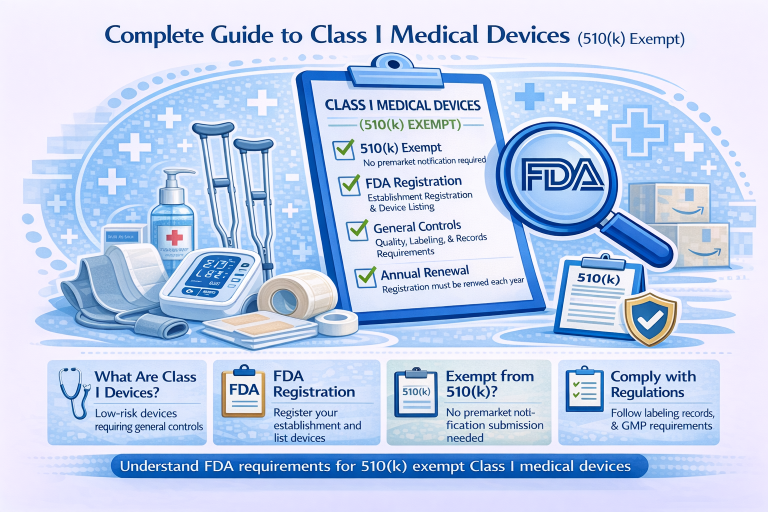
Class I Medical Devices & the 510(k) Exemption
What the 510(k) exemption really means, its limits, what you still must do — and the sterile exception that catches companies out.
Key Takeaways
- Most Class I devices are 510(k)-exempt — no premarket notification to file.
- Exempt ≠ requirement-free — still register, list, and meet general controls.
- The exemption has limits (xxx.9) — new use, different technology, IVD high-morbidity.
- GMP-exempt except records & complaints — 820.180 and 820.198 still apply.
- Sterile = full quality system — the GMP exemption doesn't apply to sterile devices.
- "Reserved" devices aren't exempt; and exempt ≠ cleared ≠ approved.
"510(k)-Exempt" Explained
A 510(k) is a premarket notification that shows a device is substantially equivalent to a legally marketed predicate. FDA has exempted the large majority of Class I devices (and some Class II devices) from that requirement — so an exempt device can be marketed without filing a 510(k) or waiting for a clearance.
- Applies to almost all Class I — and a subset of Class II device types
- No premarket notification — and no FDA premarket review of the device
- "Reserved" devices are excluded — certain Class I types still require a 510(k)
- Set device-type by device-type — in the classification regulation, not by class alone
Exempt Doesn't Mean Unregulated
The 510(k) exemption removes one requirement — premarket notification. Everything else that applies to a marketed device still applies:
- Establishment registration & device listing — 21 CFR Part 807 (annual)
- Compliant labeling — 21 CFR Part 801 (and UDI, 21 CFR Part 830, where applicable)
- Medical Device Reporting — 21 CFR Part 803
- Records & complaint files — 21 CFR 820.180 & 820.198 (kept even under the GMP exemption)
- Corrections/removals & the misbranding/adulteration prohibitions
When the Exemption Doesn't Apply (21 CFR xxx.9)
The exemption applies only to the extent your device has the existing or reasonably foreseeable characteristics of devices already in that generic type. It can be lost when:
| The exemption is lost if the device… | Example |
|---|---|
| Has a new intended use | A basic device marketed for a new medical claim/population |
| Uses a different fundamental scientific technology | A different material, energy source, or operating principle than the classified devices |
| (IVDs) A misdiagnosis would cause high morbidity/mortality | An in vitro diagnostic where an error is high-risk |
GMP Exemption — and the Sterile Exception
Most Class I devices are exempt not only from 510(k) but from most of the quality system/GMP regulation (21 CFR Part 820, now the QMSR):
- Still required: the records requirements (820.180) and complaint files (820.198)
- Exempt from: most of the rest of the quality system — for non-sterile Class I devices
How to Verify Your Device's Exemption
- Find the product code — in FDA's Product Classification Database, based on intended use
- Check the exemption indicators — the 510(k)-exempt and GMP-exempt flags for that code
- Read the classification regulation — 21 CFR Parts 862–892, including the xxx.9 limitations
- Confirm it isn't "reserved" — reserved Class I devices still need a 510(k)
- Check for a new use / different technology — either can remove the exemption
- Still unsure? — a 513(g) request can obtain FDA's view on classification/exemption
Exempt Class I Devices in Practice
Each of these is a Class I, generally 510(k)-exempt device — and each still requires registration, listing, general controls, and (where sterile) the full quality system:
Common 510(k)-Exemption Mistakes
- Reading "exempt" as "no FDA obligations" — registration, listing, general controls, records/complaints still apply
- Assuming every Class I device is exempt — reserved devices aren't
- Treating a sterile device as fully GMP-exempt — sterile = full quality system
- Overlooking the xxx.9 limits — a new use or different technology can remove the exemption
- Calling an exempt device "FDA cleared/approved" — it's neither
- Missing UDI; missing the U.S. Agent (foreign)
Confirm Your 510(k) Exemption
FDA Registration Assistance confirms your device's classification and whether the 510(k) exemption truly applies (checking the product code, the xxx.9 limitations, "reserved" status, and sterility), then handles establishment registration and device listing, general-controls and labeling review, and U.S. Agent service for foreign makers — so an exempt device is properly registered, without over- or under-doing the requirements.
Contact us at info@fdaregistrationassistance.com or call +1 (928) 275-8333 for a quote. An independent compliance firm serving 1,000+ companies across 135+ countries, with 15+ years of experience.
Frequently Asked Questions — 510(k) Exemption
1. What does "510(k)-exempt" mean?
It means the device does not require a 510(k) premarket notification before it can be marketed. FDA has exempted almost all Class I devices (and some Class II devices) from the 510(k) requirement, so for an exempt device you don't file a 510(k) and don't wait for a clearance. But 510(k)-exempt is not the same as unregulated - registration, listing, and general controls still apply, and the exemption has limits.
2. Are all Class I devices 510(k)-exempt?
Almost all, but not every one. FDA has exempted the large majority of Class I devices from 510(k), but certain "reserved" Class I devices are not exempt and still require a 510(k). And even for exempt devices, the exemption is subject to limitations. So you can't assume a device is exempt just because it's Class I - confirm the specific product code's exemption status (and any "reserved" flag) in FDA's classification database.
3. If my device is exempt, do I still have to do anything with FDA?
Yes. An exempt device still requires FDA establishment registration and device listing (21 CFR Part 807), and it must comply with general controls: truthful labeling (21 CFR Part 801), Medical Device Reporting (21 CFR Part 803), records and complaint files, reporting of corrections/removals, and the prohibitions against misbranding and adulteration. FDA's guidance is explicit that exempt manufacturers must still register and list. "Exempt from 510(k)" is not "exempt from FDA."
4. What are the limits on the 510(k) exemption?
The exemption is limited by 21 CFR xxx.9 (in Parts 862–892). Broadly, it applies only to the extent the device has the existing or reasonably foreseeable characteristics of devices already in that generic type. It's lost if the device: (1) has a new intended use; (2) operates on a different fundamental scientific technology than the classified devices (e.g., a different material, energy source, or operating principle); or (3) for an in vitro diagnostic, a misdiagnosis would be associated with high morbidity or mortality. In those cases a 510(k) may be required despite the general exemption.
5. Does the exemption cover the quality system (GMP) too?
Partly. Most Class I devices are exempt not only from 510(k) but also from most of the quality system/GMP regulation (21 CFR Part 820, now the QMSR) - except the records requirements (21 CFR 820.180) and the complaint-file requirements (21 CFR 820.198), which still apply. So even a GMP-exempt Class I manufacturer must keep device records and a complaint file. The full quality system still applies to Class II devices and to certain situations described below.
6. Does the GMP exemption apply to sterile devices?
No. The reduced GMP exemption for Class I devices does not apply to devices labeled or otherwise represented as sterile. A sterile Class I device must comply with the full quality system, including sterilization validation and process controls - even if it's still 510(k)-exempt. This catches many companies off guard: the product needs no 510(k), but because it's sterile, it needs the complete quality system, not the reduced exempt version.
7. What is a "reserved" device?
A "reserved" device is a Class I device that FDA did not exempt from 510(k) - it remains subject to premarket notification despite being Class I. When FDA exempted the class of devices, it "reserved" certain generic types from the exemption because of their risk. So being Class I doesn't guarantee exemption; you must check whether your device type is reserved. The classification regulation and the product classification database indicate the exemption/reserved status.
8. How do I confirm whether my device is exempt?
Find your device's product code in FDA's Product Classification Database and check the 510(k) exemption and GMP-exemption indicators, then read the classification regulation (21 CFR Parts 862–892) for that device type, including the xxx.9 limitations. Confirm your device fits the generic type (same intended use and fundamental technology) and isn't "reserved." If your device has a new use or different technology, the exemption may not apply. When in doubt, a 513(g) request to FDA can obtain FDA's view on classification/exemption.
9. Is a 510(k)-exempt device "FDA cleared" or "FDA approved"?
No. An exempt device receives no FDA premarket review, so it's neither "cleared" (which is a 510(k) term) nor "approved" (a PMA term). It's simply registered and listed and compliant with general controls. Marketing an exempt device as "FDA cleared" or "FDA approved" is inaccurate and misleading. The correct description is that your establishment is registered and the device is listed.
10. What are some examples of exempt Class I devices?
Common exempt Class I devices include many everyday medical products: examination gloves, specimen containers, canes and crutches, manual hospital beds, basic wound dressings and gauze, and medical adhesive tape/bandages. Each is Class I and generally 510(k)-exempt, yet each still requires registration, listing, general controls, and (where sterile) the full quality system. They're good illustrations that "exempt" still comes with real obligations.
11. Do foreign manufacturers of exempt devices need to register?
Yes. A foreign manufacturer of a 510(k)-exempt device must still complete FDA establishment registration and device listing, comply with general controls (and the full quality system if the device is sterile), and appoint a U.S. Agent. The 510(k) exemption doesn't exempt a foreign establishment from registration, listing, or the U.S. Agent requirement. Imported exempt devices are checked for proper registration and labeling at entry.
12. Can a Class II device be 510(k)-exempt?
Yes. While the 510(k) exemption is most common for Class I, FDA has also exempted some Class II devices from 510(k) (often subject to conditions, and still with their special controls). So exemption status isn't purely a function of class - it's set device-type by device-type in the classification regulation and the exemption lists. Always confirm the specific product code, whether it's Class I or II, rather than assuming based on class alone.
13. Does the exemption remove UDI or labeling obligations?
No. Being 510(k)-exempt doesn't remove labeling requirements (21 CFR Part 801) or Unique Device Identification (UDI, 21 CFR Part 830) where applicable. Exempt devices still need compliant labeling and, depending on class and type and the applicable compliance dates, may need UDI and GUDID data. The exemption is specifically from premarket notification - not from the broader device requirements that apply to marketed devices.
14. What happens if I wrongly assume my device is exempt?
It's a real risk. If your device actually needed a 510(k) (because it's reserved, has a new use, or uses different technology) and you marketed it as exempt, the device can be considered adulterated/misbranded and not legally marketed - exposing you to warning letters, import refusal, and enforcement. Similarly, treating a sterile device as fully GMP-exempt, or skipping registration/listing, creates compliance gaps. Confirming the exemption and its limits up front avoids these problems.
15. What are the most common 510(k)-exemption mistakes?
Assuming "510(k)-exempt" means "no FDA obligations" (registration, listing, general controls, records/complaints still apply); assuming every Class I device is exempt (reserved devices aren't); treating a sterile device as fully GMP-exempt; overlooking the xxx.9 limits (new use/different technology); calling an exempt device "FDA cleared/approved"; missing UDI; and (for foreign makers) missing the U.S. Agent. Most trace back to over-reading "exempt."
16. How does FDA Registration Assistance help with exempt devices?
We confirm your device's classification and whether the 510(k) exemption truly applies (checking the product code, the xxx.9 limitations, "reserved" status, and sterility), then handle FDA establishment registration and device listing, general-controls and labeling review, and U.S. Agent service for foreign makers - so an exempt device is properly registered and marketed without over- or under-doing the requirements. We're an independent compliance firm serving 1,000+ companies across 135+ countries with 15+ years of experience. Contact info@fdaregistrationassistance.com or +1 (928) 275-8333.
