
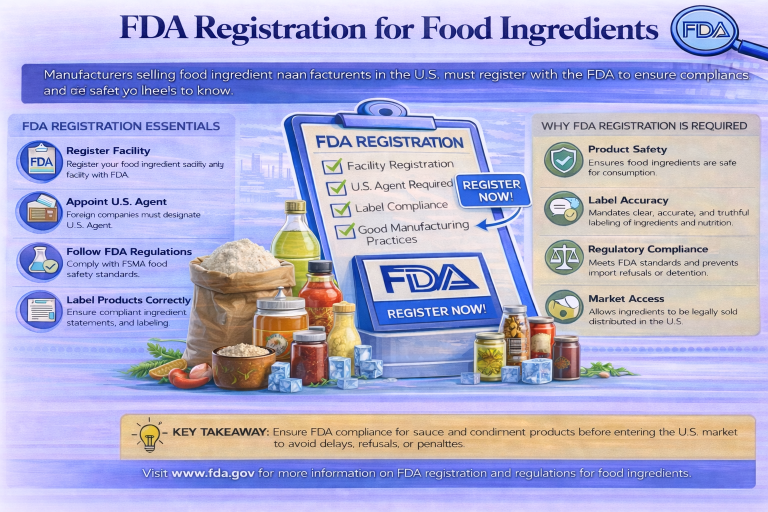
FDA Registration for Food Ingredients
Additives, flavors, sweeteners, preservatives, colors, functional ingredients — the facility side is routine. The ingredient-status side is where things get missed.
Key Takeaways
- Two separate things: facility registration and ingredient lawfulness.
- Four lawful bases: food additive, GRAS, prior sanction, or color additive.
- Registration ≠ ingredient approval — a registered facility can still ship an unlawful ingredient.
- Colors are stricter — always need approval/listing; no GRAS; some need certification.
- The Delaney Clause bars additives shown to cause cancer in humans or animals.
- Red No. 3 was revoked in food (Jan 15, 2025) — reformulate by Jan 15, 2027.
The Four Ways an Ingredient Can Be Lawful
Approved food additive
FDA premarket approval via a food additive petition; approved uses appear in 21 CFR 172–180.
GRAS
Generally Recognized As Safe for the intended use — via FDA's voluntary notification program or an independent conclusion.
Prior-sanctioned
Sanctioned by FDA or USDA before the 1958 Food Additives Amendment, for the specific use (21 CFR 181).
Color additive
If it colors food, it must be an approved, listed color additive — the strictest path (see below).
Color Additives — the Strict Path
If a substance is used mainly to add color, it lives under a tougher regime than other ingredients:
No GRAS shortcut
Colors can't rely on GRAS or a threshold exemption. Every colorant needs an approved, listed color additive status — and many synthetic dyes require batch-by-batch certification.
The Delaney Clause
FDA can't authorize a color or food additive shown to cause cancer in humans or animals — regardless of dose. It's rigid by design, which is why one animal-cancer finding can force a revocation.
Registration, Controls & Imports
| Requirement | What it involves |
|---|---|
| Facility registration | Register the maker/processor/holder; foreign facilities add a U.S. Agent |
| Preventive controls | Hazard analysis and controls under 21 CFR Part 117 |
| Prior notice | Before each imported shipment arrives |
| FSVP | Importer verifies the foreign supplier |
| Documentation | Specifications, certificates of analysis, safety/identity data |
Bringing an Ingredient to Market
Confirm the lawful basis
Approved additive, GRAS for the use, prior-sanctioned, or an approved color additive.
Register the facility
The maker/processor/holder registers; foreign facilities add a U.S. Agent.
Meet preventive controls
Hazard analysis and controls under 21 CFR Part 117.
Prepare documentation
Specifications, certificates of analysis, and safety/identity data.
Handle imports
Registration, U.S. Agent, FSVP, and prior notice.
Monitor for changes
Track additive/color actions (like Red No. 3) and reformulate ahead of deadlines.
Get Your Food Ingredient to Market
FDA Registration Assistance registers ingredient facilities, serves as U.S. Agent, reviews an ingredient's regulatory status (additive, GRAS, prior sanction, or color additive), prepares documentation, and supports FSVP and prior notice — so both the facility and the ingredient are covered.
Contact us at info@fdaregistrationassistance.com or call +1 (928) 275-8333. Trusted by companies across 135+ countries, with 15+ years of experience.
Frequently Asked Questions
1. Do food ingredients need FDA registration?
The facility that makes, processes, or holds an ingredient registers, and foreign facilities need a U.S. Agent. But that's only half the picture — the ingredient itself also needs a lawful basis. Facility registration and ingredient lawfulness are two separate things.
2. What makes a food ingredient lawful to use?
One of four bases: an approved food additive, GRAS for the intended use, prior-sanctioned (pre-1958), or an approved color additive. Without one, the ingredient isn't lawful — no matter whether the facility is registered.
3. Does registering my facility make my ingredient "FDA approved"?
No — the key misconception. Registration tells FDA the facility exists and what it does; it says nothing about whether an ingredient is lawful for a use. An ingredient from a registered facility can still be unlawful.
4. What is GRAS?
Generally Recognized As Safe — qualified experts agree the substance is safe under its intended use. It can be supported via FDA's voluntary GRAS Notification program or an independent conclusion. GRAS is tied to the specific use.
5. GRAS or food additive — what's the difference?
A food additive needs FDA premarket approval via petition, with approved uses in 21 CFR 172–180. GRAS is a separate route resting on general recognition of safety. Both make an ingredient lawful; they get there differently.
6. Are color additives treated differently?
Yes, more strictly — any substance used mainly to color food must be an approved, listed color additive (no GRAS), and many synthetic colors need batch-by-batch certification. Colorants face a tougher, dedicated path.
7. What is the Delaney Clause?
A provision barring FDA from authorizing any food or color additive found to induce cancer in humans or animals, regardless of dose or mechanism. It's "extraordinarily rigid," so a single animal-cancer finding can force revocation.
8. What happened with Red No. 3?
On January 15, 2025, FDA revoked FD&C Red No. 3 as a color additive in food and ingested drugs under the Delaney Clause. Food makers have until January 15, 2027 to reformulate. It shows an ingredient's lawful status can change.
9. Are other dyes being removed too?
Separately, in April 2025 FDA asked industry to voluntarily phase out six petroleum-based dyes (Red 40, Yellow 5, Yellow 6, Blue 1, Blue 2, Green 3). That's a voluntary request, not a binding ban — though state rules and retailers add pressure.
10. Do ingredient facilities need preventive controls?
Generally yes — under 21 CFR Part 117, the facility does a hazard analysis and controls relevant hazards. Some small or qualified facilities have modified requirements.
11. Do importers need FSVP and prior notice?
Yes — a registered foreign facility with a U.S. Agent, prior notice per shipment, and an importer FSVP. FDA often requests specs, COAs, and safety data at entry, so have documentation ready.
12. Do ingredients need labeling?
An ingredient sold packaged needs proper identity and information. And in a finished food it must be declared by its common or usual name in the ingredient list — correct naming keeps the downstream product compliant.
13. Why do ingredient shipments get held?
Importing an ingredient that isn't lawful for its intended use (no additive, GRAS, prior-sanction, or color-additive basis), or missing documentation. Confirming the ingredient's status before shipping is the most important step.
14. How does FDA Registration Assistance help?
It registers ingredient facilities, serves as U.S. Agent, reviews an ingredient's status (additive, GRAS, prior sanction, or color additive), prepares documentation, and supports FSVP and prior notice, for companies across 135+ countries. Contact info@fdaregistrationassistance.com or +1 (928) 275-8333.