FDA Registration for Nuts & Seeds
Almonds, peanuts, cashews, pistachios, sunflower, chia, sesame — same two questions decide compliance: is it labeled right, and is it safe?
Key Takeaways
- Nuts & seeds are conventional food — registration, labeling, preventive controls.
- Aflatoxin action level: 20 ppb total aflatoxins — a top import-refusal cause.
- Salmonella survives in low-moisture nuts — needs a validated kill step.
- Tree nuts declared by type; FDA's 2025 guidance narrowed the list to 12 (coconut removed).
- Sesame is the 9th allergen (a seed) — effective Jan 1, 2023.
- Part 117 hazard analysis for nuts flags aflatoxin, Salmonella, and allergen cross-contact.
Aflatoxin and Salmonella
Aflatoxin (a mold toxin)
Managed through supplier controls, sorting out moldy/defective nuts, and testing to stay within the action level. Peanuts, pistachios, and Brazil nuts get particular attention, and imports are routinely sampled.
Salmonella (a pathogen)
Nuts are low-moisture foods where Salmonella can persist — several outbreaks trace to nuts and nut butters. Control means a validated kill step (roasting, steam, or other pasteurization) plus sanitation and testing.
Allergen Labeling — Declare by Type
Nuts and seeds are central to the major-allergen rules, so labeling has to be precise:
Tree nuts
Declare the specific type (almond, walnut, cashew…). FDA's 2025 guidance narrowed the labeling list to 12 tree nuts and removed some, including coconut.
Peanuts
A separate major allergen — peanuts are legumes, not tree nuts. A peanut allergy isn't a tree-nut allergy, which is why each is labeled on its own.
Sesame
The 9th major allergen (effective Jan 1, 2023). A seed — so sesame, tahini, and products with them must declare it.
The Hazard Analysis for Nuts & Seeds
| Hazard | Typical control | Framework |
|---|---|---|
| Aflatoxin | Supplier controls, sorting, testing (≤ 20 ppb) | 21 CFR Part 117 |
| Salmonella | Validated kill step + sanitation + testing | 21 CFR Part 117 |
| Allergen cross-contact | Segregation, scheduling, cleaning, label controls | 21 CFR Part 117 |
Bringing a Nut or Seed Product to Market
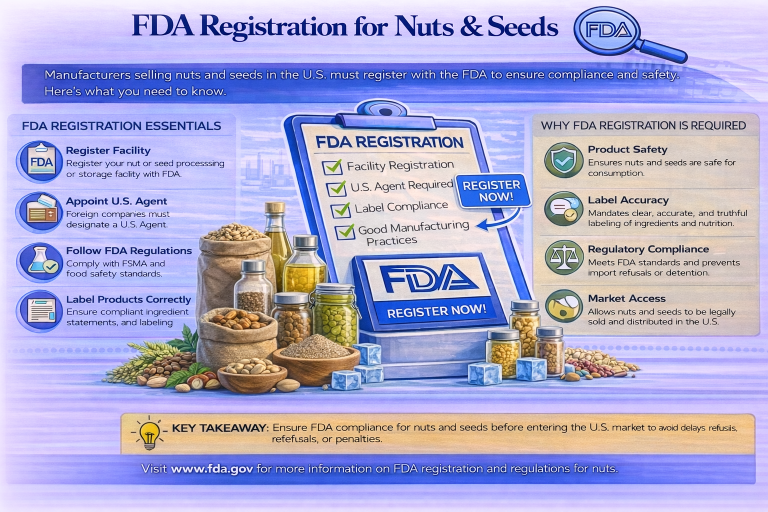
Register the facility
The processor/packer/holder registers; foreign facilities add a U.S. Agent.
Run the hazard analysis
Part 117: evaluate aflatoxin, Salmonella, and allergen cross-contact.
Control contamination
Aflatoxin testing/supplier controls (≤ 20 ppb) and a validated Salmonella kill step.
Get allergen labeling right
Declare tree nuts by type, plus peanuts and sesame; control cross-contact.
Handle imports
Registration, U.S. Agent, FSVP, and prior notice before shipping.
Keep it current
Renew every two years; keep testing and food-safety records; revisit labels on change.
Get Your Nuts & Seeds to Market
FDA Registration Assistance registers nut and seed facilities, serves as U.S. Agent, reviews allergen labeling, supports preventive-controls hazard analysis for aflatoxin and Salmonella, and handles FSVP and prior notice — so labeling and contamination issues surface before the port, not at it.
Contact us at info@fdaregistrationassistance.com or call +1 (928) 275-8333. Trusted by companies across 135+ countries, with 15+ years of experience.
Frequently Asked Questions
1. Do nuts and seeds need FDA registration?
The facility that processes, packs, or holds them registers, and foreign facilities need a U.S. Agent. Nuts and seeds are conventional food, but FDA watches them closely for allergens and for aflatoxin/Salmonella. Registration isn't approval.
2. Why does FDA scrutinize nuts and seeds so much?
Two reasons: allergens (tree nuts and peanuts are major allergens; sesame — a seed — is the 9th) and contamination (aflatoxin, plus Salmonella in these low-moisture foods). Both are frequent causes of detention and refusal at import.
3. What is aflatoxin and what's the limit?
A toxin from Aspergillus molds that can occur in peanuts and tree nuts. FDA's action level for total aflatoxins in human food like nuts is 20 parts per billion — above that, the product can be adulterated under Section 402(a)(1). It's a top reason nut shipments get refused.
4. How is Salmonella controlled in nuts?
Nuts are low-moisture foods where Salmonella can persist — outbreaks have been linked to nuts and nut butters. Control usually means a validated kill step (roasting, steam, other pasteurization) plus sanitation and testing, documented in the preventive-controls plan.
5. How do I label tree nuts?
By specific type — almond, walnut, pecan, cashew — not just "tree nuts." FDA's 2025 allergen guidance narrowed the labeling list to twelve tree nuts and removed some, including coconut, from the major tree-nut list.
6. Is sesame an allergen now?
Yes — under the FASTER Act, sesame became the 9th major food allergen, effective January 1, 2023. As a seed, it's directly relevant: sesame seeds, tahini, and products containing them must declare sesame.
7. Are peanuts tree nuts?
No — peanuts are legumes, but they're their own major allergen and must be declared. A peanut allergy isn't necessarily a tree-nut allergy, which is why FDA requires each to be labeled specifically.
8. Do nut facilities need a preventive controls plan?
Generally yes — under 21 CFR Part 117, the hazard analysis for nuts and seeds typically flags aflatoxin, Salmonella, and allergen cross-contact. Where a hazard needs a control, the plan documents it. Some small/qualified facilities have modified requirements.
9. What about raw nuts straight from a farm?
Raw agricultural commodities can involve different requirements, and some farm activities fall under other rules. But once nuts are roasted, shelled, ground, flavored, or packaged for sale, a facility is generally involved and registers. Classification depends on the operation.
10. Do importers need FSVP and prior notice?
Yes — imported nuts need a registered foreign facility with a U.S. Agent, prior notice per shipment, and an importer FSVP. Given aflatoxin and Salmonella, supplier verification and testing are central.
11. Is "FDA registered" the same as "FDA approved"?
No — registration tells FDA a facility exists and what it does; it isn't approval of the product. "FDA approved" based on registration is inaccurate.
12. Why do nut shipments get held?
Undeclared or wrong allergens, aflatoxin above the action level, Salmonella findings, and unregistered facilities. Getting allergen labeling and contamination controls right up front keeps products moving.
13. Is compliance a one-time task?
No — registration renews every two years, testing and food-safety records stay current, and each import needs prior notice. New products or reformulations mean revisiting labels and allergen controls.
14. How does FDA Registration Assistance help?
It registers nut and seed facilities, serves as U.S. Agent, reviews allergen labeling, supports hazard analysis for aflatoxin and Salmonella, and handles FSVP and prior notice, for companies across 135+ countries. Contact info@fdaregistrationassistance.com or +1 (928) 275-8333.