
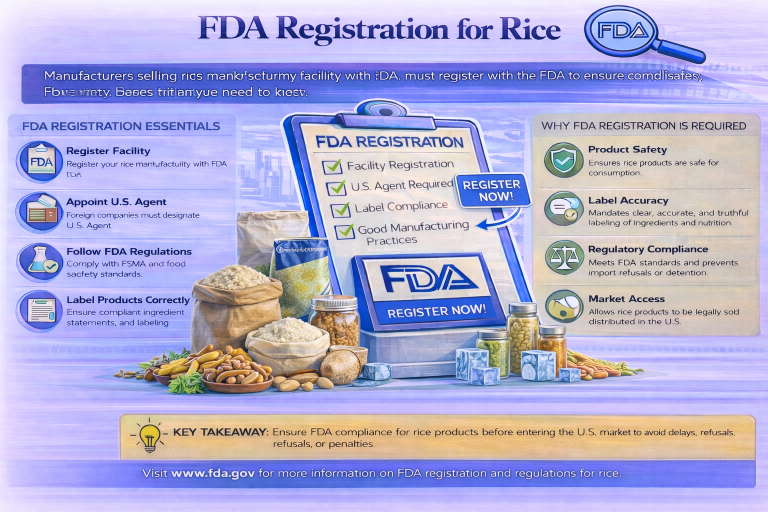
FDA Registration for Rice
Registration for every rice type, the inorganic-arsenic enforcement landscape, serving sizes, enriched-rice and variety labeling, and the FSVP hazards that get rice detained at U.S. ports.
Key Takeaways
- All rice mills, processors & packers register — every variety and rice-based product.
- Inorganic arsenic is FDA's #1 rice concern — 100 ppb action level for infant rice cereal.
- RACC serving sizes: 140g cooked / 45g dry — home-country formats are misbranding.
- Variety names must be true — jasmine and basmati can't be ordinary long-grain.
- "Enriched rice" has a standard — thiamine, niacin, iron, folic acid (21 CFR 137.350).
- Importers need a real FSVP — arsenic, pesticides, heavy metals, aflatoxin.
Inorganic Arsenic in Rice
Why rice, specifically? Rice is grown in flooded paddies, and those conditions mobilize inorganic arsenic from soil and water into the grain at higher levels than in most crops. Inorganic arsenic is a known human carcinogen linked to neurodevelopmental effects in infants — which is why rice draws more toxic-element attention than nearly any other commodity.
- Infant rice cereal — 100 ppb — FDA finalized this action level in August 2020; it treats exceedances as a factor in whether a product is adulterated
- "Closer to Zero" — FDA's 2021 action plan to reduce arsenic, lead, cadmium, and mercury in foods for babies and young children — rice is central, and levels may tighten over time
- All rice is monitored — FDA samples imported rice and can detain lots as adulterated where levels present a safety concern, not just infant cereal
- Geographic & varietal risk — arsenic varies by origin (former cotton-growing regions where arsenical pesticides were used can be higher) and by variety
FDA Serving Sizes (RACC) for Rice
Rice has specific reference amounts (RACC) under 21 CFR 101.12 that the Nutrition Facts panel must use. Substituting a home-country format is one of the most common rice misbranding errors:
| Rice product | FDA RACC | Common labeling error |
|---|---|---|
| White / brown rice, cooked | 140 g | 100g, 200g, or "1 cup" with no gram weight |
| Dry uncooked rice (any variety) | 45 g | Per-100g dry comparison; "½ cup" with no grams |
| Parboiled / converted, cooked | 140 g | Same errors as white rice |
| Wild rice, cooked | 140 g | Per-100g or preferred portion |
| Flavored / seasoned mixes (dry) | Varies | Per-package serving instead of the RACC |
Varieties, Enriched Rice, Wild Rice & Claims
- Jasmine & basmati must be real — "jasmine" must be the jasmine variety (Thai Hom Mali or similar aromatic long-grain); "basmati" must be basmati (Oryza sativa var. indica). Passing off ordinary long-grain as either is misbranding, and FDA can test for variety authenticity
- "Enriched rice" is a standard of identity — 21 CFR 137.350 sets required levels of thiamine, niacin, iron, and folic acid; a product labeled "enriched" that misses the standard is misbranded
- Wild rice is a different species — Zizania aquatica, regulated the same way; a "wild rice blend" that's mostly white rice with a trace of wild rice can mislead
- "Organic" is USDA, not FDA — it needs USDA National Organic Program certification; using it without certification is a federal violation
The Rice FSVP Hazard Analysis
Rice is unusual: it has documented chemical hazards at the raw-material level, so supplier verification has to be substantive, not a formality.
- Inorganic arsenic — significant chemical hazard; periodic testing + geographic/varietal risk assessment
- Pesticide residues — EPA sets tolerances; violations trigger detention (Import Alert 99-23)
- Heavy metals — cadmium and lead
- Aflatoxin — a mycotoxin from improper storage/humidity
- Salmonella & physical hazards — biological risk in milling environments; stones and metal fragments
How to Register a Rice Facility
- Activity codes — Manufacture (milling, cleaning, hulling, parboiling, enriching), Pack (bagging), and Hold (warehousing finished rice); update within 60 days when you add types (21 CFR 1.234)
- U.S. Agent — foreign rice mills must designate a U.S. Agent with a physical U.S. address
- Prior Notice — filed before each shipment (about 8 hours by water, 4 by air, 2 by land), with the correct registration number and product code
- Biennial renewal — every even year (October–December); a lapse means detention of subsequent shipments
Get Your Rice Business FDA-Compliant
FDA Registration Assistance handles facility registration with the right activity codes, U.S. Agent for foreign mills, label review (RACC, variety naming, enriched-rice standard, gluten-free and organic claims), FSVP with inorganic-arsenic and pesticide controls, Prior Notice accuracy, and biennial renewal.
Contact us at info@fdaregistrationassistance.com or call +1 (928) 275-8333. Complete service: $858 — FDA charges no government fee; DUNS costs separate. Trusted by companies across 135+ countries, with 15+ years of experience.
Frequently Asked Questions — FDA Registration for Rice
1. Do rice manufacturers and processors need FDA registration?
Yes. Rice mills, processors, and packers must register with FDA under 21 U.S.C. 350d and 21 CFR Part 1 Subpart H. It applies to all rice types — white, brown, jasmine, basmati, enriched, parboiled, wild — and all rice-based products (rice cakes, crackers, flour, pasta). Foreign manufacturers must also designate a U.S. Agent. Our complete service is $858; FDA itself charges no government fee, and any DUNS costs are separate.
2. What is inorganic arsenic and why is it FDA's main concern for rice?
Rice is grown in flooded paddies, which mobilize inorganic arsenic from soil and water into the grain at higher levels than most crops — making rice a leading dietary source of inorganic arsenic, a known carcinogen with neurodevelopmental effects in infants. FDA finalized an action level of 100 ppb for inorganic arsenic in infant rice cereal in August 2020, and it monitors and can detain other rice products as adulterated if levels present a safety concern. A rice FSVP must treat inorganic arsenic as a significant chemical hazard.
3. What is FDA's "Closer to Zero" plan and does it affect rice?
Closer to Zero is FDA's action plan (launched 2021) to reduce dietary exposure to arsenic, lead, cadmium, and mercury from foods commonly eaten by babies and young children — and rice is central to it because of its arsenic uptake. It signals continued FDA attention (and potentially tighter future levels) for rice used in infant and toddler foods. It's a program to track: the 100 ppb infant-rice-cereal action level sits within this broader effort.
4. What is the FDA serving size (RACC) for rice?
Under the reference amounts in 21 CFR 101.12: cooked rice (white, brown, parboiled, wild) uses a 140g RACC, and dry uncooked rice uses a 45g RACC. Using a home-country format instead — per 100g dry, per 100g cooked, or a manufacturer-preferred portion — is a common misbranding error under 21 U.S.C. 343. The serving size must show grams plus a common household measure.
5. Does rice variety naming (jasmine, basmati) have FDA requirements?
Yes — variety names must be accurate. "Jasmine rice" must be the jasmine variety (Thai Hom Mali or similar aromatic long-grain), and "basmati rice" must be basmati (Oryza sativa var. indica from the Indian subcontinent). Labeling ordinary long-grain white rice as jasmine or basmati to command a premium is misbranding, and FDA can test imported rice for variety authenticity as part of import sampling.
6. What is enriched rice and what does the FDA standard require?
Enriched rice has a standard of identity under 21 CFR 137.350: it must contain specified levels of thiamine (vitamin B1), niacin, iron, and folic acid per pound. A product labeled "enriched rice" that doesn't meet the standard is misbranded. The "enriched" designation is only required if you make the claim — but if you do, the product has to meet the standard exactly.
7. Is rice gluten-free, and can I label it that way?
Rice is naturally gluten-free, and it's a common gluten-free base. But "gluten-free" is an FDA-defined claim (under 20 ppm gluten, 21 CFR 101.91), so if you make the claim you must meet that standard and control cross-contact — especially in facilities or blends that also handle wheat, barley, or rye (for example, seasoned rice mixes with wheat-based flavorings). Naturally gluten-free doesn't remove the claim's requirements.
8. What labeling is required on rice bags for the U.S. market?
Under 21 CFR Part 101: a statement of identity (e.g., "Long Grain White Rice," "Jasmine Rice"); net quantity in both U.S. and metric units; a Nutrition Facts panel in the current format with the correct RACC; an ingredient list for blended/seasoned products; allergen declarations where applicable; and the manufacturer or distributor name and U.S. address. All required text must be in English.
9. What FSVP hazards must rice importers address?
A rice FSVP hazard analysis should address: inorganic arsenic (a significant chemical hazard that varies by origin and variety); pesticide residues (EPA tolerance violations trigger detention, e.g., under Import Alert 99-23); heavy metals (cadmium, lead); mycotoxins/aflatoxin (from poor storage); Salmonella (a biological hazard in milling environments); and physical hazards (stones, metal fragments). Two-year FSVP recordkeeping is required, per supplier.
10. How should a rice importer verify arsenic compliance?
Through supplier verification tied to the hazard: periodic inorganic-arsenic testing by accredited laboratories, review of the foreign supplier's own arsenic monitoring data, a geographic and varietal risk assessment (some origins — including former cotton-growing regions where arsenical pesticides were used — carry higher risk), and corrective-action procedures for lots exceeding FDA's levels. The 100 ppb action level is specific to infant rice cereal, but arsenic monitoring applies across rice categories.
11. Is wild rice treated the same as other rice?
Yes for regulatory purposes. Wild rice (Zizania aquatica) is a different plant species from common rice (Oryza sativa) but is regulated the same way as a conventional food — its processing facility must register. In blends, all components are listed in descending order by weight, and a "wild rice blend" that's predominantly white rice with only a trace of wild rice can be misbranded if the label implies more.
12. Do "organic" rice claims need USDA certification?
Yes. "Organic" is a USDA National Organic Program claim, not an FDA one — it requires certification by a USDA-accredited certifying agent, and using it without certification violates the Organic Foods Production Act. Imported organic rice must be certified under USDA NOP or a recognized equivalency arrangement. This is separate from (and on top of) FDA registration and food-safety compliance.
13. What activity codes should a rice mill select?
Manufacture (milling, cleaning, hulling, parboiling, enriching, processing); Pack (bagging into retail or foodservice packages); and Hold (if the facility warehouses finished rice). Under 21 CFR 1.234, update your registration within 60 days when you add new rice types or activities. Getting the activity codes and product categories right helps prevent Prior Notice mismatches at import.
14. Do foreign rice exporters need a U.S. Agent?
Yes. A foreign rice mill or processor must register and designate a U.S. Agent with a physical U.S. address. The U.S. Agent is FDA's point of contact for the facility and is required for the registration to be valid. FDA Registration Assistance provides U.S. Agent services for foreign rice manufacturers.
15. What is Prior Notice, and when is it filed for rice?
Prior Notice (21 CFR Part 1 Subpart I) must be submitted to FDA before each rice shipment arrives — generally no less than 8 hours before arrival by water, 4 hours by air, and 2 hours by land. It must include the foreign manufacturer's correct FDA registration number and the correct product code for the specific rice type. Errors cause port holds that delay delivery.
16. Why do rice shipments get detained at U.S. ports?
The usual reasons: an expired or missing facility registration; elevated inorganic arsenic in sampling; pesticide residues over EPA tolerances; labeling violations (wrong RACC, variety-name misrepresentation, non-compliant Nutrition Facts); Prior Notice errors; or the supplier being on an active Import Alert (such as 99-23 for pesticide residues), which can mean detention without physical examination.
17. What FSMA preventive controls apply to rice manufacturers?
Full preventive controls under 21 CFR Part 117: a written food-safety plan with a hazard analysis and a preventive-controls-qualified individual (PCQI). Key rice hazards to evaluate include inorganic arsenic and pesticide residues (chemical), aflatoxin (a mycotoxin from poor storage), Salmonella (biological), and physical hazards from milling. The plan sits alongside registration and any import obligations.
18. Do rice crackers, rice cakes, and rice pasta need FDA registration?
Yes. Rice crackers, rice cakes, puffed rice, rice-based snacks, and rice pasta are manufactured foods whose facilities must register. Watch the allergens: sesame in rice crackers must be declared (the 9th major allergen since the FASTER Act took effect January 2023), and soy sauce in seasoned rice products brings in soy and wheat declarations.
19. Does a U.S. importer that warehouses rice need to register?
Often yes. A U.S. importer that holds rice in its own warehouse before reselling generally must register that warehouse as a food holding facility under 21 CFR Part 1 Subpart H. A company that arranges imports without physically holding the rice at its own location typically doesn't register its office — but it still carries FSVP and Prior Notice obligations as the importer.
20. How does FDA Registration Assistance help rice businesses?
Complete rice compliance: facility registration with the correct activity codes, U.S. Agent for foreign manufacturers, label review (RACC, variety naming, enriched-rice standard, gluten-free and organic claims), FSVP programs including inorganic-arsenic and pesticide-residue controls, Prior Notice accuracy, and biennial renewal management. Our complete service is $858 (FDA itself charges no government fee; DUNS costs are separate), for companies across 135+ countries with 15+ years of experience. Contact info@fdaregistrationassistance.com or +1 (928) 275-8333.
