
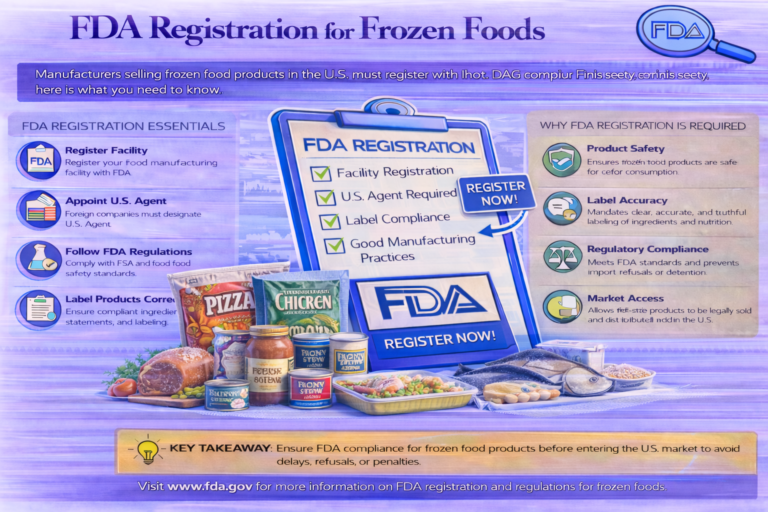
FDA Registration for Frozen Foods
Most of the frozen-food failures FDA sees aren't about the freezer working — they're about mistaking "frozen" for "safe."
Key Takeaways
- Freezing preserves, it doesn't sterilize — bacteria and viruses survive and revive on thaw.
- It's a control, not a kill step — "frozen" holds growth static (a listeristatic effect).
- The exception: parasites — freezing does destroy them (the basis for raw-fish freeze rules).
- "Looks cooked but isn't" — NRTE products need validated cook instructions + clear labeling.
- Frozen produce isn't automatically safe — blanching isn't a full kill step; Listeria & viruses persist.
- Most frozen food is FDA — frozen meat & poultry entrees are USDA.
Freezing Preserves — It Doesn't Sterilize
This is the frozen-food equivalent of "drying is not a kill step." Freezing to 0°F halts the activity of bacteria, yeasts, and molds — but it holds them dormant rather than destroying them. The moment the food warms up, survivors resume growing at roughly the same rate as on fresh food.
What freezing does
Suspends microbial growth (a bacteriostatic / listeristatic control), preserves quality, and — with the right time and temperature — destroys parasites.
What freezing doesn't do
Reliably kill bacteria or viruses, inactivate spores, or neutralize toxins. Contamination present at freezing is simply preserved until thaw.
Freezing Does Kill Parasites
Parasites are the one hazard freezing reliably destroys — which is why FDA requires freezing for parasite destruction in fish that will be eaten raw or undercooked (sushi, sashimi, ceviche). Any one of these three time-temperature options works:
| Option | Temperature | Hold time |
|---|---|---|
| 1 | -4°F (-20°C) or below | ≥ 7 days (168 hours) |
| 2 | -31°F (-35°C) or below, until solid | then ≥ 15 hours at -31°F |
| 3 | -31°F (-35°C) or below, until solid | then ≥ 24 hours at -4°F |
"Looks Ready-to-Eat" but Isn't
Some frozen products look fully cooked — browned, breaded, grill-marked — but are actually raw or only partially cooked and must be fully cooked by the consumer. When people treat them as heat-and-serve, illness follows. Frozen breaded, stuffed chicken items (the chicken-Kiev / cordon-bleu style) are the textbook case, tied to repeated Salmonella outbreaks.
Frozen Produce & the Cold Chain
Frozen fruit & vegetables
Blanching before freezing reduces enzymes and some microbes, but it's not a full kill step. Frozen produce has been linked to Listeria and to viruses like Hepatitis A and norovirus, especially in items eaten without cooking. Sourcing controls and sanitation still carry the load.
The cold chain
Frozen food must stay frozen from production to delivery; temperature abuse is a leading detention reason. The FSMA Sanitary Transportation rule 21 CFR part 1, subpart O sets vehicle, temperature, and record requirements in transit.
From Freezer to Compliant
Confirm FDA vs USDA
Most frozen food is FDA; frozen meat & poultry entrees are USDA.
Identify the real hazards
Freezing won't kill bacteria/viruses — map what could survive, and whether it's RTE or must-cook.
Handle raw-fish parasites
Apply and document parasite-destruction freezing, or hold a supplier letter.
Get cook instructions & labeling right
Validated instructions + "not ready to eat" for products that look cooked but aren't.
Register & control the cold chain
FDA registration + U.S. Agent; Sanitary Transport; prior notice + FSVP.
Verify & keep records
Temperature, parasite, and validation records; renew every two years.
Get Your Frozen Food Compliant
FDA Registration Assistance registers your facility, serves as U.S. Agent, and helps you address the frozen-specific issues — parasite-destruction freezing, validated cook instructions and not-ready-to-eat labeling, and cold-chain controls — inside your food-safety plan, plus labeling and FSVP.
Contact us at info@fdaregistrationassistance.com or call +1 (928) 275-8333. Food Facility Registration is available starting at $858. Trusted by companies across 135+ countries, with 15+ years of experience.
Frequently Asked Questions
1. Do frozen foods need FDA registration?
Yes, for FDA-regulated frozen foods — frozen vegetables, fruit, seafood, desserts, and prepared meals without enough meat to be USDA. The facility registers with FDA, and a foreign facility also names a U.S. Agent. The exception is frozen meat and poultry entrees, which are USDA-regulated.
2. Does freezing kill bacteria?
No. Freezing halts growth and holds bacteria static, but doesn't reliably kill them. Once thawed, survivors become active again and multiply. As FSIS puts it, freezing stops bacteria from growing but doesn't destroy most of them — so frozen isn't the same as safe, and thawed product must be handled like any perishable food.
3. So what does freezing actually control?
Freezing is a control, not a kill step. It suspends growth — which is why "frozen" counts as a food that doesn't support the growth of pathogens like Listeria (a listeristatic effect). But suspending growth isn't the same as eliminating the organism; contamination present at freezing is preserved, waiting for the thaw.
4. Does freezing kill parasites?
Yes — parasites are the one thing freezing reliably destroys. That's why FDA requires freezing for parasite destruction in fish eaten raw or undercooked (sushi, sashimi, ceviche). It's the key exception to "freezing doesn't kill": it does kill parasites, but not bacteria, viruses, or spores.
5. What are the FDA freezing parameters for parasite destruction in fish?
Under the FDA Food Code, fish to be served raw or undercooked must be frozen one of three ways: -4°F (-20°C) or below for at least 7 days (168 hours); or -31°F (-35°C) or below until solid and held at -31°F for at least 15 hours; or -31°F until solid, then held at -4°F or below for at least 24 hours. Very thick fish may need a validated study, and certain tunas and some farmed fish are excepted.
6. What records are needed for parasite-destruction freezing?
The freezing time and temperature must be recorded for each lot and kept at least 90 days beyond the sale of the last product from that lot. If an approved supplier did the freezing, a written purchase agreement or letter of guarantee can substitute for your own records.
7. What is the "looks ready-to-eat but isn't" problem?
Some frozen products look fully cooked — browned, breaded, grill-marked — but are raw or only partially cooked and must be fully cooked by the consumer. Frozen breaded, stuffed chicken items are the classic example, tied to repeated Salmonella outbreaks when people microwaved them instead of cooking through. These need validated cook instructions and clear not-ready-to-eat labeling.
8. What are validated cook instructions?
Instructions tested to show that, when followed, the product reaches a safe internal temperature — accounting for appliance type, wattage, and starting from frozen. For not-ready-to-eat products, they should specify verifying the final internal temperature and generally shouldn't rely on microwave-only directions, which are inconsistent.
9. Are frozen vegetables and fruit automatically safe?
No. Freezing preserves whatever is present, and blanching reduces enzymes and some microbes but isn't a full kill step. Frozen produce has been linked to Listeria and to viruses like Hepatitis A and norovirus, especially in items eaten without further cooking. Sourcing controls, sanitation, and — for RTE frozen items — environmental monitoring still matter.
10. How does freezing relate to Listeria and ready-to-eat foods?
Frozen RTE foods benefit from freezing stopping Listeria growth, but freezing doesn't remove it, and temperature abuse or thawing reactivates it. So frozen RTE foods still need the RTE Listeria controls — sanitation, hygienic zoning, environmental monitoring — covered on our ready-to-eat foods page.
11. What cold-chain rules apply to frozen foods?
Frozen foods must stay frozen from production to delivery; temperature abuse is a common detention reason. The FSMA Sanitary Transportation of Human and Animal Food rule (21 CFR part 1, subpart O) sets vehicle, temperature-control, and record requirements in transit. Documented cold-chain control is part of demonstrating safety.
12. Are frozen desserts and ice cream covered here?
The freezing science applies, but frozen desserts also have their own composition standards (standards of identity for ice cream, sherbet, and similar). For those, see our frozen dairy page; this page focuses on the microbial and labeling principles common to all frozen foods.
13. Do frozen food importers need a U.S. Agent and FSVP?
Yes. A foreign frozen-food facility needs a U.S. Agent, each import needs prior notice, and the importer maintains an FSVP — which should verify the supplier's relevant controls, including parasite-destruction freezing or validated cook instructions where they apply.
14. How does FDA Registration Assistance help?
We register your facility, serve as U.S. Agent, and help you address the frozen-specific issues — parasite-destruction freezing, validated cook instructions and not-ready-to-eat labeling, and cold-chain controls — inside your Part 117 plan, plus labeling and FSVP. Starting at $858, for companies across 135+ countries. Contact info@fdaregistrationassistance.com or +1 (928) 275-8333.
