
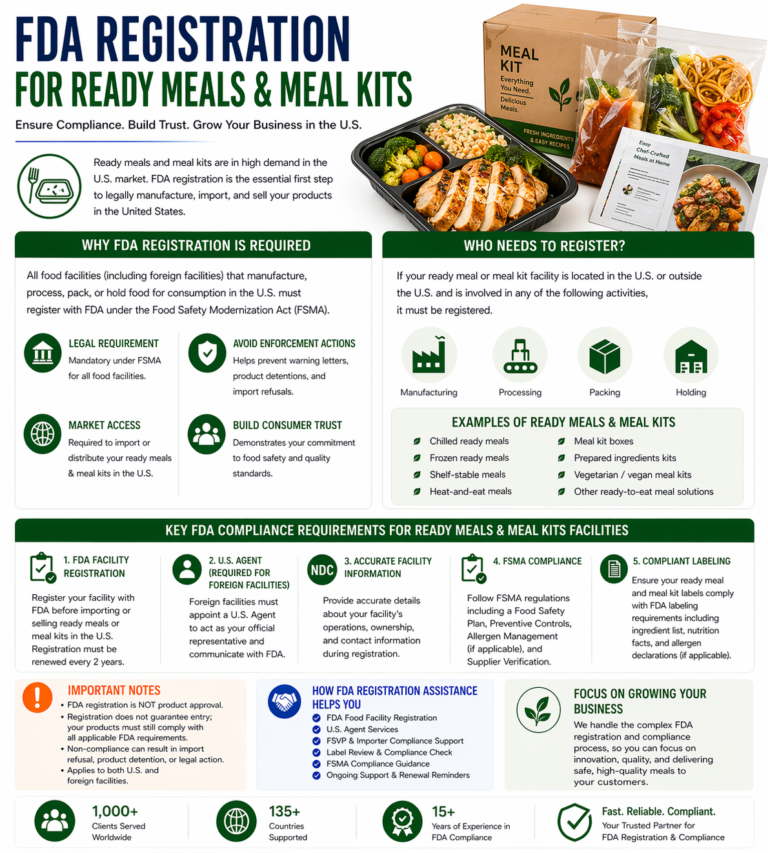
FDA Registration for Ready Meals & Meal Kits
Ready-to-eat vs not-ready-to-eat, the frozen/refrigerated/shelf-stable format split, and the USDA/FDA line for meat.
Key Takeaways
- Ready meal ≠ meal kit — this page is ready meals; meal kits have their own guide.
- RTE vs NRTE is the first question — it changes the whole hazard picture.
- NRTE means validated cook instructions — the label step is a real safety control.
- Format decides the regime — frozen, refrigerated (cold chain), or shelf-stable (LACF).
- Meat/poultry >2% cooked or >3% raw → USDA-FSIS — not FDA.
- Allergens across every component — the leading failure point in multi-part meals.
Ready Meal vs Meal Kit
These two get lumped together, but they raise different questions. A ready meal is a complete, fully assembled meal the consumer just heats — a frozen entrée, a refrigerated tray, a shelf-stable pouch. A meal kit is a set of separate ingredients and a recipe the consumer combines and cooks.
Ready meals turn on how the finished meal is preserved and whether it's ready-to-eat. Meal kits turn on shipping many components safely to the consumer — the cold chain, per-ingredient rules, and supplier verification.
Ready-to-Eat or Not-Ready-to-Eat?
Settle this first — it changes the hazard picture entirely:
- Ready-to-eat (RTE) — fully cooked, only needs reheating; the focus is Listeria monocytogenes and date marking, because there's no consumer kill step
- Not-ready-to-eat (NRTE) — the consumer must cook it (or a component) to be safe; the cooking instructions are the safety control and must be validated
Format Decides the Regime
The same recipe can carry very different obligations depending on how you preserve it:
| Ready-meal format | Kept safe by | Regime |
|---|---|---|
| Frozen entrée | Freezing | Register; RTE or NRTE (validated cook instructions if NRTE) |
| Refrigerated tray | Cold chain | RTE Listeria + date marking; reduced-oxygen adds rules |
| Shelf-stable tray / pouch / can | Commercial sterilization | Low-acid canned food → FCE + scheduled process |
| Microwaveable tray | Packaging + reheat/cook | Food-contact-cleared packaging for the heat |
FDA or USDA? The Meat Threshold
Which agency regulates your ready meal depends on its meat content. As a general rule, a product with more than 2% cooked meat or poultry, or more than 3% raw meat by weight, falls under USDA-FSIS; below those thresholds it stays with FDA.
- Beef / chicken / pork entrée — usually USDA-FSIS: carries the USDA inspection legend and generally needs pre-market label approval (a review measured in weeks), plus FSIS inspection
- Vegetarian, cheese, or very-low-meat meal — usually FDA: no pre-approval of food or labels; you ensure compliance and FDA enforces after the fact
- Seafood entrée — stays FDA, and adds Seafood HACCP (21 CFR 123)
Components & Allergens
- Assess each component, then the assembly — a tray can mix an RTE element with an NRTE one, or an FDA element with a USDA one
- Allergens across the whole meal — a sauce or seasoning often hides milk, soy, wheat, or egg; sesame is now the 9th major allergen
- Nutrition Facts + full ingredient list — for the finished packaged meal (USDA-jurisdiction labels go through FSIS pre-approval)
- Imports — FDA meals need foreign-facility registration + FSVP; USDA meals follow the FSIS country-equivalence import pathway
Get Your Ready Meals Compliant
FDA Registration Assistance classifies the meal first — RTE vs NRTE, the preservation format (and so whether an FCE/scheduled process applies), and whether meat/poultry content puts it under USDA instead of FDA. From there we handle facility registration, U.S. Agent, labeling (allergens, and validated cook instructions for NRTE), and FSVP for imports — and we flag the USDA pathway when it applies.
Contact us at info@fdaregistrationassistance.com or call +1 (928) 275-8333. Food Facility Registration is available starting at $858. Trusted by companies across 135+ countries, with 15+ years of experience.
Frequently Asked Questions
1. Do ready meals and meal kits require FDA registration?
Yes — a facility that manufactures, processes, packs, or holds ready meals or meal kits for the U.S. registers with FDA (foreign facilities also need a U.S. Agent), unless the product falls under USDA. But "ready meal" and "meal kit" are different products: a ready meal is a fully prepared meal you reheat; a meal kit is a box of components you assemble and cook. This page focuses on ready meals — for meal kits and subscription boxes, see our dedicated meal-kits guide.
2. What's the difference between a ready meal and a meal kit?
A ready meal is a complete, fully assembled meal that the consumer simply heats — a frozen entrée, a refrigerated tray, a shelf-stable pouch. A meal kit is a set of separate ingredients and instructions the consumer combines and cooks. The distinction matters because ready meals turn on how the finished meal is preserved and whether it's ready-to-eat, while meal kits turn on shipping many components safely to the consumer. We cover meal kits and subscription meals separately.
3. Is my ready meal ready-to-eat (RTE) or not-ready-to-eat (NRTE)?
It's the first thing to settle. A ready-to-eat meal is fully cooked and only needs reheating — so pathogens like Listeria monocytogenes and date marking are the focus. A not-ready-to-eat meal still needs the consumer to cook it (or a component of it) to be safe. For NRTE meals, the cooking instructions on the label are a genuine safety control and must be validated — especially for frozen NRTE meals, where outbreaks have occurred because products looked cooked but weren't.
4. Why do cooking instructions matter so much for frozen NRTE meals?
Because they're the safety step. Several outbreaks involved frozen products that appeared ready-to-eat (browned or breaded) but actually needed thorough cooking — consumers under-heated them and got sick. Regulators (FSIS Notice 75-06 addressed exactly this) expect validated cooking directions: instructions demonstrated to bring the product to a safe temperature under realistic consumer conditions. If your ready meal is NRTE, treat the cook instructions as a controlled, tested part of the product, not marketing copy.
5. How does the format (frozen, refrigerated, shelf-stable) change the rules?
The preservation format decides the regime. Frozen ready meals rely on freezing to stay safe. Refrigerated ready meals rely on the cold chain, so Listeria control and date marking are central (and reduced-oxygen packaging adds its own rules). Shelf-stable ready meals in a tray, pouch, or can are typically low-acid canned foods — which means a Food Canning Establishment (FCE) registration and a filed scheduled process. So the same recipe can carry very different obligations depending on how you preserve it.
6. When is a ready meal regulated by USDA instead of FDA?
When it contains enough meat or poultry. As a general rule, a product with more than 2% cooked meat or poultry, or more than 3% raw meat by weight, falls under USDA-FSIS rather than FDA. So a beef or chicken entrée is usually USDA; a vegetarian, cheese, or very-low-meat meal is usually FDA. Two similar-looking meals on the same shelf can be under different agencies — which changes inspection, labeling, and even label pre-approval.
7. How is USDA oversight different from FDA for a ready meal?
USDA-FSIS is more pre-market. USDA-regulated meat/poultry meals carry the USDA inspection legend and generally need pre-market label approval from FSIS (a review step measured in weeks), plus FSIS inspection. FDA, by contrast, doesn't pre-approve food or food labels — you ensure compliance yourself and FDA enforces after the fact. If your ready meal is USDA-jurisdiction, build that label-approval lead time into your launch plan.
8. What about a seafood ready meal?
Seafood stays under FDA but adds Seafood HACCP (21 CFR 123). A shrimp pasta or fish entrée follows the RTE/NRTE and format analysis like any ready meal, plus the seafood-specific hazard controls (histamine for certain species, parasites, and so on). So a seafood ready meal is "FDA + HACCP," not USDA.
9. How are the multiple components in a ready meal handled?
Each component is assessed on its own, then as an assembly. A tray with a protein, a starch, and a vegetable may mix an RTE element with an NRTE one, or an FDA element with a USDA one. Allergens must be captured across every component (a sauce or seasoning often hides milk, soy, wheat, or egg), and sesame is now the 9th major allergen. The classification of the finished meal follows from the mix, so map the whole tray before deciding the regime.
10. Do ready meals need Nutrition Facts and allergen labeling?
Yes. Packaged ready meals need a compliant Nutrition Facts panel, a full ingredient list, and complete allergen declarations covering every component. Because ready meals combine many ingredients from different suppliers, allergen accuracy across the whole product is one of the most common failure points — and, for USDA-jurisdiction meals, the label goes through FSIS pre-approval before use.
11. Does importing ready meals require anything extra?
Yes. FDA-jurisdiction imported ready meals require the foreign facility to register (with a U.S. Agent) and the U.S. importer to run FSVP with prior notice for each shipment. USDA-jurisdiction meat/poultry meals go through a different import pathway (the exporting country must be certified as equivalent, with FSIS import controls). Determining FDA vs USDA first tells you which import framework applies.
12. Are subscription ready meals regulated differently?
No — the subscription/delivery model doesn't change the underlying food rules; a subscription ready meal meets the same requirements as any other. What the direct-to-consumer model does add is a shipping/cold-chain dimension. For the shipping-to-consumer and multi-component side (which is central to meal kits), see our meal-kits and subscription-meals guide.
13. Does FDA approve ready meals?
No. FDA doesn't pre-approve food products. You register your facility, classify the meal correctly (RTE/NRTE, format, and FDA vs USDA), and comply with the applicable rules; FDA enforces at the facility and, for imports, at the border. Note the contrast: if your meal is USDA-jurisdiction, USDA does pre-approve the label — so "no pre-approval" is an FDA rule, not a universal one.
14. How does FDA Registration Assistance help with ready meals?
We classify the meal first — RTE vs NRTE, the preservation format (and so whether an FCE/scheduled process applies), and whether meat/poultry content puts it under USDA instead of FDA. From there we handle facility registration, U.S. Agent, labeling (allergens, and validated cook instructions for NRTE), and FSVP for imports, and we flag the USDA pathway when it applies. Registration is available starting at $858, for companies across 135+ countries. Contact info@fdaregistrationassistance.com or +1 (928) 275-8333.
