
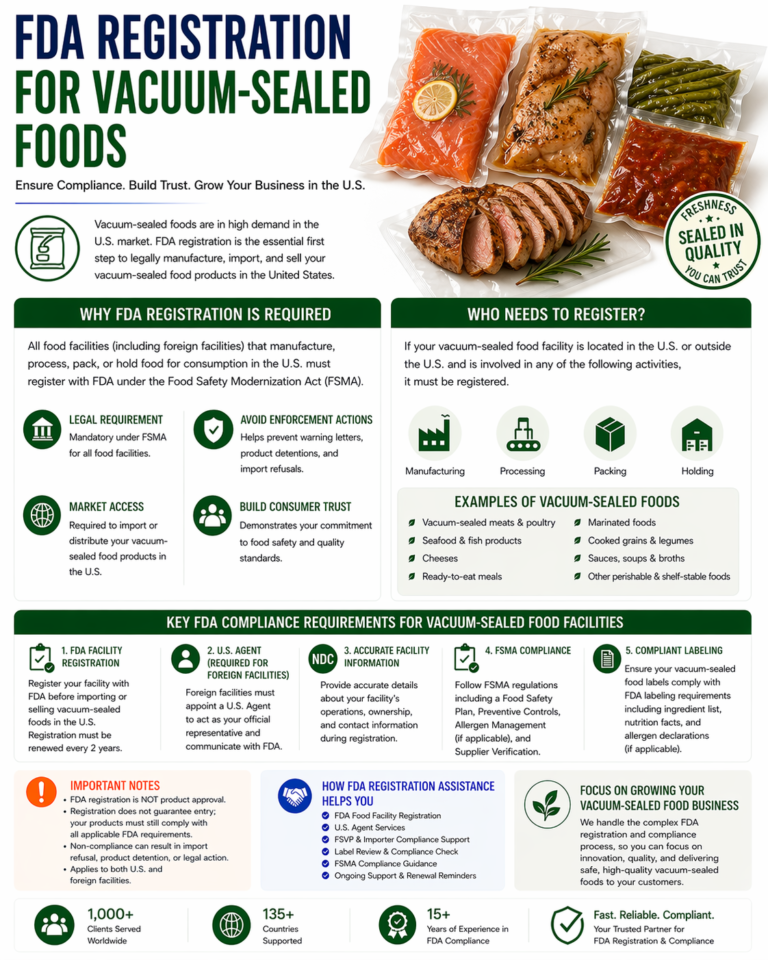
FDA Registration for Vacuum-Sealed Foods
Why reduced-oxygen packaging is a botulism hazard, the barrier controls that manage it, and the path by product type.
Key Takeaways
- Vacuum sealing is a process, not preservation — it doesn't make food safe.
- Removing oxygen favors C. botulinum — the anaerobic, deadliest hazard.
- It also hides spoilage — the food can look and smell fine and be dangerous.
- Control with barriers — refrigeration ≤41°F plus a second hurdle, or freezing.
- Refrigeration alone needs a TTI — type E C. botulinum grows in the cold.
- The path depends on the food — shelf-stable low-acid = LACF (FCE/SID).
Why Vacuum Sealing Is Regulated
Vacuum (reduced-oxygen) packaging looks like pure upside — longer shelf life, fresher product. But removing oxygen does two dangerous things at once:
- It favors Clostridium botulinum — an anaerobic bacterium that thrives without oxygen and produces a lethal toxin
- It suppresses aerobic spoilage — the mold, slime, and off-smells that would normally warn you a food has gone bad are exactly what oxygen removal prevents
How C. botulinum Is Controlled — the Barriers
Because reduced-oxygen packaging favors C. botulinum, the food needs a HACCP plan and, for refrigerated products, usually at least two barriers. Here are the recognized control approaches:
| Control approach | What it requires |
|---|---|
| Refrigeration + a second barrier | ≤ 41°F (5°C) plus one of: aw ≤ 0.91, pH ≤ 4.6, cured meat/poultry, or high competing organisms |
| Refrigeration as the sole control | A Time-Temperature Indicator (TTI) on each package + strict cold chain + limited shelf life |
| Frozen | Keep frozen — prevents C. botulinum growth (required for most reduced-oxygen seafood) |
| Shelf-stable | Commercially sterilized (low-acid canned → FCE/SID) or acidified |
The Route Depends on What the Food Is
"Vacuum-sealed" isn't one regulatory category — the controls depend on the product and how it's kept:
| Your vacuum-sealed food | The path |
|---|---|
| Refrigerated (prepared meals, cheese, deli) | HACCP + two barriers (or a TTI); storage/dating labeling |
| Frozen | Freezing as the control; "keep frozen" labeling |
| Shelf-stable, low-acid | Low-acid canned food → FCE + SID |
| Shelf-stable, acidified | Acidified-foods track |
| Seafood / fish | Seafood HACCP — frozen or a variance |
| Meat / poultry | Generally USDA-FSIS, not FDA |
Labeling, Registration & Imports
- Storage & dating labeling — reduced-oxygen foods relying on refrigeration must be prominently labeled "keep refrigerated" (or "keep frozen") with a use-by/discard date; at retail the refrigerated shelf life is capped (14 days from packaging) unless frozen
- Standard label — identity, ingredients, Nutrition Facts, allergens, net quantity, responsible firm
- Facility registration — the maker/packer/holder registers; foreign facilities add a U.S. Agent
- FSVP for imports — verify the reduced-oxygen controls specifically (C. botulinum barriers, cold chain, shelf life, frozen status for seafood)
Get Your Vacuum-Sealed Foods U.S.-Ready
FDA Registration Assistance starts by identifying what your vacuum-sealed food actually is — refrigerated, frozen, shelf-stable, seafood, or USDA-regulated — then maps the right controls: the C. botulinum barriers and HACCP for reduced-oxygen packaging, FCE/SID for shelf-stable low-acid products, seafood HACCP for fish, and the required storage/dating labeling — plus registration, U.S. Agent, and FSVP for imports.
Contact us at info@fdaregistrationassistance.com or call +1 (928) 275-8333. Food Facility Registration is available starting at $858. Trusted by companies across 135+ countries, with 15+ years of experience.
Frequently Asked Questions
1. Do vacuum-sealed foods need FDA registration?
Yes. Any facility that manufactures, processes, packs, or holds vacuum-sealed food for the U.S. market must be registered with FDA, with a U.S. Agent if foreign and prior notice for each shipment. But registration is only the baseline. Vacuum sealing changes the food's hazard profile, and the real compliance work is controlling the risks that reduced-oxygen packaging creates — above all Clostridium botulinum.
2. Why is vacuum sealing regulated at all?
Because removing oxygen is a double-edged sword. Vacuum (reduced-oxygen) packaging creates an anaerobic environment that favors Clostridium botulinum — the bacterium behind botulism, one of the deadliest foodborne illnesses — and it also suppresses the normal aerobic spoilage that would otherwise make spoiled food look and smell "off." So a vacuum-sealed food can appear perfectly fine and still be dangerous. Vacuum sealing is a process, not a preservation method that makes food safe on its own.
3. Does vacuum sealing make food safe or shelf-stable?
No — this is the most important misconception. Vacuum sealing extends shelf life by slowing aerobic spoilage, but it does not sterilize the food or, by itself, make it shelf-stable or safe. In fact it can increase risk by removing oxygen (favoring C. botulinum) while hiding spoilage cues. The food inside still needs its own controls — refrigeration plus a barrier, freezing, or true shelf-stable processing — depending on what it is.
4. How is Clostridium botulinum controlled in vacuum-sealed foods?
Through barriers — and usually more than one. For a refrigerated reduced-oxygen-packaged food, the recognized approach requires a HACCP plan and at least two barriers: the food kept at 41°F (5°C) or below PLUS at least one of a water activity of 0.91 or less, a pH of 4.6 or less, an appropriate cured meat/poultry, or a high level of competing organisms. Alternatively the product can be frozen, or made genuinely shelf-stable by commercial sterilization (low-acid canned) or acidification.
5. What if refrigeration is my only control?
Refrigeration alone is risky, because non-proteolytic C. botulinum (type E) can grow at refrigeration temperatures. If refrigeration below 38°F is the sole control for C. botulinum, FDA's approach calls for a Time-Temperature Indicator (TTI) on each package plus a strict cold chain and a limited shelf life. Relying on refrigeration by itself, without a TTI or a second barrier, is one of the most common and serious mistakes with vacuum-sealed foods.
6. Do vacuum-sealed foods have a shelf-life limit?
Refrigerated reduced-oxygen-packaged foods generally have a limited shelf life — at retail, the Food Code caps it at 14 days from packaging (unless the product is frozen or meets other criteria) — and the package must carry clear instructions to keep it refrigerated (or frozen) and a use-by/discard date. Shelf life ties directly to the C. botulinum control, so it isn't a marketing choice; it's a safety parameter that has to be validated.
7. What controls apply if my vacuum-sealed food is shelf-stable?
If you intend a vacuum-sealed food to be shelf-stable at room temperature, it can't just rely on the seal — it has to be made commercially sterile or otherwise safe without refrigeration. A shelf-stable low-acid food in a hermetically sealed package is a low-acid canned food, needing FCE registration and a scheduled process (SID); an acidified product follows the acidified-foods rules. Vacuum sealing plus room-temperature storage without that processing is a serious hazard.
8. How does vacuum-sealed seafood differ?
Seafood is the highest-risk case. Because fish carries C. botulinum type E and the reduced-oxygen environment favors it, reduced-oxygen-packaged seafood generally must be kept frozen — or produced under a Seafood HACCP plan with at least two validated barriers. Cold-smoked and other vacuum-packed fish are especially scrutinized. If you vacuum-seal fish, treat it as a seafood HACCP matter from the start.
9. What about vacuum-sealed sous vide or cook-chill foods?
Sous vide and cook-chill are reduced-oxygen processes: food is cooked (or will be) in a sealed, low-oxygen package. They carry the same C. botulinum and Listeria concerns and need the same controls — validated cooking, rapid cooling, refrigeration with a barrier (or freezing), limited shelf life, and a HACCP plan. Sous vide's convenience doesn't remove the reduced-oxygen hazard; if anything, it concentrates the need for tight controls.
10. Is Listeria a concern in vacuum-sealed foods too?
Yes. Listeria monocytogenes grows in cold, low-oxygen conditions — exactly what refrigerated reduced-oxygen packaging provides — and it's especially a concern for ready-to-eat vacuum-sealed foods (deli items, smoked fish, prepared meals). So the controls for reduced-oxygen packaging target both C. botulinum and Listeria: sanitation and environmental monitoring for Listeria, and the barriers/temperature/shelf-life for C. botulinum.
11. Do vacuum-sealed meat and poultry have different rules?
Often, yes. Most meat and poultry products fall under USDA-FSIS rather than FDA, so a vacuum-sealed beef, pork, or poultry product is generally a USDA matter (with its own reduced-oxygen and safe-handling requirements). FDA covers the many other vacuum-sealed foods — seafood, produce, prepared vegetarian meals, cheese, and so on. Identifying whether your product is FDA- or USDA-regulated is an early, important step.
12. What labeling do vacuum-sealed foods need?
Beyond the standard label (identity, ingredients, Nutrition Facts, allergens, net quantity, responsible firm), reduced-oxygen-packaged foods that rely on refrigeration must be prominently labeled to keep the product refrigerated (or frozen) and to observe a use-by/discard date. These storage and dating statements aren't optional — they're part of the safety control, and missing them is a common compliance failure.
13. Do imported vacuum-sealed foods need FSVP?
Yes. The U.S. importer holds FSVP and must verify the foreign supplier controls the hazards, with prior notice before each shipment. For vacuum-sealed foods, verification should focus specifically on the reduced-oxygen controls — the C. botulinum barriers, cold chain, shelf life, and (for seafood) frozen status or HACCP — because that's where the real risk sits, not in the packaging itself.
14. How does FDA Registration Assistance help with vacuum-sealed foods?
We start by identifying what your vacuum-sealed food actually is — refrigerated, frozen, shelf-stable, seafood, or USDA-regulated — then map the right controls: the C. botulinum barriers and HACCP for reduced-oxygen packaging, FCE/SID for shelf-stable low-acid products, seafood HACCP for fish, and the required storage/dating labeling, plus facility registration, U.S. Agent, and FSVP for imports. Starting at $858 for registration, for companies across 135+ countries. Contact info@fdaregistrationassistance.com or +1 (928) 275-8333.