
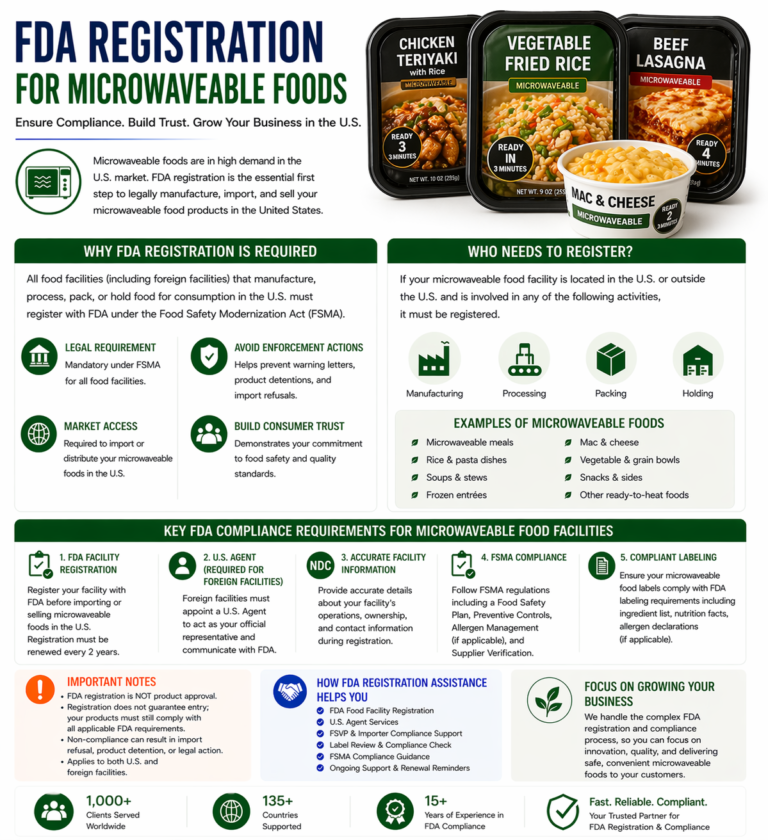
FDA Registration for Microwaveable Foods
The high-heat packaging (susceptors), microwave cooking as a safety control, and the path by what the food actually is.
Key Takeaways
- "Microwaveable" isn't an FDA category — the food inside drives requirements.
- The packaging is a food-contact substance — cleared for the heat it reaches.
- Susceptors reach 400°F+ — high-heat clearance and migration testing required.
- Cooking instructions can be a safety control — microwaves heat unevenly.
- Not-ready-to-eat means the microwave is the kill step — validated instructions.
- Shelf-stable bowls are LACF — FCE + a scheduled process.
The Packaging Is a High-Heat Food-Contact Substance
Any packaging that contacts food is a food-contact substance and must be suitable for its intended use (21 CFR 174.5). Microwave use is a demanding condition because the packaging gets hot — and FDA's food-contact "conditions of use" include a high-temperature category, Condition of Use J (cooking above 250°F), specifically for microwave heat susceptors.
Cooking Instructions Can Be a Safety Control
This one surprises people. Microwaves heat unevenly — creating hot spots and, crucially, cold spots. That matters enormously when the microwave step is the product's kill step:
- Ready-to-eat (RTE) — already safe; the microwave just reheats for quality
- Not-ready-to-eat (NRTE) — the consumer must cook it to make it safe, so the microwave is the kill step
- For NRTE products, the instructions are validated safety controls — wattage, time, stand/rest time, and stirring/rotating, proven to reach safe temperatures throughout the food (cold spots can leave pathogens alive)
- The label must be clear — a "not ready to eat / cook thoroughly" statement, not RTE-style copy
The Path Depends on What the Food Is
Because "microwaveable" is just the format, classify the food first — that determines the core requirements:
| Your microwaveable food | The path |
|---|---|
| Shelf-stable bowl/meal (low-acid, retort) | Low-acid canned food → FCE + SID |
| Frozen meal | Kept frozen + validated cooking instructions |
| Refrigerated ready-to-heat | Reheat instructions (RTE); cold chain |
| Contains a susceptor (popcorn, crisping) | Packaging cleared for high-heat food-contact use |
| Seafood-based meal | Seafood HACCP |
| Meat / poultry meal | Generally USDA-FSIS, not FDA |
Labeling, Registration & Imports
- Standard label — identity, ingredients, Nutrition Facts, allergens, net quantity, responsible firm
- Cooking & storage instructions — accurate heating instructions, "keep frozen"/"keep refrigerated," and a ready-to-eat vs cook-before-eating statement
- Facility registration — the maker/packer/holder registers; foreign facilities add a U.S. Agent
- FSVP for imports — verify the food's controls (LACF/HACCP), the packaging's high-heat suitability, and the validity of NRTE cooking instructions
Get Your Microwaveable Foods U.S.-Ready
FDA Registration Assistance classifies the food inside — shelf-stable low-acid, frozen, refrigerated, seafood, or USDA — maps the resulting requirements (LACF process filing, seafood HACCP), and reviews the two microwave-specific pieces: the high-heat suitability of the food-contact packaging (including susceptors) and the cooking-instruction/ready-to-eat labeling — plus registration, U.S. Agent, and FSVP for imports.
Contact us at info@fdaregistrationassistance.com or call +1 (928) 275-8333. Food Facility Registration is available starting at $858. Trusted by companies across 135+ countries, with 15+ years of experience.
Frequently Asked Questions
1. Do microwaveable foods need FDA registration?
Yes. Any facility that manufactures, processes, packs, or holds microwaveable food for the U.S. market must be registered with FDA, with a U.S. Agent if foreign and prior notice for each shipment. But "microwaveable" isn't an FDA category — it describes how the food is heated, not what it is. Registration is the baseline; the requirements are driven by the food inside and by two microwave-specific issues: the packaging and the cooking instructions.
2. Is "microwaveable" a regulatory category?
No. It's a format, like vacuum-sealed. FDA regulates each microwaveable product by what it actually is — a shelf-stable low-acid bowl is a low-acid canned food, a frozen entrée is a frozen food, a seafood meal is a seafood-HACCP product, and a meat/poultry meal is usually USDA. So the first step is classifying the food itself; "microwaveable" then adds the packaging and cooking-instruction requirements on top.
3. Does microwaveable packaging have special requirements?
Yes — this is the biggest microwave-specific point. Packaging that contacts food is a food-contact substance and must be suitable for its intended use, and microwave use is a demanding condition because the packaging gets hot. FDA's food-contact "conditions of use" include a high-temperature category (Condition of Use J) for cooking above 250°F, which applies to microwave heat susceptors. So microwaveable packaging has to be cleared/suitable for the temperatures it actually reaches.
4. What is a susceptor and why does it matter?
A susceptor is the metallized film in packaging that crisps and browns food in the microwave — the silver patch in microwave popcorn bags, pizza discs, and similar products. Susceptors absorb microwaves and can reach 400°F or more, far hotter than the food. Because of that heat, they need to be cleared as a food-contact substance for high-temperature use, with migration testing to confirm nothing harmful transfers to the food. Susceptor packaging is a specialized food-contact material, not a generic film.
5. Are microwave cooking instructions a safety requirement?
They can be — and this surprises people. Microwaves heat unevenly, creating hot and cold spots. If the microwave step is the product's kill step (as in a not-ready-to-eat frozen entrée the consumer must cook), the cooking instructions — wattage, time, stand/rest time, and stirring or rotating — are a validated food-safety control, not just a suggestion. Cold spots can leave pathogens alive, so the instructions must be validated to achieve safe temperatures throughout the food, and the label must make clear whether the product is ready-to-eat or needs cooking.
6. What's the difference between "ready-to-eat" and "not-ready-to-eat" microwaveable foods?
A ready-to-eat (RTE) microwaveable food is already safe and just being reheated for quality; a not-ready-to-eat (NRTE) product must be cooked by the consumer to be safe, so the microwave step is the kill step. NRTE frozen entrées have caused foodborne illness outbreaks when consumers undercooked them, so their labels must clearly say the product is not ready to eat and give validated cooking instructions. Blurring RTE and NRTE on the label is a serious, and common, mistake.
7. Do shelf-stable microwaveable bowls need FCE/SID filing?
Often yes. A shelf-stable microwaveable bowl or meal (like microwaveable rice, beans, or a retort pouch entrée) that's low-acid and sold at room temperature is a low-acid canned food — it must be commercially sterilized, so the facility needs FCE registration and a scheduled process (SID). The microwave is just the reheating method; the shelf-stability comes from retort/thermal processing, which is what triggers the process-filing requirement.
8. What about frozen microwave meals?
Frozen microwave meals rely on freezing for safety and stability, so they don't need FCE/SID — but they do need clear "keep frozen" storage and validated cooking instructions, especially if the product is not-ready-to-eat. The combination of frozen storage, uneven microwave heating, and a required cook step makes the cooking instructions particularly important for frozen entrées.
9. Do microwaveable seafood or meat meals have extra rules?
Yes. A microwaveable seafood meal is a seafood-HACCP product (with the hazards that come with the species and process), and a microwaveable meal containing meat or poultry generally falls under USDA-FSIS rather than FDA. So identifying whether your product is FDA- or USDA-regulated, and whether seafood HACCP applies, is an early step — the microwaveable format doesn't change which agency or hazard framework governs the food.
10. Is microwave popcorn regulated differently?
Microwave popcorn is a good example of the packaging point: the bag contains a susceptor to heat the kernels, so the packaging is a high-temperature food-contact material that must be suitable for that use. The popcorn itself is a conventional food (ingredients, allergens, Nutrition Facts). Historically, certain flavoring ingredients in microwave popcorn drew attention, so ingredient and flavoring compliance matters too — but the susceptor packaging is the distinctive microwaveable element.
11. What labeling do microwaveable foods need?
The standard label (identity, ingredients, Nutrition Facts, allergens, net quantity, responsible firm) plus clear, accurate cooking/heating instructions and, where relevant, storage instructions ("keep frozen"/"keep refrigerated") and a ready-to-eat vs cook-before-eating statement. For not-ready-to-eat products, the cooking instructions and the "not ready to eat" message are part of the safety story, not just convenience copy.
12. Do imported microwaveable foods need FSVP?
Yes. The U.S. importer holds FSVP and must verify the foreign supplier controls the hazards, with prior notice before each shipment. For microwaveable foods, verification should cover the food itself (including LACF process filing for shelf-stable bowls, or seafood HACCP), the high-heat suitability of the packaging, and the validity of the cooking instructions for any not-ready-to-eat product.
13. Does registration mean FDA approved my microwaveable food?
No. FDA doesn't pre-approve food or facilities — registration just puts the facility on record. It doesn't certify your packaging, your process filing, or your cooking instructions; those remain your responsibility. A microwaveable food can be registered and still be adulterated (an under-processed shelf-stable bowl, unsafe packaging migration) or misbranded (a not-ready-to-eat product labeled as ready-to-eat). FDA enforces at import and in the marketplace.
14. How does FDA Registration Assistance help with microwaveable foods?
We classify the food inside (shelf-stable low-acid, frozen, refrigerated, seafood, or USDA), map the resulting requirements — LACF process filing (FCE/SID) for shelf-stable bowls, seafood HACCP where relevant — and review the two microwave-specific pieces: the high-heat suitability of the food-contact packaging (including susceptors) and the cooking-instruction/ready-to-eat labeling, plus facility registration, U.S. Agent, and FSVP for imports. Starting at $858 for registration, for companies across 135+ countries. Contact info@fdaregistrationassistance.com or +1 (928) 275-8333.
