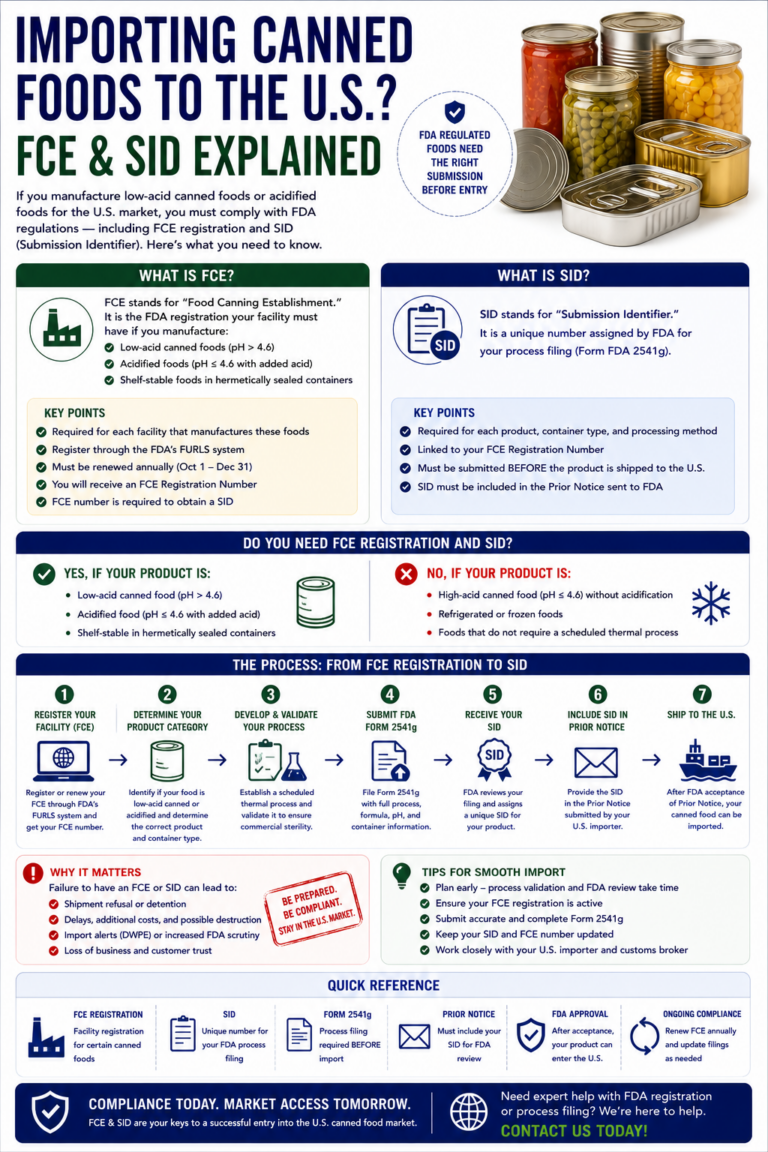
Importing Canned Foods to the U.S.? FCE & SID Explained
What each filing is, how they differ, who files them — and what you verify as the importer.
Key Takeaways
- FCE = the facility — one registration per plant, filed first.
- SID = the process — one per product, container, and process.
- Importers can't file either — only the manufacturer or their agent can.
- Your job is to verify — valid FCE and a SID for each product and size.
- You do hold FSVP — that one's the importer's own responsibility.
- A process authority validates the SID — the manufacturer engages them.
FCE vs. SID
They're often said in the same breath, but they operate at different levels — one about the facility, one about each product:
FCE
- Level: facility — one FCE per plant
- Purpose: registers the establishment as a canning facility
- Timing: must be in place first
- Changes: stays with the facility, not the product
SID
- Level: product — one per product, container, and process
- Purpose: defines the validated safe process
- Timing: filed against an existing FCE
- Changes: new formula, container, or size may need a new SID
Who Files, Who Verifies
This is where the importing picture differs from the manufacturing one. FCE and SID belong to the manufacturer — you verify them and carry your own separate duties:
| Party | Responsible for |
|---|---|
| Manufacturer (or their FDA agent) | Files the FCE and the SID for each product; engages the process authority to validate the process |
| You, the U.S. importer | Verifies the supplier's FCE and SID are valid for what you import; holds your own FSVP obligations |
| Customs broker | Files prior notice and the customs entry, using details that match the filings |
What to Verify Before You Import
For a low-acid or acidified canned food, confirm each of these with your supplier before the shipment moves:
- Valid, current FCE for the manufacturing facility
- A SID for each exact product you're importing
- A SID for each container type and size — a new size needs its own
- Process-authority documentation supporting the scheduled process
- A label that matches the SID filing and formulation
- Your own FSVP assigned and documented as the importer
The Gaps That Hold Imports
FCE, SID & Importer Compliance — Handled
FDA Registration Assistance works both sides of a canned-food import. As a manufacturer's agent we handle FCE registration, scheduled process (SID) filing, and process-authority coordination; for U.S. importers we handle FSVP and verify a supplier's FCE and SID are valid for the exact products and containers you're bringing in — plus label review.
Contact us at info@fdaregistrationassistance.com or call +1 (928) 275-8333. Food Facility Registration is available starting at $858. Trusted by companies across 135+ countries, with 15+ years of experience.
Frequently Asked Questions
1. What are FCE and SID for importing canned foods?
They're two separate FDA filings for low-acid canned foods and acidified foods. FCE (Food Canning Establishment) registers the manufacturing facility — one per plant. SID (the scheduled process filing) validates how each specific product is safely processed — one per product, container, and process. FCE comes first; the SID is filed against it. In short: FCE is the facility, SID is the process.
2. Do I need both FCE and SID to import canned foods?
If the product is a low-acid or acidified canned food, yes — both are required, and the SID has to cover the exact product and container being imported. FCE alone isn't enough, and a SID can't exist without an FCE. Naturally acidic foods and several excluded categories don't need either, so classification determines whether they apply.
3. Can I file FCE and SID as the importer?
Generally no. Only the manufacturer or their official FDA agent can register an FCE and file scheduled processes — importers, distributors, and brokers can't file them on a facility's behalf. As the importer, your role isn't to file FCE and SID but to verify that your supplier has valid ones for the products and containers you're bringing in.
4. What's the difference between FCE and SID?
FCE is facility-level: one registration identifying the establishment, and it has to be in place first. SID is product-level: a separate scheduled process filed for each product, formulation, container type, and size, defining the validated process. One facility has one FCE but many SIDs — typically one for every product-and-container combination it makes.
5. Does each product need its own SID?
Yes — and often each container size too. A scheduled process is specific to the product and how it's packaged, so a 15 oz can and a 28 oz can of the same product usually need separate SIDs, and a retort pouch needs its own separate from any can. Adding a new size without filing a new SID is one of the most common import gaps.
6. What does the importer actually have to do?
Verify, not file. Confirm your supplier's FCE is valid and current, confirm a SID exists for each exact product and container you import, and confirm the label matches the filing. Separately, you hold your own FSVP obligations as the U.S. importer, and your customs broker files prior notice. FCE and SID themselves stay with the manufacturer.
7. Is a process authority required?
Yes. A process authority validates the scheduled process — determining the safe processing parameters and providing the documentation the SID depends on. Without process-authority validation, a SID isn't properly supported and can be questioned during an FDA review. The manufacturer engages the process authority as part of establishing the SID.
8. What happens if the FCE or SID is missing or wrong?
Your shipment can be placed on hold while FDA requests documentation, delayed while it's resolved, or refused. A missing or mismatched filing can't be fixed once the goods are at the port. For repeated or fundamental failures, a facility can face detention without physical examination on future shipments, so verifying before import matters.
9. How do I know if my product even needs FCE and SID?
It comes down to pH, processing, packaging, and shelf stability. Low-acid canned foods (pH above 4.6) and acidified foods (added acid to pH 4.6 or below), packaged shelf-stable, generally need them; naturally acidic and excluded categories generally don't. Because the boundary is technical, a process authority should confirm the classification.
10. Does labeling have to match the SID?
Yes. The label's ingredients, identity, and product description have to be consistent with what's in the SID filing and with the actual formulation. A label that doesn't match the filed process is a common cause of holds, even when the FCE and SID themselves are valid — so label consistency is part of verifying an import is ready.
11. Can FCE and SID be filed after the shipment leaves?
No. Both must be complete before export, and a missing filing can't be back-dated to rescue a shipment already in transit or at the port. Because process-authority validation takes time, this is a reason to verify your supplier's filings well before you plan an import, not at the last minute.
12. Does having FCE and SID mean FDA approved the product?
No. FCE registration and the scheduled process filing are compliance steps, not an FDA approval or endorsement. FDA doesn't pre-approve foods or labels; the filings put the facility and its validated process on record. The product still has to meet all applicable requirements at import, including labeling and your FSVP obligations.
13. Who files prior notice — me or the manufacturer?
Neither, usually — prior notice is typically filed by your customs broker before the shipment arrives, using details that must match the FCE, SID, and registration. It's separate from FCE and SID, but it references them, so accurate filings upstream help prior notice line up cleanly. Confirm your broker has the correct facility details.
14. How does FDA Registration Assistance help?
We work both sides: as a manufacturer's agent we handle FCE registration, scheduled process (SID) filing, and process-authority coordination; for U.S. importers we handle FSVP and verify that a supplier's FCE and SID are valid for the exact products and containers being imported, plus label review. Starting at $858 for registration, for companies across 135+ countries. Contact info@fdaregistrationassistance.com or +1 (928) 275-8333.