
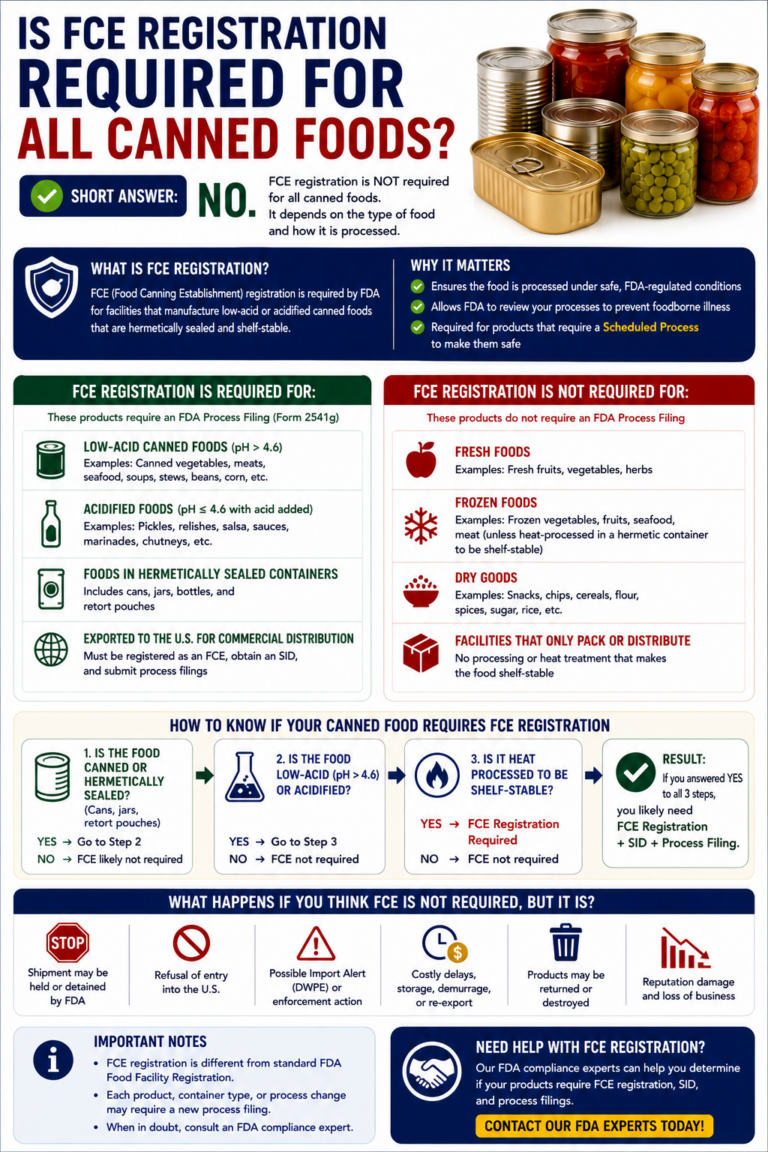
Is FCE Registration Required for All Canned Foods?
A direct answer, the exact categories that do and don't need FCE, and how to confirm yours.
Key Takeaways
- Not all canned foods need FCE — only certain categories do.
- FCE required: low-acid canned (LACF) and acidified foods.
- FCE usually not: naturally acidic, refrigerated/frozen, dry foods.
- Food Facility Registration is always required — FCE is an added layer.
- "Canned" doesn't decide it — classification (pH & process) does.
- If FCE applies, so does SID — a scheduled process per product.
Which Canned Foods Need FCE — and Which Don't
- Low-acid canned foods (LACF) — pH > 4.6, aw > 0.85: canned vegetables, meats, seafood, soups, ready meals Part 113
- Acidified foods — low-acid base + added acid → pH ≤ 4.6: pickles, many hot sauces, relishes, salsas Part 114
- Shelf-stable, hermetically sealed foods relying on heat or acidification for safety
- Naturally acidic foods — natural pH ≤ 4.6, no acid added (many fruit products)
- Refrigerated or frozen products — not shelf-stable
- Dry / low-risk foods — powders, grains, spices not relying on a controlled process
FCE Is Not the Same as FDA Registration
This mix-up causes a lot of the mistakes. They're two separate things:
FDA Food Facility Registration
The base requirement for essentially all food facilities. Lists your facility with FDA. Foreign facilities also appoint a U.S. Agent.
FCE (Food Canning Establishment)
An additional registration only for LACF and acidified food facilities — and it comes before any scheduled process (SID) filing.
Where to Go Next
If your product lands in the FCE-required column, here's the detail for each part:
FCE + scheduled process
What the filing is, what it contains, and the forms.
Process filing explained →Low-acid canned foods
The pH/water-activity science behind LACF and its rules.
LACF guide →Acidified foods
Hot sauces, salsas, pickles, and the acidified-food path.
Acidified foods →Readiness checklist
Confirm your FCE/SID filings are actually in order.
FCE/SID checklist →Why Getting This Right Matters
Misjudging the FCE requirement is one of the most common — and most preventable — canned-food export mistakes. If you assume FCE isn't required when it is, your shipment can be held while FDA requests documentation, delays can run from days to weeks, and in some cases the shipment is refused, with added storage costs and lost time. Confirming your classification before you ship avoids all of it.
Not Sure If You Need FCE? We'll Confirm It
FDA Registration Assistance evaluates your product's classification to determine whether FCE applies — then handles whatever's needed: Food Facility Registration and U.S. Agent, FCE and scheduled process filings with process-authority coordination, and label review — so you meet the right requirements before shipping.
Contact us at info@fdaregistrationassistance.com or call +1 (928) 275-8333. Food Facility Registration is available starting at $858. Trusted by companies across 135+ countries, with 15+ years of experience.
Frequently Asked Questions
1. Is FCE registration required for all canned foods?
No. FCE registration is required only for specific categories — low-acid canned foods (LACF) and acidified foods. Naturally acidic foods, refrigerated or frozen products, and dry or non-low-acid foods generally don't need it. But Food Facility Registration is always required, whether or not FCE applies.
2. Which canned foods do require FCE?
Low-acid canned foods — finished pH above 4.6 with water activity above 0.85, such as canned vegetables, meats, seafood, soups, and ready meals — and acidified foods, which are low-acid foods brought to a finished pH of 4.6 or below with added acid, such as pickles, many hot sauces, relishes, and salsas. Both rely on controlled processing, so both need FCE and a scheduled process.
3. Which canned foods don't require FCE?
Naturally acidic foods (a natural pH of 4.6 or below with no acid added), refrigerated or frozen products that aren't shelf-stable, and dry or low-risk foods whose safety doesn't depend on a controlled thermal or acidification process. These still need Food Facility Registration, just not FCE and a scheduled process.
4. What's the difference between FCE and FDA Food Facility Registration?
They're separate. FDA Food Facility Registration applies to essentially all food facilities and is the base requirement. FCE — Food Canning Establishment registration — applies only to facilities making low-acid canned or acidified foods, and it must be in place before any scheduled process filing. Having Food Facility Registration alone doesn't mean you're fully compliant.
5. Do acidified foods always require FCE?
Generally yes — a true acidified food (a low-acid base acidified with added acid to a finished pH of 4.6 or below) needs FCE and a scheduled process. The main nuance is that some acid-predominant products, like certain dressings and condiment sauces, are classed as acid foods rather than acidified foods and can fall outside the requirement. Classification confirms it.
6. Do frozen or refrigerated foods require FCE?
No. Frozen and refrigerated products aren't shelf-stable and are outside the low-acid canned and acidified food rules, so they don't need FCE. They still need Food Facility Registration and compliant labeling, and refrigerated products are specifically excluded from the acidified-food rules.
7. Does "canned" automatically mean I need FCE?
No — the container doesn't decide it, the classification does. A naturally acidic product in a can may not need FCE, while a low-acid product made shelf-stable without a traditional can still might. What matters is whether it's a low-acid or acidified food, not whether it's literally canned.
8. Do I need SID filing if FCE is required?
Yes. If FCE applies, each product also needs a scheduled process (SID) filing that describes how it's safely processed, and that filing has to be validated by a process authority. FCE registers the establishment; the scheduled process covers each individual product and container.
9. How do I determine if my product requires FCE?
It comes down to finished pH, whether acid was added to a low-acid base, the processing method, packaging, and shelf stability. Because misclassifying a product is easy and costly, a classification review by a process authority or regulatory expert is the safest way to confirm before you ship.
10. What happens if I assume FCE isn't required but it is?
Your shipment can be held while FDA requests documentation, delays can run from days to weeks, and in some cases the shipment is refused — with added storage costs and lost time. Misjudging the FCE requirement is one of the most common and preventable mistakes in canned-food exports.
11. Why do so many exporters get this wrong?
Because they assume all canned foods need FCE, or that none do, or they misclassify acidified versus low-acid, or they rely on a broker for a step a broker doesn't handle. The safe path is confirming the classification before shipping rather than assuming either way.
12. Is Food Facility Registration still required if FCE isn't?
Yes. Even when FCE and a scheduled process don't apply, FDA Food Facility Registration is mandatory for the facility, along with compliant labeling, an FSVP importer, and prior notice. FCE is an additional layer on top of the base requirements, not a replacement for them.
13. Who can confirm whether FCE is required?
A process authority or a regulatory compliance specialist can review your product's classification and confirm whether FCE and a scheduled process apply. This is worth doing before production and shipping, because the answer shapes your entire compliance timeline.
14. How does FDA Registration Assistance help?
We evaluate your product's classification to determine whether FCE applies, then handle whatever's needed: Food Facility Registration and U.S. Agent, FCE and scheduled process filings, process-authority coordination, and label review — so you meet the right requirements before shipping. Starting at $858 for registration, for companies across 135+ countries. Contact info@fdaregistrationassistance.com or +1 (928) 275-8333.